THE MATHEMATICS OF DECISION MAKING

May 1st, 2019

Photo: Michael Gos

By Michael W. Gos

Route 66, Texas

On a beautiful afternoon, we were driving along Route 66 through the Texas panhandle. As a kid, I grew up hearing about this magical road and watched the TV show every week with my mother. I wanted to be Buz Murdock. Growing up in a family that didn’t have a car and had to travel everywhere by city bus, Route 66 seemed like a fairyland to me. Some kids wanted to go to Disneyland. I wanted to cruise Route 66 in a big convertible. By the time I got out of high school, I had read Steinbeck’s Grapes of Wrath and Kerouac’s On the Road, so I had seen Route 66 from a variety of points of view and I was still fascinated.

Built in 1926, one of the original roads in the U.S. highway system, Route 66 was also called the “Will Rogers Highway,” or more commonly, the “Main Street of America.” While it was popular for decades, it eventually fell out of favor with a general public that was set on going through life as fast as possible—with no pauses in between. As a result, it was replaced by interstates and soon the Mother Road lost her appeal. In some places, it doesn’t even exist anymore. But when I finally got a chance to see a remnant of it, I jumped at the opportunity. They tell me Amarillo is the place where the old road is most like it was in the early ‘60s. So, on a Palo Duro Canyon adventure, we took a day and made a side trip to see this cultural icon.

It was indeed like going back 60 years. The shops and restaurants were proud of the fact that they remained basically unchanged since 1960. In some shops you are greeted at the door by a dog or two and in others you can sit on a round, rotating stool at a counter and have a phosphate or a root beer made right there on-site. All are proud of their place on this famous highway and promote it heavily.

Any time I am in an “old-timey” environment like the shops along the route, I find myself thinking about the changes I have seen over the decades. As a kid, I remember the milkman in my aunt’s town delivering from a horse-drawn wagon. I remember the Kennedy assassinations and fellow Purdue man Neil Armstrong landing on the moon. And I think I remember yesterday. I can’t help but be in awe of all the changes I have seen. But one thought I can’t escape is “What are the costs of all these changes?”

While all humans are capable of making decisions, clearly some of us are better at it than others. I think most of us have a pretty superficial method of calculating the cost of decisions we are making. Whether we realize it or not, it is impossible for the human mind to make a decision without a set of criteria we can use to measure the various options. The problem is, sometimes we don’t think about, much less articulate, what those criteria are. But even if we can’t articulate our criteria, they have to be there subconsciously, or we would never be able to make a decision. At the very least it comes down to a decision of “Does the coin land heads or tails?”

Let’s say I am looking for a new car. I don’t even have to think about it to know it needs to have off-road capabilities and a high ground clearance. That is in-bred in me. I use it to make the decision, even if I don’t think about it or even know it is there. But of course, a good criteria set needs to be more substantial than that.

Among other things, I also would like the car to be either black or silver. Is this criterium equal in importance to the off-road capabilities? No, and it is important to establish that up front. Color might be negotiable if I can’t really find the car I want, but off road and ground clearance are not. These non-negotiable ones are what we call “all-or-nothing” criteria. If an option doesn’t meet an all-or-nothing criterium, it is immediately removed from consideration. For instance, I absolutely have to have a convertible. If not, on the first nice day, I know I will have to take a chain saw to the roof. That is an all-or-nothing criterium.

So, some criteria carry more weight than others. Some are necessary, some are nice to have, and some are “Gee, in a perfect world it would have X.” People who are good at the math of decision making usually can articulate, and then weigh, their criteria.

My best friend’s son recently had a job offer from a company in Seattle for a substantial raise in pay. He is good with decision math and understood he needed to go beyond just the salary offer. He took time to compare the cost of living between Seattle and McKinney, Texas, where he now works. Suddenly the raise which looked enormous on first view, became much less impressive.

Many of us would stop there. But being good at the math of decisions, he took a look at some of the intangibles. This is where many of us go wrong. How do we quantify something that we may not even be able to clearly define? What value do you put on the fact that McKinney is thriving while Seattle is a dying city? Or, as was the case in his decision, what value do you put on being able to see the sun? For him, that turned out to be the final straw. It was comparing Texas to Hell. He turned down the job.

Measurement of the intangibles is the point where most of us find that our decision skills are not what they should be. Because we don’t know how to quantify these things, we find we can only react to them emotionally or, if they are really hard to quantify, we ignore them altogether. That is when we get into trouble.

That brings me back to the Mother Road and those U.S. Highway Department people back in the ‘60s. How good were they at decision math? It is obvious that they had in mind a criterium about moving traffic quickly and efficiently from one place to another and for the most part, with the interstate system, they succeeded in their goal. But did they ever consider articulating criteria for the intangibles? Did they think about the towns that would be wiped out? Far more important, did they think about the generations of travelers who would never be able to experience a mythic cross-country road trip along something like old Route 66?

I fear that until we get better at quantifying intangibles, we will continue making bad decisions and generations of Americans will lose out on valuable, and enjoyable experiences—all because we were bad at the mathematics of decision making. It is important that we be able to enjoy those experiences—even if we don’t remember them the next day.
Serendipity

March 4th, 2019

Photo by Michael W. Gos

By Michael W. Gos

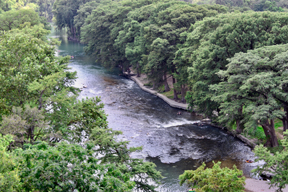
Guadalupe River, Texas

My running buddy and I were surrounded by what appeared to be an ocean of college kids, each dragging a tube and some with elaborate beer-cooler/multi-tube floatation systems that suggested these people were not the novice river runner I was. I felt a bit out of place, but at the same time, I was looking forward to trying this classic Texas activity—even if I was bit on the geriatric side.

As we stood on the bank, the bus driver/guide told us about the four sets of rapids we would encounter and how to safely negotiate our way around each. The first was Hueco Falls and we were told to stay to the far left. When he was finished, we waded into the icy water. It was absolutely shocking on entry, but after a few seconds it felt great on this blazing August day.

Feeling like a hippo trying to mount a tricycle, I fought my way onto the tube and began my trip downstream. Seconds later, I was underwater with a snoot full of river and the rather unpleasant sensation of bouncing off rocks. The driver failed to tell us Hueco Falls was barely 100 yards from our put-in point.

After what seemed like minutes underwater, being battered repeatedly, I surfaced at the end of the falls minus my tube. It seemed my day on the river had come to an abrupt end after less than two minutes and I was going to be paying for a lost tube. I struggled over to the left bank and hung on a tree root, just trying to catch my breath.

About five minutes later I heard a young man shout, “Did anyone lose a tube?” I guess my day wasn’t over after all. I retrieved the tube, thanked him profusely and then rested a few more minutes. Finally, hanging onto the tube for dear life, I waded down to a shallower spot where I would be able to once again “gracefully” climb aboard.

The rest of the trip turned out to be much less eventful, and at the end of the day, we pulled out in beautiful downtown Gruene. I returned the tube, changed clothes and headed to the Gristmill for dinner.

Sitting in one of the open areas overlooking the river, I enjoyed a chicken fried steak and a Corona. I planned to attend a show at Gruene Hall that night, so I just hung out there on the deck for a couple of hours watching the river run far below me and listening to restaurant’s music (which, by the way, was far more appropriate for someone my age than the people I had shared the river with that day). About an hour later, Cream’s “Sunshine of Your Love” came on and instantly, I was 17 again with a guitar hanging around my neck.
Like most kids in the ‘60s, I was part of a very bad garage band. We never amounted to anything, but we had a great time and dreamed of the day we would be more famous than the Beatles. One of the songs we played was this Cream hit and it led to one of my proudest moments. Well, it was at the time anyway. The song ends with a continuous striking of a single chord as the sound fades out. But the chord didn’t give closure to the song. While Cream made it work on the record by fading out the sound, in live performances, you can’t do that; songs need to end.

That open cadence drove me crazy for weeks and one practice day, as we finished the song, I just couldn’t take it anymore and I hit the chord that would give the song closure. Immediately, I, and everyone else in the band, recognized it as the first of the three-chord opening to the Who’s “I can See for Miles.” We segued immediately into that song and loved the way it sounded. Forever after, we performed those two songs together.

Back then, I didn’t understand that music was just math and architecture was frozen music. If I did, this “discovery” would have been no big deal. It would have been obvious if I just looked at it mathematically. But I didn’t know that then; I just knew that the final chord left us hanging and it drove me crazy. I had to close the loop. The way it happened was serendipity at its best—a totally pleasant accident.

Some of our most interesting discoveries have come from this kind of serendipitous event. Penicillin, Post-it notes, Viagra and even microwave ovens were all happy accidents. We are always shocked and delighted when they happen. We treat these events as if they were gifts— or even miracles—and in a sense, they are.

But I really have to wonder if these things we call serendipitous are really accidental or even all that rare for that matter. If you think about it, these “accidents” appear to be all around us, and they are happening far too often to be considered rare. A quick Google search will give you list after list of them—things like The Top 100 Serendipitous Scientific Discoveries. I wonder if they just might be the norm, rather than special events.

If they are indeed as common as I suspect, perhaps the thing that turns these everyday events into serendipity is our ability to see them when they are right there in front of us.
How many do we miss just because we aren’t open to them, or more important, are not expecting them? I wonder if it is possible to not only expect these happy accidents but, more importantly, to make a concerted effort to look for them. Maybe it is somewhat like hunting for morel mushrooms. They seem to be rare and very hard to find, but once you get “in the zone,” you realize they are everywhere. It may take two hours to get there, but once you do, you can gather a basket full of them in five minutes.

I experienced two “accidents” on this day, one not-so-pleasant one over Hueco falls (which I later learned was actually a Class III rapid; I guess I was lucky to just get a little bruised) and another in remembering my “discovery” of the connector between two songs. Yet I can’t help but wonder, how many other happy accidents didI miss on this, and every other day of my life.

How much more could we accomplish if we just made a concerted effort to be open to, and more importantly, to expect these events and be prepared to act on them when they occur?

Vacations

November 1st, 2018

By Michael W. Gos
King Ranch, Texas

We learn a lot of valuable lessons from our parents. Work hard. Don’t tell lies. Never punch out a moose. And most of those lessons serve us well in life. But we also learn some, shall we say, “less helpful” lessons. One of those is about vacations.

We were spending a bit of time on the King Ranch. For me it has always been a place with a two-fold draw. First, of course, is the historic angle. It was the largest ranch in America and it still is the most famous one today. Most of us have heard the stories of “Captain” King and how the ranch got its start. He bought the first grant (15,500 acres) at just under two cents an acre and then grew the ranch into the 825,000 acres it is today. Imagine, a single ranch larger than the entire state of Rhode Island.

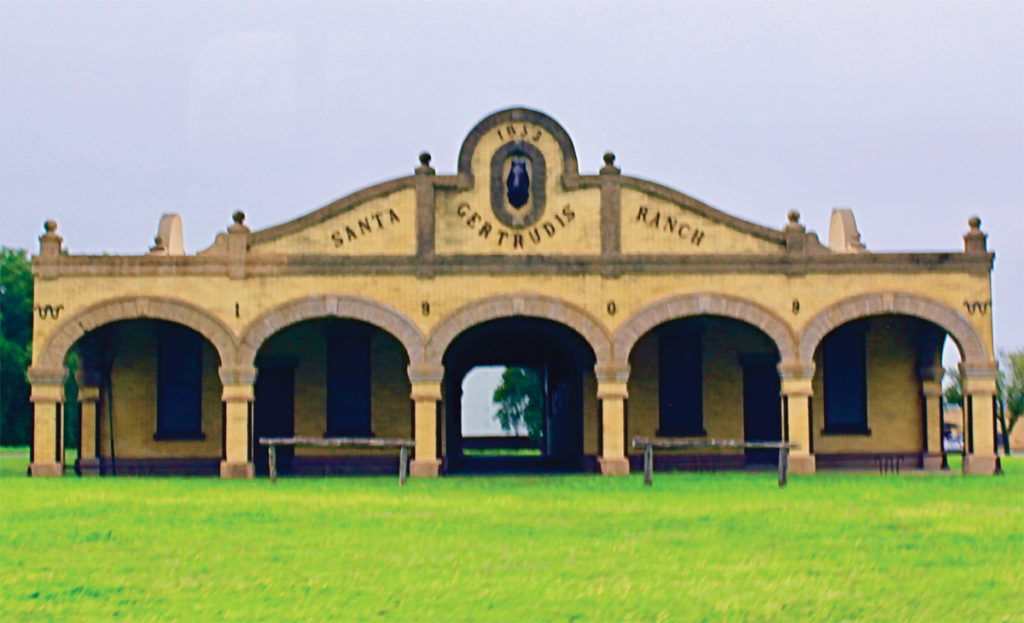
King Ranch gave us the first American cattle breed, the Santa Gertrudis. King’s cowboys (the kinenos) also worked with the mustang horses they found roaming the Wild Horse Desert and through steady improvement of the breed, the ranch became famous for quarter horses and thoroughbreds. In 1946, they even had a Triple Crown winner, Assault, who is buried there at the ranch.

But there is also another, far more important reason I love this place. Out here I can just sit for a while in my boots and cowboy hat and feel like I belong. This place suits me. I wouldn’t mind just staying here for a few days, or months, hanging out in a small cabin and just spending my days ambling around the back forty. In many parts of the ranch there is no cell phone service. I could drive here (with a cooler of beer, of course), park my Jeep somewhere where I can’t see it, and just do whatever felt right at the moment. For a month of so, I would hope to see no signs of the 21st century urban world at all. That is my idea of the perfect vacation.

My wife wants to take a trip to Italy. I am okay with that. I’d love to see the art and architecture of Rome and Florence. Like everyone else, I’d like to do the gondola ride under the Bridge of Sighs in Venice. But I don’t want to do a two-week Grand Tour. I want to experience life there. Tuscany might be a good home base, but I’d want to live there for at least a year. Clearly, I am not—and never will be a tourist by nature; I am a vacationer…a long vacationer.

Unfortunately, that is often not how it turns out for me. More commonly, when it is vacation time, there are flights involved. I don’t particularly enjoy flying even under the best of circumstances. Even worse than the flight itself are the airports. Parking issues, hauling heavy luggage, long hours sitting and waiting, and eating very bad, over-priced food are all less than pleasant. And then, of course, there is the ultimate depravity: security. Every time I enter an airport I think about that morning, sitting nude (well, bottomless anyway) for a half hour on a cold metal chair in a tiny “room” at the Hobby Airport security area, my cell phone confiscated while the screeners were off somewhere doing something with my knee brace. It was beyond unpleasant. None of this matches my idea of a fun way to spend some time off.

But that is just the start. Once you get to your destination, there is travel from the airport to the hotel. Do you go through the hassles of renting a car or do you look for a shuttle? Then there is the hotel check-in process. Don’t even get me started there.

Of course, once at your destination, there are all the “sights” you came to see. The travel to them, the long lines and the fact that I am getting grumpier by the minute make this not only unpleasant for me, but for all around me. (Poor Jill. When you see her, give her your condolences.) And when it is all over, you return home exhausted and needing another week’s rest before you can even face the prospect of going back to work.

I do understand that many people have jobs that are not only unpleasant but also demanding in terms of their time and attention. Sometimes we just have to run away. Taking a week or two off and staying home is often not an option. Even if you can walk away from work (and most of us can’t), work will find you. The phone calls and emails don’t stop just because you are “on vacation.” No one cares, or even believes that you are truly “away from work.”

For many of us, our daily life is unpleasant enough that we will spend thousands of dollars and endure the inevitable indignities the travel industry forces on us just to be able to spend ten or twelve days beyond the reach of those responsibilities.  Our lives have degenerated into 50 weeks of unpleasantness, or as Curley said in City Slickers, “getting knots in our rope.” Then we try to do all of our living in the two (or three, or four) weeks we call “vacation”.

This vacation business is tough, but before you say it is worth it, think again—you’re not going to get off that easily. Before you can leave on this vacation, you get the inevitable bonus of increased stress due to the need to get extra work done before your exodus. The whole time you are gone, you are entertained by worries about what a mess you will return to when it is finally over.

What I find most amazing is that this problem is ubiquitous. Somewhere along the line, it has become the norm.  What I described is not surprising to anyone; we all live it—and do it, willingly. You, and just about everyone you know, are doing it. How did that happen?

They say the best way to impose an idea on someone is to start when he is still a child. I suspect that is what happened here. We grew up seeing this vacation scenario as “the thing we do.” Just as brushing our teeth, sleeping at night or taking a bath are normal because they are what we grew up doing, this mode of vacationing is what we were taught was normal. Many of us never considered an alternative. I remember the novelty of the “staycation” when that word was first coined a few years ago. We found it interesting because “we never thought about that.”

Yes, some of those lessons our parents taught us turned out to be extremely valuable in life. But some are less helpful. At the top of that second list is the way we vacation. It sort of makes you question other things you were taught growing up.

But I still won’t punch out a moose.

Happiness and Success

March 1st, 2018

By Michael W. Gos

Parker, Texas

We were up around McKinney for a Saturday night wedding and had the better part of a day to kill until the ceremony. Having researched the vicinity to discover any natural areas that might provide us a brief respite from the city and suburbs, we found none we hadn’t already visited. So instead we decided to head down to Parker to see the Southfork Ranch of TV’s Dallas fame. Like most people who visit the ranch, my first reaction was surprise at how small it was. But that was only the start of what would transpire there.

I am, without a doubt, the least likely person to ever tour Southfork, having never watched even a single episode of the show. Still, it was hard to be alive in the ‘80s and not hear about the show constantly— at work, on the radio, on other TV shows, even at home (yes, other family members watched it religiously).

From what I saw and heard, my impression of the show was that it was a soap opera about a bunch of very rich, and very unhappy people. And for some reason, being at the ranch and thinking about those characters reminded me of an old Brooks and Dunn lyric I once heard: “Happiness isn’t just for high achievers.” But, of course, as a natural follow-up on that thought, I realized that, at least in the case of this show, even high achieving did little to provide true happiness. I know the show was just fiction, but it still got me thinking.

Over the centuries, there have been lots of ideas about what makes us happy. Some people believe happiness comes from external sources, like having wine, women and song; lots of big-boy toys; wealth; power; etc. We often call these people hedonists. And there are some who believe that, while all the goodies are fine, that’s not enough. To be truly happy, we must also do all we can to avoid pain. That great party on Saturday night is less fun when you know you are going to be sick Sunday morning. These people are called epicureans. Others say happiness is simply a matter of truly appreciating the things you have. I certainly know several unhappy people who are always needing more and more new stuff, new places to go, even new houses, and they never really do come to appreciate the things they already have.

But there are also those who believe happiness is an internal thing, that we create it by the way we think and the decisions we make. These people are called stoics and I think theirs is probably the correct reading.

Over the years I have come to see that everyone has the ability to be happy. It is something we choose rather than something that happens to us. The stoics say happiness comes from the way we see events rather than from the events themselves. An event in our lives has no inherent quality, good or bad, in and of itself. It is only our opinion of that event that gives it a value, positive or negative.

If the stoics are correct, if we are able to choose to make ourselves happy through our decisions, it stands to reason that we should also be able to make ourselves high achievers in the same way. After all, our level of achievement, like our level of happiness, is merely the end result of the decisions we make. Do we want to achieve or not? How willing are we to work for it? Each time an opportunity comes up, how do we respond? If we follow that line of thinking, Brooks and Dunne appear to be wrong. After all, personalities tend to be consistent. It would stand to reason that someone who is a go-getter in the realm of happiness would be equally competent in the area of achievement and vice-versa.

Yet, we all know of highly successful people who are miserable in their lives, like the characters in Dallas. Most of us also know very happy people who have next-to-nothing by today’s standards. These two examples would seem to support Brooks and Dunn’s position. So how do we explain this apparent contradiction?

While standing in the living room of the main house at Southfork, I decided Brooks and Dunn have missed the mark. Don’t get me wrong. I’m not saying you need wealth and fame to be happy…but I firmly believe that, to be happy, you do indeed need to be a high achiever.

I’ve talked to a lot of really happy people. Every one of them saw themselves as high achievers—even the ones who are living from paycheck to paycheck. They just define success differently than the rest of us. When I think of the things that I believe make me successful in life, I don’t think about degrees earned, jobs held or books published. That’s all just “stuff.” Instead, I see success in the friends I maintain, the appreciation I have for the people and the world around me and the fun I have each and every day. All the other happy people I hang out with feel pretty much the same way.
And even those happy people who are seen by most as high achievers tend to see their success in different ways than the general public might assume. As one friend said when I asked him his opinion on this subject, “Forget my bank account! Let me tell you about my new grandson!”

After we toured the main house, we walked around the ranch for a couple of hours. We toured the stables and even sat out under one of the enormous oaks that lined the driveway, enjoying the autumn afternoon. You know, it is a good thing the characters of Dallas weren’t real. If they were, one could become really depressed sitting there thinking about their lack of happiness—and of success.

Regrets?

October 1st, 2016

gos-img_1625By Michael W. Gos

Waco, Texas

It had been a really hard day on the road.  I should point out that I hate driving.  I know—a strange affliction for a guy who wanders around Texas a lot just for fun.  On this day, I left Canyon, Texas, about seven in the morning and had driven all day.  It wasn’t too bad until I got to Eastland, but from there I was stuck behind a motor home going 20 miles per hour below the speed limit on a two-lane road.  For 40 miles, I could not negotiate a pass.  Every time I pulled out to take a peek, there was another car coming in the opposite direction.  It was frustrating.

Finally we came through a tiny town whose name I don’t even remember.  As we slowed for the only stop sign in town, I saw a series of parallel parking spaces on the right, all untaken.  I swerved hard to the right and raced through those parking spots to negotiate the pass.  Fortunately, there were no law enforcement personnel around and I got away with it.   Coupled with the countless previous attempts to pass, that slick move at the stop sign pushed my wife over the edge, but I figured it saved me more than two hours over the alternative, so I don’t regret taking the opportunity.

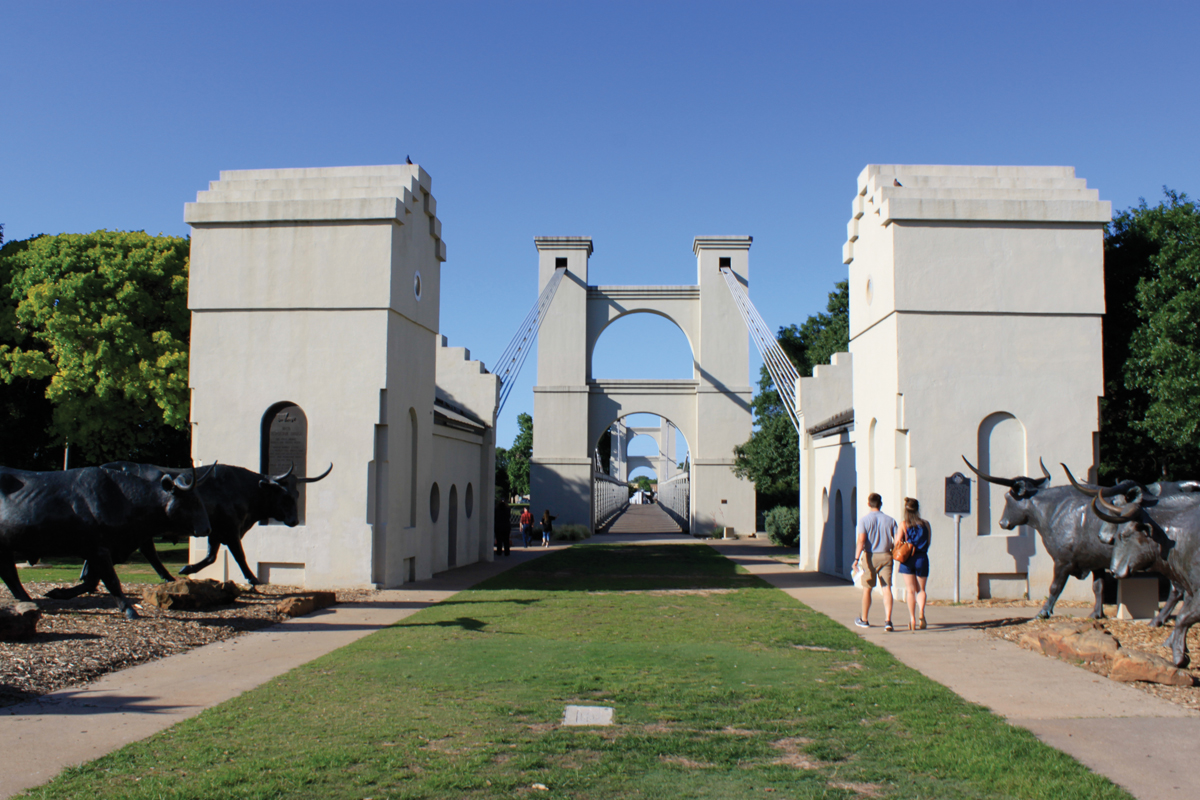
I finally arrived in Waco in the late afternoon.  I had come to do some photo work and I had a lot on the agenda.  I had only this afternoon to spend here and I had three sites I wanted to shoot: the Waco Mammoth National Monument, the spot where the Clintons burned the Branch Davidians, and the beautiful foot bridge across the Brazos River.   I checked into my hotel and then immediately went back out to begin work. I headed first for the bridge.

After studying the site and checking out the light levels, I made several photos of the bridge and the enormous bronze sculptures at its entrance.  I was fairly efficient and in less than half an hour, I had everything I needed.  I gave the photos a look over and was pleased with what I saw.  It was time to move on to the next site while I still had enough daylight to get something done.  But that’s not what happened.

Life is a non-stop parade of events and decisions.  Every step of the way we are presented with opportunities.  There are forks in the road, and at each one we have to decide, usually in short order, which way to go—which opportunities to accept and which to decline.  And, as Robert Frost points out in his poem “The Road Not Taken,” because “way leads on to way,” every decision we make sets us on a new path; one from which it is difficult, if not impossible, to back track should we later decide we would like to reverse the previous decision.  Once made, each of these choices puts us on the new path our lives will take from that point forward.

Many people look back on old decisions and wonder what would have happened if they had made the other choice.  Others go even further; they look back with regret.  “I should have made the other choice.”  But opportunities, once passed by, cannot be revisited again.  We have to move on from where we are.  As a result, as time goes on, the stack of missed opportunities grows until the pile becomes enormous, and for some people, that can be intimidating.  The regrets build.

But I think that few of us see the big picture, the full reality of the situation here.  Certainly, had we taken any of those opportunities when they presented themselves, our lives might have gone in a different direction.  And as a result of accepting them, we might have had other, new opportunities down the road that could have led to a better life—opportunities that we never even got to see because of earlier choices we made.  But there is another way to look at the issue.  Had we indeed made the other choice, we would not have had many of the opportunities we got to see as a result of the earlier decision we did make.  It seems to me, there isn’t much point in grieving over missed chances.  It all evens out in the wash.

Back in Waco, I found I just couldn’t bring myself to move on to my next destination.  I was still so tied up in knots from the hard drive that I needed to just sit awhile.  In the shade of an old oak tree on the bank of the river, I took a moment to sit at a picnic table and just relax.

That moment lasted a little over three hours and when I finally felt like moving on, it was nearly dark.  I would not be getting the other photos I needed on this day.

It would have been easy to look at the decision I made that day and think I really missed an opportunity.  Now, to get the photos I need, I’ll have to make another trip to Waco.  I passed on a chance and will have to pay a heavy price.  But I don’t see it that way.

Having a good, brisk sit at the river transformed me from nervous, irritable, and frankly, a general pain to be around, to a laid back, relaxed guy who was just enjoying a beautiful summer’s evening on the river.  To this day, my wife comments on how she sat there next to me just watching the stress melt away.  In her eyes, it was such an improvement over the grouch that first arrived in Waco that she was perfectly willing to spend three hours just sitting there.  But there was even more benefit gained by the choice I made.  The fact is, I was having fun, and after all, isn’t that what life is all about?  Today, it is clear I made the right decision.

When thinking about missed opportunities, it is easy to be pessimistic.  It seems almost logical to get down on ourselves for making the wrong choices.  That’s understandable.  Our lives at any given moment are nothing more than the sum total of all the decisions we made to this point.  But we also need to see the bigger picture. It is critical to always remember that it is also a missed opportunity not to idle away a few hours when the chance presents itself.

Generation Gaps

December 1st, 2015

The bank had become to historical society.

The bank had become to historical society.

By Michael W. Gos

Comfort, Texas

It all started over a few bottles of honey.

Many decades ago, an old man I know fell in love with Fain’s honey.  It wasn’t available in Baytown, where he lived, but it didn’t matter because he could always get it in Hill Country, and since he made several hunting trips there a year, he just packed in a supply every time he traveled.  It was a good system and it served him well for more than 40 years.

But as he grew older he found he no longer had the inclination, and eventually even the ability, for the many trips he took when he was younger.  His journeys there were fewer and further apart.  He still wanted to spend time at the beer lease with his sons and grandsons, if only just to sit around the fire and do the Wild Turkey thing.  And he still got his honey.

But then his 80s came and even those trips stopped.  It wasn’t long before his supply of Fain’s ran out.  It was then he thought of me.  He had heard I was headed to San Antonio for a conference and asked if I would be willing to make a run into Lowe’s Food Market in Comfort to get him ten or twelve bottles.  I told him I’d be happy to.

It had probably been ten years since my last trip to Comfort.  I remembered it as a quaint little village that had a wool exchange and an egg hatchery.  That was about it.  But it was big enough to have a weekly newspaper and some beautiful old buildings “downtown,” a couple of blocks off the highway.  One of those buildings housed Lowe’s Food Market, a Norman Rockwell image of a 1950s tiny town grocery store.

Ten years is not that long of a time and I have a pretty good memory, but when I drove down High Street where I thought I remembered Lowe’s being, I found I was wrong.  Thinking perhaps my memory had failed me, I drove down Main Street, then Broadway, the two streets in town that paralleled High Street.  Thinking my memory must really be failing, I even drove along 473 to look.  Still having no luck, I finally violated the sacred man code and stopped at a gas station to ask directions.

The attendant said, “It used to be back on High Street, but it burned down a couple of years ago.  Now there’s just a vacant lot there.”  He said he’d heard they were planning on rebuilding on Front Street, but as far as he knew, that hadn’t started yet.  Accepting that I had failed in my quest, I decided to move on.

While I think I do a good job of hiding it, the fact is I have a sentimental side.  I like to take out old memories now and then and look at them.  Since I had come this far, I figured I might as well take advantage of the opportunity.  I got back in the car and drove along High Street again to see if I could find the exact spot where the store used to sit.  As I looked more closely at the buildings in the old downtown section, I noticed that the library was pretty much as I remembered it; so were a couple of five and dime-type stores.  But almost everything else was different. The bank had become the historical society. There was a Beatles-themed bar, three small restaurants, a couple of gift shops and even an ice cream store.  None of these were at all familiar to me.

Disappointed, I decided to drive on toward Bandera where I hoped I’d be able to find the honey.  As I pulled on to Highway 27, I found myself obsessing over the changes I had encountered in Comfort.  It was no longer the town I remembered.  I suppose to someone seeing it for the first time, it would still be a sweet, quaint little Hill Country town.  But they didn’t know the Comfort that I knew—and it made me sad.

I understand we can’t live in yesterday; things change over time.  That’s just mankind marching on.  And I can also appreciate the fact that the mundane everyday tasks of our lives sometimes become easier as a result of these changes, but it seems to me our quality of life suffers as a result.  As I turned onto FM 173, I remember thinking, “I’m not sure all this change is worth the price.”

My God!  I was so shook up by that thought that I pulled over to the side of the road to try to calm myself and think this through.  Decades ago I heard those exact words come out of my father’s mouth.  His general view of life was that the whole world was going to hell in a hand basket.  Of course, at the time I just laughed it off.  Only the old see the world that way.  As a teenager, I thought the world was great just as it was, and the few changes that were happening, I saw as improvements.  To a teenage boy, my father might as well have been a space alien.  His views were as completely incomprehensible to me, as I’m sure mine were to him.  Back then we called it the Generation Gap.  But this day, as I drove away from Comfort, I was struck by the realization that somewhere over the years, I had become my father.

As time goes on I am beginning to suspect that we are all really more similar than we are different.  As I look back on it now, I realize I didn’t become my father at that moment in Comfort; I suspect I have always been him.  I just didn’t know it.  The idea we had way back then about a generation gap came from a mistake in the way we viewed each other.  Quite simply, we had been comparing apples to oranges.

Every year Beloit College puts out its “Mindset List” for college faculty.  It is a list of the experiences and worldviews of incoming college freshmen that is designed to help faculty understand the critters they are about to encounter.  According to the list, for members of the 2015 freshman class, the Daily Show with Jon Stewart has always been the only news program that really “gets it right,” and when they see wire-rimmed glasses, they think Harry Potter, not John Lennon—or John Denver. The list goes on.

Obviously, the world seen by these students is radically different from the one I live in.  I’m sure these young people see the world as it is today and think it has always been this way.  They may see problems, but if they do, they view them as obstacles that were created by previous generations and view any changes that take place as improvements.  In essence, they see the world exactly as I saw it at their age.

In the late ‘60s, I was a boy of 17 looking at my father, a man of 48.  Back then, I had a Fender guitar—he only saw a (expletive) guitar that constantly needed to be turned down.  I loved my top 40 music.  He heard only noise.  Today, I hear a car driving down the road booming and vibrating and think, “turn down that (expletive) radio.”  Truth is, it is probably an MP3 player.  I wonder—what if, as that teenage boy, I could have met my father when he was 17?  I suspect we would have been very similar in our worldviews.

Now, several years later, I still haven’t returned to Comfort to see the new Lowe’s Market building.  I doubt if it can be as cool as the old one.  But then, that is exactly what my father would have said.

Bay Area Houston Magazine