The Art of Being Human

September 1st, 2015

The Leakey Merchantile-A true Texas general store with beer, groceries, clothing, camping supplies, ammo and bait.

The Leakey Merchantile-A true Texas general store with beer, groceries, clothing, camping supplies, ammo and bait.

By Michael Gos

Earl Langley is an artist.  We all are, I suppose.  Inside us is an artistic bent that comes as a part of being human and it is constantly struggling to get out.  Little children make art instinctively.  Eighty-four percent of American children rank high in creativity in kindergarten.  But for some reason, that quickly changes.  By the time children reach the second grade, only ten percent still rank high in creativity.  As adults, most of us have locked that part of ourselves away deep inside. There is nothing sadder than a man who goes to the grave with his music still in him. That won’t happen to Earl.

Earl owns a small engine repair shop in Leakey.  On Mondays, and on Wednesdays through Saturdays, Earl fixes lawn mowers and chainsaws.  But on Tuesdays, Earl practices his art.  His medium—chicken. Earl is the proprietor of Chicken Earl’s, a home built food trailer next door to his shop. His fried chicken is not fast food or even truck food.  It is a high art form.  I’ve never tasted any that could even come close to his masterpieces.  It is worth the five-hour drive from Houston just to have lunch out on the picnic tables in front of his wagon.

I once asked him why he was only open on Tuesdays.  With his close proximity to Garner State Park, I would figure he’d make a ton of money on weekends. He said he was only cooking one day a week and there was only one Tuesday in the week so it seemed like the perfect match.  So now, whenever I go to Leakey, it is on a Tuesday.

But Leakey holds more significance for me than just Chicken Earl’s. Back in 2005 I spent a week there running from Hurricane Rita. Rumor had it that some not-so-sharp civic leaders were about to try to evacuate Houston and send more than four million people north, into the path of the hurricane.  I bugged out before they had a chance to close the roads heading west to safety.  Since my running buddy was a 100-pound Labrador retriever, my choice of hotels was limited.  In the last ten years hotels have become more dog friendly, but back then, it was an issue.  I found a place in Leakey, a town I’d never even heard of, that would accept us both and after 9 hours on the road, we arrived late at night at the tiny town in southern Hill Country. They told me over the phone the office would be closed but I would be in room 12 and they would leave the key in the door.  I would have been worried about vandalism if I owned the place, but now I understand they knew what they were doing.

My week there was a real eye-opener.  Past experience had shown me that when hurricane running, you hang out in a motel, go to dinner and just be bored out of your mind until its time to go home.  But then again, I’d never spent a week in a small town motel.

The first morning, I woke up to find a note on my door telling me to come to the office to pick up a package.  A couple of the townswomen had sent over breakfast.  The hospitality just grew from there.  On Thursday night I was invited to attend the town pep rally and bonfire in preparation for the football game the next day, and on Saturday my dog and I were invited to a barbecue and party at a local ranch welcoming the town’s new nurse practitioner.  The food was great, they had a live band playing cowboy music and almost everyone at the party came up and introduced himself. It was magical. For years I just assumed my week there was an isolated event, people feeling sorry for me because of the hurricane, and

I appreciated it for what it was.  As a result, I have always had a special place in heart for Leakey.

But then other things kept happening.  I’ve written here previously about going to Montel, Texas, to photograph a 19th century wooden church back deep in the woods. The church was next to an old one-room schoolhouse that served as a community center.  As we pulled up, a woman came out of the schoolhouse and insisted we come in and join her family reunion for lunch.  Again, everyone came up to us with introductions, and I had a long conversation with two of the folks who were also Purdue grads about ten years before my time there.

And there has always been Terlingua.  I never could explain that either.  You go to the ghost town, buy a beer at the trading post and sit on the front porch drinking it and meeting all your new “friends” who want to know all about you. (“Do professors always wear cowboy hats?”  “Did you really drive all the way from Houston in a Jeep?”)

These places are so different from what I was used to.  I grew up in a city.  Today I live in a suburb of a city.  You know a few of your neighbors, and even fewer well.  Strangers pass by and there is either a tiny bit of small talk, or far more likely, none at all.  The closer you get to the center of the city, the more pronounced this isolation becomes. The longer you stay there, the more “normal” this starts to feel.

I think living in the city makes people leery of strangers.  When we have spent any measurable amount of time in that environment we begin to forget that man is, by nature, a social creature.  His true self is freely displayed, even reveled in, unless he is overcrowded.  Then a degree of protectionism and mistrust starts to creep in. Because having so many others in such close proximity overwhelms man, he tends to turn inward and that leads to misgivings that make him leery of others.  I’m sure the crime in cities doesn’t help matters either.

But move away from the crowds, spend some time in the tiny towns and the wide open spaces and you once again see man as he was designed to be.  His social nature is once again clear. That is why it is important to spend time in places like this.  We may have to live in cities because of jobs or family obligations, but we can always take some time to visit places that are more in tune with our human nature.

From time to time we need to remind ourselves of who we really are.  To be a fully developed human being requires two things: being social and letting your art out.  We are all social creatures—and artists…if we just give ourselves a chance.  Just ask Earl and the rest of the people in Leakey.

Post Script: Chicken Earl’s has recently moved around the corner onto road 337 going toward Vanderpool.  Just a few hundred feet from the “downtown” Leakey intersection is the Frio Pecan Farm. Earl now has an indoor restaurant there.  He is still open only on Tuesdays.
It’s Magic

August 1st, 2015

IMG_0723By Michael Gos

El Camino del Rio, Texas

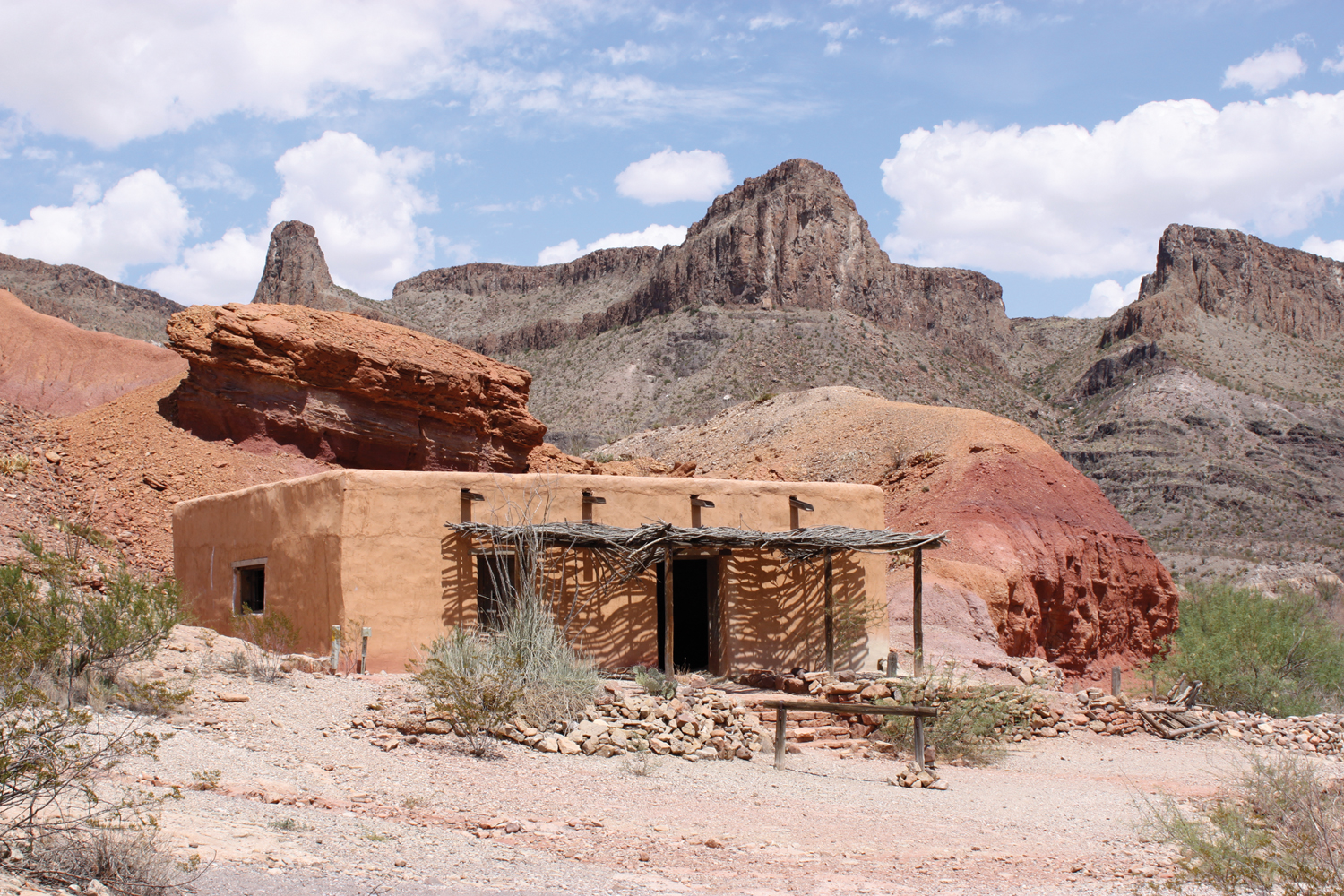
A lot has been written about the most beautiful drives in Texas.  Most people include on their lists the Willow City Loop near Fredericksburg when the bluebonnets are in bloom and the River Road between New Braunfels and Canyon Lake. There is almost unanimous agreement that the number two most beautiful drive in Texas is the three sisters (Ranch Roads 335, 336 and 337) from Vanderpool, through Leakey and on to Camp Wood.  And number one on just about every list? Of course, El Camino del Rio (FM 170) that runs along the Rio Grande from Lajitas to Presidio.  The run from Lajitas to the Santana Mesa Overlook just beyond the teepees at the roadside picnic area is particularly spectacular. So on about a third of my trips to the Big Bend area, and every time I take a first-timer, I take an afternoon to enjoy the drive.  On several previous trips I had noticed a sign indicating a “Contrabando Movie Set” but I always passed it by.  On this trip I had plenty of time to kill so I thought, “Why not?”

To me, movies have always been sheer magic.  The ability of the cinema artists to create creatures and settings that I know don’t exist, yet look so real, has always fascinated me.  I had seen this particular “town” before in the movie The Streets of Laredo and in the Brooks and Dunn video “My Maria.”  But here, on the actual set, I was disappointed.  I found myself wondering how I could have possibly seen this place as real in those works.  It just didn’t work for me now that I was really here.  I could easily tell that everything was fake.  I couldn’t tell for sure what the real composition was, but it looked like stucco over chicken wire.

That got me to thinking about just how the artists made something like this look so real on the screen.  What is the secret behind that feat?  Was it computer-altered?  Did they play with the lighting?  How did they make this place look like a real frontier desert town 150 years ago—like Boquillas looks today?

Before I left, I took a few photos of the buildings on the set anyway.  The “town” may look lame, but at least I would have a few photos as memories of an unproductive side trip.

But long after I left, the dissonance remained.  Why did something so clearly fake convince me on the screen?  Whenever I am faced with questions like this, I generally “think out loud,” mulling over my concerns and questions.  Unfortunately for him, my best friend Kevin is generally the victim of these ruminations.  So later that night, I gave him a call.

Kevin is an engineer and has a strong scientific orientation, so I was somewhat surprised to hear him say he believed that sometimes it is better not to know how things are done.  His experience had been that once you know, it loses the magic that made it so special in the first place—sort of like finding out how sour cream or hot dogs are made.

At first the artist side of me had a positive reaction to that.  My right brain understood the magic of creativity.  But deep down, I too have a fairly strong scientific orientation.  As I spent more time thinking about what Kevin said, I began to think that he had to be wrong.  At least some of the time, understanding how things are done makes you truly see what is magical in our world—magic you would have never known existed if you didn’t understand the workings behind the scene.

Consider the memory system in the first and second-generation computers.  Physically, the core memory unit was a large square frame box with thousands of small wires running from top to bottom, lined up in rows from front to back.  Thousands more wires were strung running from left to right, again lined up in rows, front to back.  None of these crisscrossing wires actually touched, but they came very close to it.

Wherever two wires “near-crossed”, a little metallic donut circled the juncture.  To store something in memory, the donuts were magnetized or not (1 or 0).  How do you magnetize the right donut in this matrix of thousands of donuts?  You shoot 55% of the electricity needed to magnetize down the vertical wire that intersects the donut and 55% of the electricity needed down the horizontal wire that intersects.

The result is that in only one place in this massive structure is there enough power to magnetize a donut, and that is where the two wires near-cross.

Now here’s the magic.  As we look at it now, this design is so simple, elegant and easy-to-understand.

And yet, who would think of such an approach to the problem of computer memory?  What kind of a mind comes up with something like this?  What happened in that guy’s head sure feels like magic to me.

Or even more so, try out the one of the early methods of detecting whether a fetus would have the genetic disease cystic fibrosis.  Before genome work, one way researchers could determine if the baby would have cystic was to take a sample of the amniotic fluid from the mother’s womb and put it on a live clam.

If the cilia in the clam stop moving in 30 minutes, the baby would be born with cystic.  Again, simple, elegant, and it makes perfect sense.  Among other complications, cystic fibrosis clogs the alveoli in the lungs.  Cilia are some of the smallest structures commonly available in living organisms.  It stands to reason that what will clog the alveoli later will clog cilia more quickly.  But again, what kind of a mind thinks like this?

After I got home I loaded the pictures into the computer.  When I took my first look at the photos on the full screen, I was stunned.  They were magnificent!  They looked as real as the town looked in the movie and video.  But I was there in person; I took those photos. I know the “town” didn’t look like that at all.  Yet here it was on my computer screen—as real as it could be.  How did that happen?  How did my photography skills, lame as they may be, make that happen?

It took me several weeks to figure it out…and I’m still not positive I have it right, but I’m pretty sure it has nothing to do with my abilities as a photographer.  I think what is happening is the man who designed and built the Contrabando movie set had the uncanny ability to see, not with human eyes, but with the eye of the camera—an ability I clearly lack.  He could see what the camera would see and he built accordingly.  The photos I brought back give strong evidence for this interpretation.

Life is a never-ending process of learning.  As a child, I sometimes found it to be a chore.  There were a few things I found interesting, but for the most part, learning was work, pure and simple.  I’m sure a lot of other people have viewed school that way as well, at least for a while.  But at some point in life most of us figure out that learning isn’t really work at all; it’s fun.  Let’s face it, we all love magic.  I guess the more I learn about how things in the universe work, the more magical it all becomes.

I think it’s time to take apart that old-time crystal radio I have in the attic.  I always wondered how that worked.

La Vie Dansante

July 1st, 2015

GosimageBy Michael Gos

Hondo, Texas

While some people know Hondo, Texas, as the birthplace and childhood home of Luckenbach’s Hondo Crouch, most of us know it because of the rather famous signs along highway 90 at either end of town.  And it is probably a good bet that if you don’t live in the area, your only experience with Hondo is as a milestone on the way to Garner State Park.

I was passing through town, not on my way to Garner but rather to Marathon in Big Bend country, when I decided to stop at the Sonic to share a couple of cheeseburgers and a diet cherry limeade with my ever-hungry running buddy, a Labrador retriever.  We were sitting outside at a picnic table and eavesdropping on a family sitting nearby.  Apparently the parents were trying to convince their thirty-something son that he should move back home to San Antonio.  Through the conversation, I was able to determine that he lived there in Hondo and worked as a night produce manager at the local HEB.  His parents seemed disappointed at both his choice of job and home.  They said he should be able to do much better than that given he had a college degree, and they practically begged him to come back to the city where good jobs were more plentiful.  He replied that he wanted to live in Hondo because from there it was a short trip to both Concan and Bandera, two places he seemed to be rather fond of.  They kept reminding him of the fact that he could probably find a better job in the city.  The repetition became tedious even for me.  I could only imagine what he must have felt and how many times he had heard this before.

Failing to get through to him with their first ploy, they even tried asking him to consider taking a job in the city and commuting the 45 minutes or so to and from work.  He balked at the idea of giving up an hour and a half of his day driving to work.  He said that was time he could spend in much more pleasant endeavors.

As my dog and I were leaving, I heard him say that he would rather work in a grocery store the rest of his life than live in the city.  For me, the conversation was mercifully over.  I’m sure he wasn’t so lucky.

I think most of us understand that millennials, those reaching adulthood around the turn of the century, think differently than the baby boomers or generation X-ers who came before them.  While we older ones work long hours and often take our work home with us, millennials give a good eight-hour effort and then, when the day is over, it’s over.  Work is completely out of their minds.  There is a total separation between work and life.  We boomers went where the jobs were—lived where we had to live to get those jobs; the millennials decide where they want to live and then find a job there.  They feel that life is too short, or too important, to let work dominate or dictate major life decisions.

I would imagine that this pattern of questioning the values of a younger generation is not unique to boomers and gen X-ers.  Throughout history, each generation has looked at the ones coming up after them and seen young people who they view as somehow inferior.   Most of the time they have been wrong.   I think my generation might be the exception.  As boomers, our parents were from what is often called “the greatest generation.”  Perhaps they were right in their view of us.  While they went down in history as the greatest, we boomers are likely to go down in history as the most pathetic generation.  Look at how we have taken the world we were given in the fifties and early sixties and changed it into the world we see today.  History will not look kindly on us for that.  But even in spite of our own shortcomings, like all generations before us, we tend to see the millennials as lazy and prone to making irrational decisions.  We think they should spend more time and effort bettering themselves and planning and preparing for their future.

Personally, I have mixed feelings on this.  There are times when I lament time I have wasted.  I wish I had begun earlier with savings, retirement planning and home ownership.  I’m sure that would have made my parents rest easier.  It certainly would have made retirement more realistic.  But then, at other times, I think about the time I spent in Guadeloupe, Martinique, London, Paris, Oxford and Cozumel and wish I had done more of that.

But you can only dwell on the past for so long.  Eventually you have to think about the future—and the diminishment it will bring.  I already see signs of it physically.  I am beginning to realize that things I used to do easily are becoming more and more difficult.  I did the South Rim hike in a single day in my 40s and 50s.  Today, I’m not sure I could do that, even if I didn’t have to carry a backpack. I know it is probably inevitable that, should I be fortunate to hang around the planet long enough, I will no longer be able to keep living in my house and keep all of the many things I love.  My library alone would over-fill most apartments in “senior living” complexes.  As we begin the downward slope on the bell curve that is life, it is only natural to ask if it was worth all that effort we put in to gather all this “stuff.”

The French have a philosophy called La Vie Dansante.  There is no equivalent phrase in English, probably because English-speaking people just don’t think this way.  Language always reflects the thinking of a culture.  A word-for-word translation is “the dancing life” though it has nothing to do with dancing.  The closest equivalent I have been able to come up with is something like “life is too short to spend any part of it doing anything other than having a good time.”

I’m beginning to think the French, and that young man at Sonic, may have had the right idea.  When you think about how short our time here is and the way it will ultimately end, I wonder if we should be thinking less about tomorrow and more about tomorrow’s yesterday.  All things considered, La Vie Dansante may be the wiser choice in the long run.

That young man will probably continue dancing his way through life and be no worse off for it—and we boomers will probably continue to see him and others of his type as irresponsible and poor decision-makers.

And we will probably be wrong.

Heroes and Villains

June 1st, 2015

IMG_0272By Michael Gos

Carrizo Springs, Texas

In everything we do, we are governed by rules that have been set up by society to keep things running smoothly. I’m not sure who in antiquity set up the original rules, but most of us seem to have at least a vague awareness of them and follow them without question.  Call it instinct if you will.

In the realm of romantic pursuit, for example, the rules are simple, but very strict.  The man chases the woman over an unspecified period of time.  This process continues until she decides to catch him.  But it is absolutely essential that he have no idea of this second facet or the rule.  He must forever think he was in absolute control of the pursuit all along.

It’s not just in romance; everything we do in our lives follows pre-set parameters.  When you go to see a doctor, for example, the rules are simple.  You tell him what is wrong, then just step back and listen.  After all, he is the expert.  You would think this is even more critical in emergency situations but recently I watched as a small woman, unhappy with how the team of doctors was addressing her very sick husband, took over and started demanding a series of things be done. For some reason I still don’t understand, she got her way.  A few weeks later, I saw how each of those same doctors had come to love and respect that woman because of, or maybe in spite of, her role in creating a positive outcome from a dangerous situation.

I thought about that for quite a while and it eventually became apparent to me that while most of us follow the rules, there are a few people who don’t.  This woman’s choice to battle against the rules, and the people in authority, turned out to be heroic behavior.  And all parties concerned came to appreciate it—after the fact anyway.

I was in the Mount Hope Cemetery in Carrizo Springs.  I had made the journey because I wanted to find the graves of the old Texas Rangers that I heard were buried there.  Ranger graves are marked with the circled star of their order.  Since most of these graves were from the late 1800s, the markers are now weathered and covered with rust but they still stand out as special among the other graves.

I’ve always been fascinated by the stories of the old Rangers, from Bill McDonald’s famous “one riot; one ranger” story on the positive side, to the atrocities that have been attributed to some of their ranks (such as Leander McNeely’s executions).  This intermingling of the heroic and the villainous intrigues me.

Many years ago, when I was still in college, I read a newspaper story about the death of a fellow I knew in high school.  Back then he was a hoodlum.  He was well-known for administering beatings and otherwise terrorizing the smaller and weaker classmates, even some as much as four years younger than he.  He spent most of his high school life in trouble.  According to the article, he died trying to save a child who had fallen on a set of railroad tracks just as a train was approaching.  He didn’t know the child but jumped in anyway.  He managed to push the boy to safety seconds before the train dispatched him.  He apparently forgot the rule about not standing in front of oncoming trains.  As a result, our high school villain died a hero.  That started me thinking. What goes on in a person’s mind that can cause him to act the parts of a hero and a villain both?

I think the answer may lie in the root cause of both behaviors.  The two traits may have a common source, a single cause if you will.  It is sort of like the black and white yin and yang diagram from eastern cultures, with one major exception.  Though intermingled, yin and yang are true opposites; they interact with each other yet they are always separate.  In the diagram, there is either black or white.  There is never a gray.  Heroic and villainous behavior patterns, on the other hand, aren’t really opposites.  They don’t just interact like yin and yang; they can blend.  I think that may be because they are really the same thing—two sides of the same coin.

Consider for a moment the concept of love.  Ask most people you know what is the opposite of love and almost without exception, they will answer hate.  But really, when you think about it, aren’t love and hate really the same thing—a strong emotional attachment to someone or something?  Yes, one is a positive attachment and the other negative, but they are both a form of interdependence—of continued emotional involvement.  In reality, the true opposite of love is indifference.

I think the same is true of heroes and villains.  At their root, both are a function of a single personality trait: anti-social thought and behavior.  For some reason both heroes and villains are prone to habitual violations of the rules society sets up to govern the things we do—the rules that most of us follow.  There are some people who just refuse, or are constitutionally incapable, of following those rules.  Whether the person breaks bad or good, becomes a hero or a villain, the cause and process are the same. Sometimes, as in the case of my high school classmate, both results can co-exist in the same person giving further evidence that the two are just manifestations of the same concept.

For me, the Texas Rangers certainly exemplify that notion.  It takes an unusual kind of person to seek out the life of hardship and danger the 19th century Rangers led.  These were men who, by virtue of their career choice, showed that they were not governed by the same set of norms or rules that guide you and I.  Some were heroes and some not so much.

Unlike my classmate, or the woman in the hospital, I don’t think I’ve ever been bold enough, or enough of a rule violator, to qualify as a hero or as a villain.  Frankly, it is unlikely I ever will be in the future either.  I’m just too old to become a renegade now.  My wife calls me “Crunchy Granola” because I always color between the lines.

But just between you and me, it really has not always been quite that clear cut.  Over the years I have observed and sometimes even experimented a bit with this concept.  After all of that, I have come to only one conclusion.   Rules were meant to test the creativity of intelligent people.

I probably shouldn’t say any more than that.

Looking for Patterns

May 1st, 2015

Man Rowing Bamboo Boat

Man Rowing Bamboo Boat

By Michael Gos

LBJ Grasslands, Texas

I have very few memories before the age of three. One of the earliest memories I do have, however, is the discovery that I hated cities and loved wild places.  I never thought about why I felt that way.  When you are four or five years old, that just is not a part of your thought process.

As I got older, those feelings intensified.  By and large I was an obedient child, but when I was in trouble, it was almost always because of wild places.  By the time I was seven or eight, I would head out almost daily into the few acres of woods that remained near my childhood home.  It was the only place I felt comfortable.  My parents didn’t share that comfort.

When I went away to college, weekends were often spent camping at a state park.  Even in the Indiana winter, I would take my tent, along with lots of newspaper to place under my sleeping bag, and head out to the wilds.  Still, I never questioned why.  It was just the way the world was.

I guess the first time I really thought about it was when I was in my forties.  I had come to Texas to work at the University of Houston.  It was my first time living in a large city and I was terribly uncomfortable, all the time.  When I took the job, I expected to feel that way so I never gave it much thought.  It was only after I had been there awhile that I began to see this as an issue.  At U of H I met several people who not only tolerated living in the city—they claimed to love it.  That took me by surprise; it was an attitude that was totally foreign to me.  The discovery that there were people who saw things differently made me begin to question for the first time, why I felt the way I did.

Whenever I know I have to go to a city, I research a few potential road trip destinations, just in case the need should arise. I was at a conference in Dallas.  After being there a full day, I had to escape. I got into the Jeep and drove to the LBJ Grasslands.

I’m not sure why, but I have a driving need to see the entire array of what nature has to offer.  I love beaches, hills, open plains, deserts and deep woods; my absolute favorite is the mountains.  But this place was different than any of those.  Bordering two zones, forest and prairie, the LBJ Grasslands feature rolling hills with lots of open grassy areas comingled with patches of forest.  It is not one of the more beautiful places in Texas, but still it felt so much better than Dallas.  And frankly, I was excited because this kind of environment was something new to me.

It made for a pleasant morning.  I had the opportunity to walk along the edge of a small lake, to drive down dirt and gravel roads, and most important, to hear nothing for several hours but birds and the wind.

In the early afternoon, I walked a trail through a heavily wooded area and got to thinking once more about why I was so uncomfortable in Dallas yet loved it in this rather unremarkable wild spot.

My first thought was that my situation had something to do with the archetype of the garden.  In Western art, literature and mythology, the garden represents the Garden of Eden—the world as it was before it was spoiled by man.  In our culture, this archetype shows up most powerfully as a trip to the wilderness.  Early American literature is full of such references.  When things get rough, man retreats to the wilderness where he can get in touch with his true humanity and experience the world as the creator intended.  Most of us are familiar with Thoreau’s Walden but there are countless other examples as well.

But as man paves over more and more of the world, those wild places disappear and he is forced to create small, artificial garden spots to allow him a small idea—a remembrance if you will—of the real thing.  Some are in city parks, some in backyards.  Wherever they appear, gardens have come to symbolize the idea that life was better, more fit for humans in the past.

Joseph Campbell claims that we humans all share the same archetypes, regardless of the culture we come from, because we all share the same concerns and insecurities.  We know instinctively that we can’t be the kind of humans we were designed to be unless we are in an environment that was designed with us in mind.  But those environments are rapidly disappearing.  Their replacements, cities, are dehumanizing.  We rely on the archetype of the garden in our art and our stories to remind us of what it was like to be human.

While that made sense to me, and helped to explain how those who liked cities could deal with the tremendous loss in their lives of the places where we truly belong, it didn’t feel like the entire story.  I sensed that, for me anyway, there was more.  If all I needed was to be in the original garden, the wilderness, I could pick just one spot, say the Big Bend region, and stay there.  But I don’t.  I need to be in all the various types of wild places.  And not just to see them, but to study them, to try to learn their secrets.

Sunset was closing in and it was time to head back to the Jeep.  I came across a small herd of cattle grazing on land leased from the Park Service.  A mother cow stood with her baby beneath her; he was stretching out to get at his dinner.  I watched as he drank and then as he walked around the hillside, exploring his world, and trying to learn all there is to know about the place he lives.  And finally I understood.

Like that calf, I am trying to learn all there is to know about the world I was placed in.  Not the world of cities—that is man’s creation—but rather, the world that was created for man, the world of the Garden.  As I study these places, I am looking for patterns—things that repeat in the different spots I explore, even though those places appear to vary radically in nature.  I am convinced those patterns are there.  I just need to train myself to see them.

I thought about those patterns and why I have such a need to find them—about what they might reveal. Assuming that the universe was created logically, rationally (and I believe it was), those patterns just might give me a tiny glimpse into the great plan behind the design—in other words, into the mind of God.

It was dark by the time I got back to the Jeep and it was time to head out for dinner in Denton and then back to Dallas.  I had made no progress this day on seeing patterns.  But I did feel just a touch more human for having spent time in one of those wild places I’m sure was designed for me to occupy.

Posterity’s View

February 1st, 2015

IMG_1390By Michael Gos

La Porte, Texas  

Socially, he was a flop.  He had trouble getting along with people and was basically irresponsible.  Rather than face life and the everyday problems that go with it, he often just ran away, leaving others to deal with the consequences of his actions.

His problems started at an early age.  As a teenager, when his family expected him to pull his weight and help with the chores at home, he ran away to live with the Indians rather than engage in work he found unpleasant.

As a young man he tried life in the army but quit after a short time when he couldn’t get along with his superiors.  Next he tried marriage.  That lasted for a mere 11 weeks and afterwards, neither he, nor his wife, would talk about what happened.  (Sounds suspiciously like Kenny Chesney and Renee Zellweger, doesn’t it?)  Then, rather than deal with the consequences of his actions, he ran away to once again live with the Indians.  This time, he became so enamored with whiskey that the Indians named him “Big Drunk.”

Given yet another chance in society, he again messed up when he assaulted a prominent politician, beating him senseless with a stick.  He was arrested and tried.

Then he tried marriage again.  While this one lasted longer, it ended with the same result—divorce.

Trying the Army again, he rose to a leadership position only to have his troops come close to mutiny because of the decisions he made.  He survived—barely.

Given yet another chance at a responsible position, he was elected to office but decided he would vote according to his own convictions, refusing to represent his constituents’ desires. He was drummed out of office.

I think we all know people like him—someone who just doesn’t fit in; someone who is socially inept; a misanthrope.  It doesn’t matter how well they do their jobs, the inability to get along with others makes them social outcasts.  Most tragic is the fact that people like this just don’t see that it is a problem of their own doing—and they don’t learn.

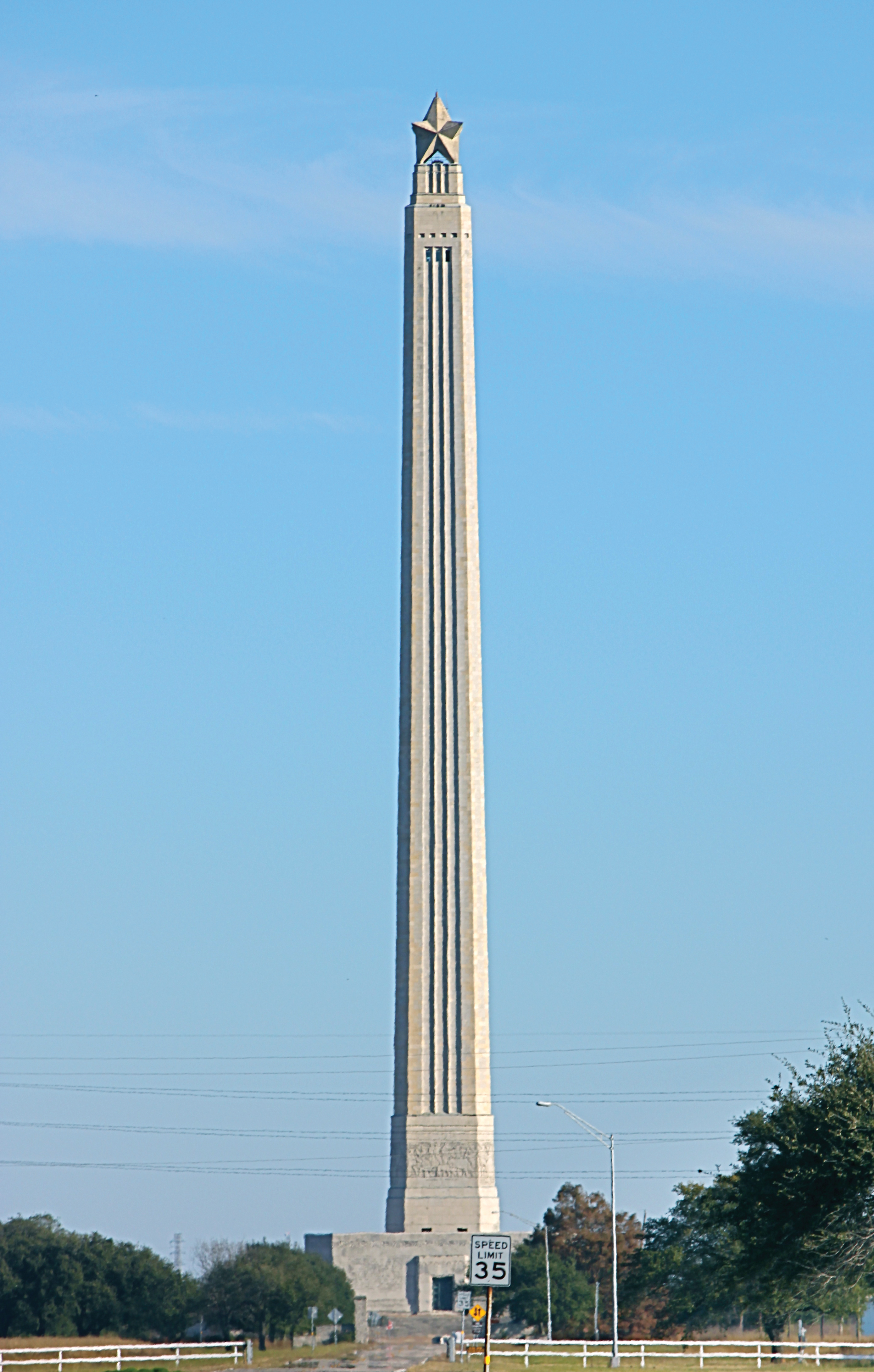
We were touring the San Jacinto Battleground historic site.  I had lived in Texas for 22 years and heard all the stories about the Texas Revolution.  I had driven over the Fred Hartman Bridge hundreds of times on my way to and from work.  I could see the monument off in the distance, several miles away but I had never found my way to the battleground itself until today.  I was surprised to learn that the memorial structure is the world’s tallest column exceeding even the Washington Monument by 12 feet.  But it makes sense.  After all, everything is bigger in Texas (except maybe the deer).

Walking the grounds and finding the spots where various events occurred, I couldn’t help but be impressed with the thought processes that went into the selection of this site for the historic confrontation.  Sam Houston had led his troops in a month-long retreat from Gonzales to this position 165 miles away.  They almost didn’t make it.  The rag-tag band of “soldiers” believed that Houston was showing cowardice by retreating.  Even his employers, the ad interim government of the Republic of Texas, agreed.  They wanted him to stay and fight.  Houston, however, wanted to use the time to gather more fighters, to drill the troops and to find a more favorable spot for the confrontation.  Today, we all know the result.  It wasn’t so clear to his men, and frankly, he was lucky to get as far as this position and maybe even to have escaped with his life.

About ten years later, as president of the Republic of Texas, Houston succeeded in his effort to get Texas to merge with the United States.  Many today might think that was a huge mistake, but Houston had the support of the bulk of his constituents at the time, something rare in his life.

But that support was short-lived.  In 1861, as governor, he tried to stop the state’s secession from the union in the run-up to the Civil War.  The people of Texas were strongly in favor of joining the Confederacy, and as a result of Houston’s taking a position against the will of the people, he was removed from office and spent the rest of his years as an outcast.

Of course, this was hardly his first time in this position.  Starting with his running away from the work at home, his failed marriages, his drunkenness, his violent temper and his inability to get along with people, Houston spent his life in a state of dissonance.  His accomplishments are unquestionable, but his personal behavior made him incapable of playing well with others.  And to the end, he never changed.

Being somewhat socially inept myself, I can relate to Houston’s difficulties.  I don’t ever feel comfortable at parties, and while I am perfectly relaxed, even thrive, speaking to a group of 100 people, my knees turn to jelly if I have to approach someone for a one-on-one, or even a small group, conversation.  I remember one of my professors in grad school telling me that when she first arrived on campus she asked several of my classmates about me.  She got one universal answer—“I’ve been in classes with him for four years, but I don’t know him.”  I told her the only way to get to know me is to read my writings.  She wasn’t impressed.

But there is, in Sam Houston’s story, something to give me hope.  In the century and a half since his life, we have come to see a very different man than his contemporaries saw.  Today we don’t see the short-tempered, anti-social drunk.  In fact, many people are not even aware of that side of his story.  Driving up I-45 through Huntsville, you can’t help but notice the enormous statue of him at the side of the highway.  That is the Sam Houston we see today.

I think there is a lesson in Houston’s story.  Nothing about you matters less to posterity than whether you gained social acceptance in your lifetime.  I’m glad.  I guess that means there is hope for us misfits after all.

Losing Illusions

January 5th, 2015

The "kitchen" at Clyde's Barbeque

The “kitchen” at Clyde’s Barbeque

By Michael Gos

Corsicana, Texas

There are any number of things that can make a place memorable for us.  Maybe someone we know and love is there.  We might have had a great time there.  Or maybe it is a place that so perfectly matches our souls that we instantly feel at home there (for me, that would include places like Luckenbach and the Terlingua porch).  None of these things were so in the case of Corsicana, yet it will forever be carved into my memory as one of those special places.

I was just moving to Texas and driving a 24-foot U-haul van trailering my car behind. I was on a mission.  On an earlier trip for a campus interview with the University of Houston, (my first trip to Texas) my soon-to-be colleagues told me that barbeque was a religion in Texas.  Back home in Indiana, barbeque meant the three H’s: hot dogs, hamburgers and a hibachi.  They assured me Texas barbeque was something very different.  Since I flew in for that interview and had a full schedule the entire time I was there, I didn’t have a chance to find out for myself.  So on this long overland journey, pulling all my stuff behind me, I decided that when I finally reached Texas, I would find a barbeque restaurant and have lunch.

I was told to avoid driving down 59 with such a huge load and to stay on the Interstate all the way to Dallas, and get on I-45 there.  I trusted the advice and made Dallas just about lunchtime.  I hate cities and the last thing I wanted to do was try to drive in town with my enormous “rig,” so I waited to find a lunch spot till I got well away from the urban mess.  About 50 miles south of all that, I began looking for a barbeque restaurant.  The first sign of one was just that—a road sign in Corsicana for a place called Clyde’s.  I followed the directions on the sign and came to a stop at a tiny, run down shack that was probably a house back in the 1950s.  Surely this couldn’t be what Texans call a restaurant!  I didn’t know much about barbeque back then.

Because my van and the trailer together were more than 40 feet long, and the four parking spots in front of the shack reached barely 10 feet, I pulled around to the side of the building and parked in the weeds and gravel.  It was then that I saw an even smaller, dilapidated shed about eight by ten in size.  Through the open, well-rotted barn door I could see that this was where the cooking was taking place.  By then I was just about sure this was a serious mistake, but the smell of the mesquite smoke (something I had never experienced) made me just crazy enough to take a chance.  With a smoke-induced high, I was feeling a bit better—until I opened the door and walked in.

The place was even smaller than it looked from the outside.  It could maybe seat 12 in a pinch.  And it was clearly a dive.  None of the tables matched and the chairs ranged from wood, to chrome to the steel folding variety.  I sat at an old, four-seat Formica table much like we had at home when I was a kid, and I waited.

After about five minutes, a girl came up to me and told me I had to order at the “window,” which was nothing more than a card table set up in the doorway that separated the front seating area from what looked like an even smaller back room.  I ordered, and about three minutes later, my love affair with barbeque began.

But that’s not why Corsicana stands out as a very special place to me.  It was the other thing.

It was fitting that at this time I would be starting a new life in a new place because I had recently become a new person.  When I was in my twenties, I was an immature kid with a major attitude problem.  My thirties and early forties were a learning time.  It took me 12 years to move to where I was that day in Corsicana.  Mostly, I had to go from seeing myself as a helpless victim kept down by the powers-that-be, to that day where I understood that if I just kept fighting, I could beat “them” and be successful in spite of anything they might throw at me.  After all, I had successfully completed grad school.  I knew they don’t give you a Ph.D. from a top-rated program because you are smart, but rather, because you are tenacious. Few are thrown out of the better programs.  Most people who don’t succeed just give up. That day, feeling like I had it all figured out and I had won, I moved on to my new life.

Blame it on Texas. Maybe it is the air, or the barbeque, but as I worked my way through that plate of ribs and brisket, I started getting the feeling that I had gotten it all wrong.  And that left me with an uneasy feeling.

When you spend two days driving alone, you have lots of time to think.  I had spent almost all of that time going over the 12 years of learning and the final lesson I had taken from it all—if you hang in there, you can beat them.  And yet, in all that driving, I had thought about several people who took time out of their lives to try to help me find my way.  Sometimes I listened; mostly I didn’t.  I remembered every success along the way (because they were so rare) and realized that, almost without exception, they came after the intervention of someone who cared—an intervention I chose to listen to.

One thing led to another, as our stream-of-consciousness thoughts usually do, and as I was eating the last rib it hit me; I had gotten the lesson wrong.  I didn’t succeed by beating “them.”  After years of struggling, I just stopped beating myself.  The unfinished rib dropped to the plate with a bang.

Corsicana is forever stamped on my heart not because of a special someone, not because I had a great time there, and certainly not because it suits my soul.  Corsicana will always be special to me because of what happened to me there.  I made a life-changing discovery.

I had spent 12 years finding truths and had a much better life for it.  But this was not what was important about that day.  And it wasn’t that I finally realized I only needed to stop beating myself. Those were just steps along the way.  The crucial event there in Clyde’s Barbeque was learning a far more important thing—something life changing.  Losing a single illusion makes us far wiser than finding a multitude of truths.  I had lost the illusion of victimhood—of a “them” that I was fighting against.  And life is so much better today as a result.

Besides, Corsicana began my obsession with barbeque.  A man has to be thankful for that!
(Gastronomic note: Today, Clyde’s is called Big Man and Lil’ Mamas. And the barbeque is still terrific!)

The Truth About Triusms

December 1st, 2014

IMG_0057Wimberley, Texas

One of the finest swimming experiences in Texas is at Wimberley’s Blue Hole.  It is a spot on the Cypress Creek that I am convinced has to be everyone’s idea of the great swimming hole up in heaven.

It was early October, sunny and in the 80s but the park was closed; it was out of season.  However, through smart thinking and persistent effort, the organizers of the small conference I was attending had managed to arrange for us participants to be given private access for the afternoon.  There were only thirteen of us there and it was as perfect an afternoon as you could ever hope for.  But now, as the sun was dipping lower in the sky, it was time for dinner, so I went to my favorite Wimberley restaurant and watering hole, INO’z.

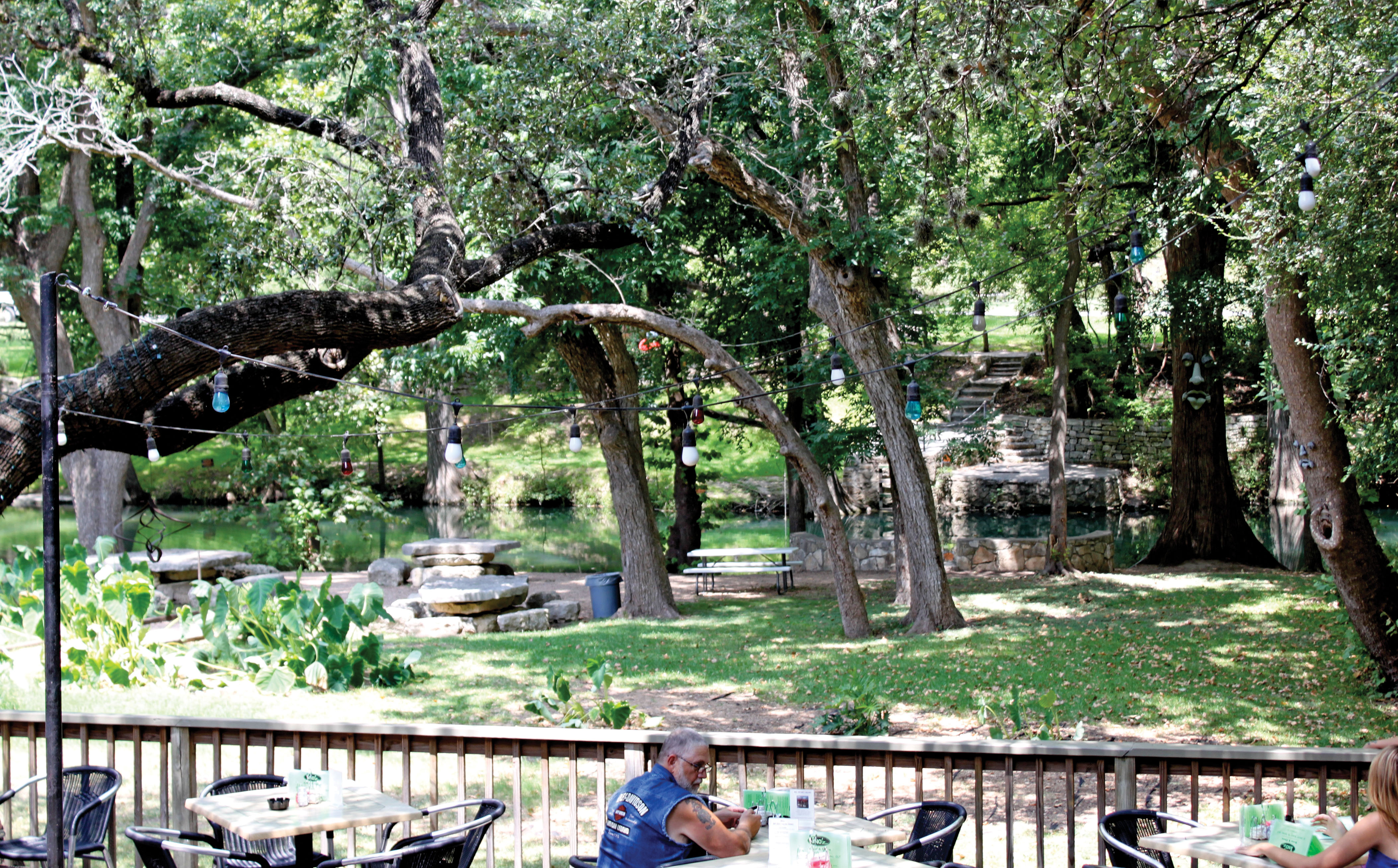
A bit downstream on the creek, in the heart of Wimberley, INO’z has an absolutely magnificent location.

The huge outdoor deck sits on a hillside that overlooks parkland with huge trees.  Many of the trees have faces.  (I’m serious!  Some of the shops in Wimberley sell carved wooden mouths, noses and eyes for attachment to tree trunks.  Apparently the city has chosen to support local business and add a bit of whimsy to their parks at the same time.)  The deeply shaded hillside slopes down to the creek below.  In the distance, it glimmers silver in the few patches of sunlight.  Only the Chisos Mountain Lodge at Big Bend National Park can rival the view.  The beer is cold, the food is good, but it is the view that brings me back every time.

He was sitting at the table next to mine and apparently was in a playful mood.  He tried the waitress first and she humored him briefly but had other tables to get on to.  Then he turned to me. My eye was immediately drawn to his broken front tooth.  It was hard not to notice given the way he grinned.

“I’ll buy your next beer if you can give me a truism that I can’t produce an equally well-known opposite truth.”

I didn’t understand and I told him so.

“You know, those little sayings that people have that capture some philosophy.  Tell me one and I’ll give you its opposite.”

I realized he probably was referring to what I call aphorisms, but terminology wasn’t important so I played along.

“Okay, ‘an ounce of prevention is worth a pound of cure.’”

“If it ain’t broke, don’t fix it.  Want to try again?”

I had to think about it for a while.  It wasn’t as easy coming up with these things as you might expect.

Eventually, another one came to mind.

“Opposites attract.”

“Bird’s of a feather flock together.”

I wondered what would possess a person to spend time thinking about something this obscure.  I’m not shy—or proud.  I asked him.

He said he worked at the Wimberley Zipline Adventures and that he had lots of downtime spent up on his stand in a tree.  Patrons ride down to his station and stop.  He unbuckles their harnesses, hooks them up to the next line and then sends them on their way.  And then he waits.  He described his job as 30 seconds of work followed by ten minutes of sitting.  It gave him lots of time to think about a lot of things.  I now suspected the broken front tooth might be work-related.  He had probably caught an errant body part.

“Okay, try this one.  ‘Absence makes the heart grow fonder?’”
“Out of sight, out of mind.”

This was starting to feel like a game and, being the competitive person I am, I was getting drawn into it.

“How about ‘Haste makes waste?’”

“He who hesitates is lost.”

It didn’t look like I was getting that beer.

I never really thought about it before that day, but after playing the game with him, the concept stayed on my mind for the next few weeks.  After giving it lots of thought, I had no choice but to conclude that he was right.  For every one of these sayings, there does indeed seem to be an opposite statement that is equally valid—equally true.  That’s an anomaly in our world. The way things usually work is very different.  The opposite of a true statement is something that is incorrect—a false statement.  If I drop a book, it falls down to the floor.  That is a fact and hence, a true statement.  Its opposite—that it will fall up—is false.  If “he is alive” is true, then “he is not alive” cannot be true.  But in the case of truisms, that’s not the way it is at all.  So what make these sayings so different?  Why do they violate this simple rule of opposites?

It took a couple of weeks but I began to suspect there was something else at work here besides the idea of something being true or false.  I was beginning to think the essence of this conundrum lies in the fact that there is a difference between something being true and something being a “great truth.”  An aphorism, or truism as he called it, isn’t just a fact.  It is a short, concise statement of a great truth—a philosophical statement about the rightful working of the universe, what the Buddhists call “dharma.”  The opposite of something true is indeed false.  But the opposite of a great truth is often another great truth.  As a result, truisms standing alone are really only half-truths.  In order to capture the whole truth of reality, they always need to be paired with their opposites.  It is simply a case of Yin and Yang.  That is one of the fascinating mysteries of the universe we live in and that is the idea this guy had somehow hit on.

It was beginning to look like I was going to lose this game.  My beer was close to empty and it was time to order another.  That meant we had to determine once and for all who would be paying for it.  I decided to give it one last try.

“How about, ‘it’s better to have loved and lost than never to have loved at all?”

That seemed to puzzle him.  He looked at me strangely, sat quietly for a minute, and then said, “You’ve got to be kidding me!  That statement is so ridiculously absurd that no one could ever take it seriously, let alone bother to write an opposite.”

But he bought me that beer anyway.

Responsibility

November 1st, 2014

The shady seating at Harry’s Tinaja in downtown Alpine.

The shady seating at Harry’s Tinaja in downtown Alpine.

Alpine, Texas

After a long day at the ranch, we were sitting outside at Harry’s Tinaja in downtown Alpine.  Harry’s is a bar with a small, rustic outdoor courtyard under the trees and since it was a truly magnificent west Texas autumn day, I wasn’t ready to be indoors.  This was the perfect spot.

I was visiting a friend who is an outstanding cowboy poet and a real 21st century philosopher.  Like most artsy types, he needs a day job to pay the bills.  For him, that means ranching.  He owns a section of land north and west of town and he and his ranch hands had been working cattle all day.  They spent the better part of it on horseback doing a variety of jobs as the need arose.  I followed along watching, trying to get some sense of what ranch life was like.

I was particularly fascinated by one of his cowboys who seemed to be the very best at everything he did, and yet, on this beautiful October day, in this magnificent place, he was just plain grouchy.  He seemed to really hate every aspect of his job.  As we nursed our beers, I asked my friend about the cowhand and why he seemed so unhappy.  The answer sent me off on a whirlwind of soul-searching that still haunts me today.

My friend told me that this man was born and raised right there in Alpine.  He had spent more than 20 years, all of his adult life, as a ranch hand.  He was well paid, had a nice house on a mountaintop and a beautiful wife and two kids—and he hated his life.  My friend said he had once overheard the man telling the other ranch hands that he was sick of the life he led.  He claimed one leg was shorter than the other from 40 years of first playing—then working—the mountainside.  All he wanted was to go somewhere where the ground was flat and where he’d never have to look at another cow or horse again.

Of course, being a city boy by birth and a resident of college towns and suburbs since turning 18, I didn’t understand how anyone could tire of a place this beautiful, and I said so.  My friend, ever the philosopher, had an answer.

“Some are born to the mountains but will never be mountain men.  And then there are lots of city people who are doing the mountains a grave injustice by not being here.  That’s you.”

My immediate response to his explanation was to take it as a compliment—like he was saying I was a natural.  I said, “Thank you.”

He answered, “Really?  Why?”

I thought about it for a second, considered elaborating, but quickly suspected I was missing something.  In an attempt to avoid embarrassing myself further, I said nothing, and the subject was never brought up again.

That was almost a year ago and since then, my thoughts have been all over the board on that conversation.  I thought for a while that maybe it was a reprimand, an accusation that I was somehow letting someone, or something, down because I chose to live somewhere based on how much money I could make there.  But then I decided that couldn’t be right. This man is one of the sweetest souls I have ever met.  I can’t imagine him attacking someone, even in such an understated way.  And yet, his response clearly indicated he didn’t intend it as a compliment.  What did it mean?

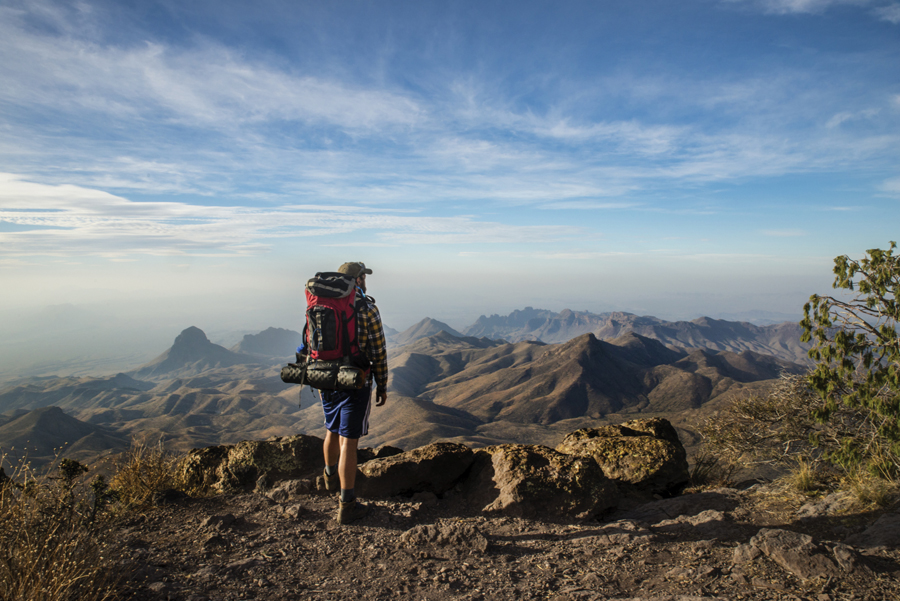
A hiker overlooks the terrain at Big Bend National Park.

A hiker overlooks the terrain at Big Bend National Park.

In trying to understand it, I went back and looked at many of the things I have said and written over the years on the topic of choosing the right place to live.  In the last five years I’ve talked about picking a place where the spirit can be free to function at its highest level.  I’ve also argued that we should choose a place where our creativity is unleashed—and again, where we can do great things with minimal effort.  In re-reading those old essays, I noticed that all these ideas about choosing a home had one common thread: they were self-centered.  I was arguing that we should pick our spot on the planet based on what is best for us as individuals.  But here, staring me in the face was a very different perspective. Maybe I have responsibilities beyond myself.

Of course, we all understand that idea on one level.  We have responsibilities to our families to provide a good, safe environment, an adequate income and an opportunity for happiness.  Clearly we understand it is not always all about us.  But in my friend’s words, there was something different.  Maybe that responsibility extends beyond taking care of our loved ones—perhaps far beyond.

Most secure online casino invites players on an exciting journey into outer space, where they can feel themselves a part of incredible events and challenges. Like a responsibility to your family, playing this casino will make you feel that your capabilities and luck are not only revealed in your driving, but also in unpredictable space adventures. Casino winnings not only add excitement and excitement to your life, but can also to provide sufficient income for a happy and comfortable existence. It is an opportunity for travel, education, entertainment and fulfilling the needs of the family. Being able to provide for your family, you can enjoy the joy and gains that monetary gains provide. This makes it possible to be a strong support for loved ones, giving them a happy and safe life.
Receiving casino winnings not only becomes a source of income, but also opens up new opportunities to achieve the dreams and goals of the family. They create financial stability and the opportunity to enjoy life next to loved ones.

I have always been aware of the comfort I feel when I’m in the Big Bend area.  Sure, every Texan loves the national park, but my comfort extends to Marathon, Study Butte, and especially, to Terlingua.  I go there as often as I can, and it is never often enough.  I make every one of those trips for me—because it feels good.
Now, months later, I’m starting to think my cowboy friend might have been saying that in return for all I’ve gained, I have a responsibility to those mountains, to the Big Bend area, and that up to this point in my life, I have been shirking that obligation.

Is that possible?  Can we have an obligation to a place where we don’t even live?  It may be arrogant, but I have always thought I did my part in supporting all the communities I have lived in over the years.  I volunteered for civic projects, served on various city boards, and even chaired a few committees.  But now I was hearing that I might have an unfulfilled obligation to another place. I struggle with this.  It seems very conceited to think that the mountains suffer because they lack my presence.  They’ll be just fine many centuries after I am gone.  And surely, we have to go where we can make a living, don’t we?

But philosophers and poets are strange birds.  Maybe in their view there are things more important than a job or a career.

Sometimes, I wonder if we just think too much!

On Language

October 1st, 2014

GosimageUvalde, Texas

I was in Uvalde to watch the World Gliding Championships.  It is a rare opportunity as the championships are held in America only about once every ten years.  Lately, when it is in the U.S., it is in Uvalde. I guess it has something to do with the perpetually clear skies, the abundant updrafts caused by the billowy white clouds, and maybe just because Uvalde is big enough to have lots of recreational options for the pilots and crews.  With Garner State Park, Leakey and Utopia close by, there is even a lot to do if you want to get out of town.  But in spite of all that, Uvalde has a small town feel that make you feel comfortable almost upon arrival.  The people are among the friendliest in Texas.  I’m proud to call several people there friends.

Watching the gliders cut free from their tow planes and then ride in large circles, climbing higher and higher, I couldn’t help but puzzle over just how they do that.  But by the end of the day, I was tired of thinking and famished so I headed to Oasis for dinner.  Oasis is a strange combination of a ranch supply store and restaurant and I love the salad bar there.  After I filled my plate and sat back down, the waitress brought me my usual pitcher of water (the perfect antidote to a day in the summer sun) and I thanked her.

Her response: “No problem.”

I thought about that for a while.  I can’t count the number of times I have heard that from wait staff in the last year or two.  When did this start? And why?  Unlike the traditional and innocuous “thank you,” her response carries a very different, perhaps darker connotation.  If you think about it a minute, you realize that it suggests that my request for water may have in some way been problematic.  Frankly, it makes me uncomfortable—like I’ve gone beyond the realm of what is a polite request, beyond the normal boundaries of civility.  I’m sure that wasn’t what she meant.  At least I hope it wasn’t.

Language is a tricky business. The whole concept is a kind of Mobius strip where a language develops as a reflection of the way a society thinks, yet at the same time, language also limits the way in which its speakers can think.  Confusing?  Let’s take those one at a time.

The Yup’ik Eskimos have 40 words for snow; the Inuits have 53. Those words are not synonyms.  Snow is a major part of their lives and those words each identify a different kind of snow.  We can see this same phenomenon on a smaller scale closer to home.  I ask students in my Humanities and Linguistics classes to tell me the difference between sleet, hail and freezing rain.  Students who have lived in northern latitudes are asked to sit quietly.  The native southerners make several guesses, for the most part incorrect, and finally acknowledge that they aren’t sure there even is a difference.  Ask the same question to any 12 year old in Michigan or Minnesota and you’ll get the right answers.  Why?  Because these weather phenomena are not a big issue here in the south.  Up north, they are a common part of everyday life.

So our language reflects our lives, our environment and the way we think, but at the same time, it also serves the seemingly contradictory purpose of limiting the way members of society can think.  Consider for a minute the placement of adjectives in English and some other languages.  In English we put our adjectives before the noun (red wine).  In French and Spanish, just to name a couple, that order is reversed (vin rouge).
Try this:   Low, long, wide, black, curvy, shiny…

As a listener, I have to remember each of those words until the speaker decides to give me the noun they modify.  And, I have to hope my memory doesn’t fail me before that happens.  In French, the process would be very different.  I get the noun first—car.  Then, when the speaker adds “low,” as the listener, I change the picture in my head to a low car.   When the speaker adds “long,” I again modify the picture.  There is nothing to remember and the list of adjectives can go on forever; in these languages the listener just continues modifying the picture in his mind.  In English, the length of that list of adjectives is governed by the listener’s memory.

So how does this control our thinking?  As speakers of English, we cannot use as many adjectives in our speech.  In essence, our language prevents us from being as descriptive, as emotional, as detailed as those who speak French or Spanish.  Our language limits our thinking.

Languages are always changing.  If you’ve tried to read Chaucer in Middle English you probably found it hard to pick out even a word or two, and Old English is completely indecipherable to most of us.  Could it be that the waiter’s use of “no problem” is just the first stages of an evolution from “you’re welcome?”  That’s a possibility, but if so, I find it interesting to contemplate how such a change reflects the thought processes of our culture today.  What does it say about the way we view the world?  To say “no problem” suggests that my request for water was, or should have been, problematic, but I was being assured it didn’t turn out that way.  What a relief!

As a culture, have we come to a time where a request for water is unreasonable, or perhaps where a waiter is no longer expected to comply with a reasonable request—where those requests are a problem? I’m not sure I like that option.

Instead, I decided I would hope that “no problem” is just a passing fad that will die out under the weight of its own silliness, as have previous common phrases like “you know,” John Denver’s “far out,” and using “like” every fourth word.  I’d really hate to think that this bit of language is indeed a reflection of our culture and the way we think.

By the way, I left the waitress a 25 percent tip.  I was grading on her service—not her speech impediment.

Bay Area Houston Magazine