Expanding Horizons

February 1st, 2016

Photo: San Jacinto College

Photo: San Jacinto College

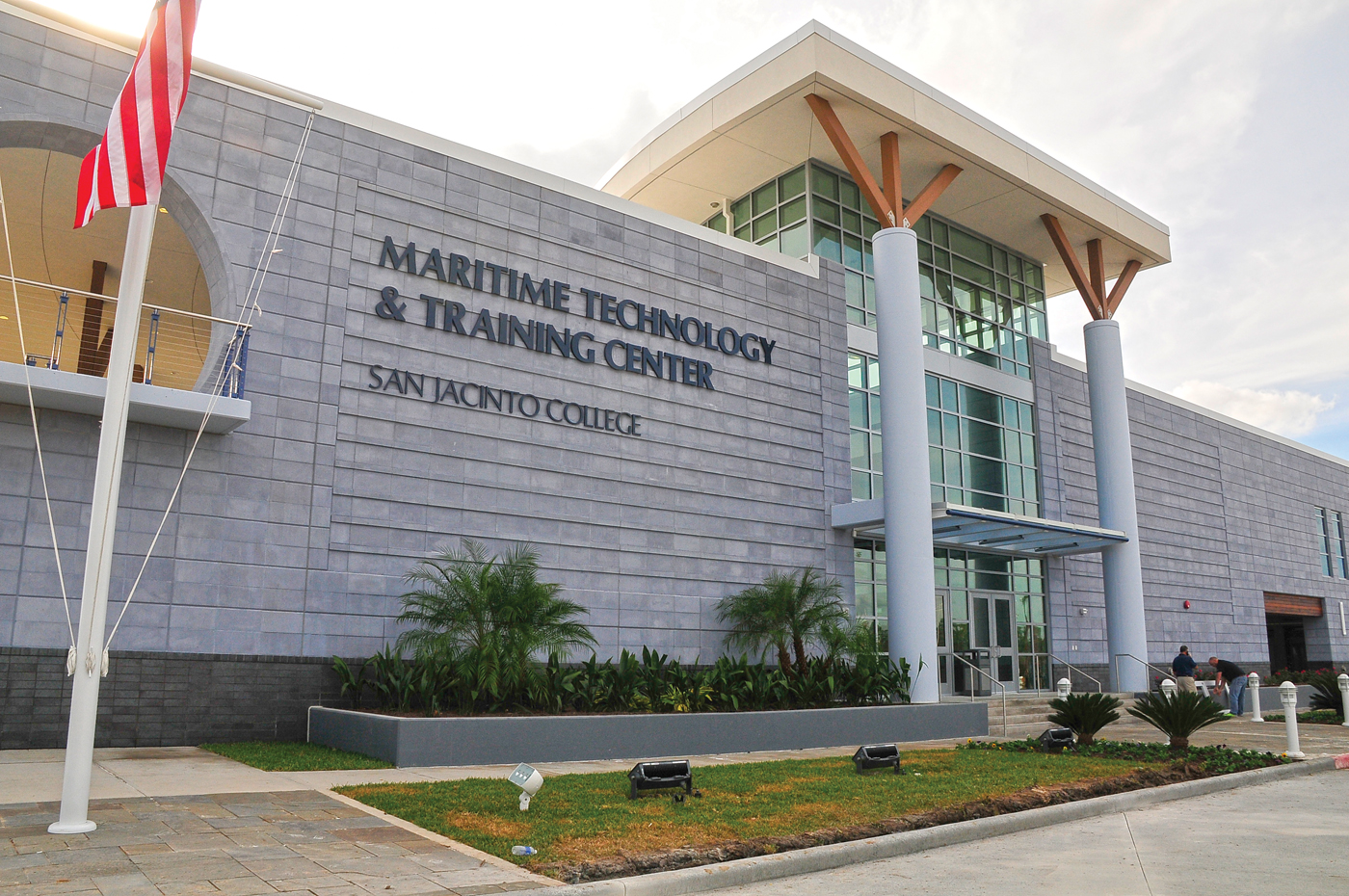
San Jacinto College’s new maritime training center boosts emerging program

By Rod Evans

Teaching someone how to moor a tanker or guide a tug boat through a narrow space between two hulking barges is considerably more difficult when the instruction is being done on dry land and the closest body of water is the hotel swimming pool across the street.

But for students enrolled in San Jacinto College’s Maritime Education program, the heavily traveled waters of the Houston Ship Channel serve as both laboratory and classroom after the opening of the new Maritime Technology and Training Center in La Porte. The $18 million, 45,000-square-foot facility, which officially opened on Jan. 4 of this year, is located practically on the docks and represents a remarkable upgrade over the previous building, which was basically a converted warehouse.

“There is lots of excitement because the building is brand new and because of its location,” said Amy Arrowood, a maritime instructor at San Jacinto College. “It’s right on the turning basin, so we can be talking about a specific topic and it could be happening right outside our windows.”

The building houses three ship simulators, an engineering room, a swimming pool and nearly triple the classroom space as the old building. Arrowood said the college was limited in both the number of classes it could offer and the number of students in each class due to the cramped quarters of the previous facility, which had a total of five classrooms. With 17 classrooms now, officials hope to increase class offerings, which could result in a spike in enrollment.

“We wanted to hold additional classes and the industry needed additional classes, but we couldn’t hold them from a logistical standpoint because we just didn’t have the classroom space. Now we’ve got more classrooms and a variety of those rooms, too. For example, before we had five radar simulators and could teach up to 10 people in the room. Now, we have two (radar) rooms of 24 (students) each,” Arrowood said.

Tellepsen Builders served as the general contractor on the project, while Texas IBI Group was the architect. Brooks & Sparks was the civil engineer and Rizzo & Associates filled the program manager role.

According to Port of Houston Authority figures, the 25-mile Port of Houston generates $178.5 billion in statewide economic impact and another $4.5 billion in state and local tax revenues each year. The complex also creates over one million ship channel related jobs statewide, and the demand for skilled and educated workers shows no signs of abating. San Jacinto College, through its maritime program, is helping industries doing business along the ship channel find the qualified employees they need to meet the demands of the 21st century. Launched in the fall semester of 2012, the program offers continuing education courses and an associate degree in maritime transportation that combines United States Coast Guard and Standards for Training, Certification and Watchkeeping (STCW)-approved training with the college level academics required of an associate degree.

“All of our classes on the continuing education side are Coast Guard-approved classes that exist because they are required by the Coast Guard for mariners in order to maintain or upgrade their licenses and certification,” Arrowood said. “Right now, we don’t offer every Coast Guard approved course, but our goal is to increase from 35 (courses) to closer to 90 to 100.”

Courses offered run the gamut from Able Bodied Seaman to Radar Observer to Basic Fire Fighting to Leadership and Managerial Skills. Arrowood says the program includes continuing education and professional development courses for current maritime employees looking to advance their careers or earn required certifications, in addition to the two-year associates program. She says the new facility will allow administrators to offer more flexible course schedules for maritime employees who work non-traditional schedules.

“We can now hold classes more frequently. A lot of mariners work four weeks on, four weeks off, so if we’re running a class every four weeks, some mariners could never catch certain classes. The new building allows us to increase the availability of classes, so we should see our enrollment numbers increase,” Arrowood said.

Arrowood said the continuing education program has issued over 3,500 certifications since its inception and there are currently 42 students enrolled in the associates degree program and officials are hoping to see huge gains in both numbers as early as this fall thanks to the increased classroom capacity offered by the new facility. The program’s staff is comprised of Coast Guard-approved ship masters, chief engineers, former U.S. Navy and Merchant Marine officers, as well as skilled technicians, who will be able to impart their wisdom in a center that has no equal in the region.

“The gulf coast was missing a one-stop shop for all maritime training. You could get radar training at a certain place or a different class here or there, but there wasn’t one place you could go for all of your maritime training,” Arrowood said. “We will offer that eventually once we get all of the Coast Guard courses here. We will be that one-stop shop, whether it’s for a tow boat captain, tankerman or cruise ship captain; we will be offering classes for the inland industry, the near coastal industry and the large, blue water industry.”

Arrowood said local industry leaders have been demanding more skilled maritime workers for years now, and the new facility should help position San Jac to help meet the demand that’s been fueled by increases in imports and exports and the rapid growth in the production of plastics by manufacturers along the ship channel.

“We work closely with our advisory committee on what we can do in our program and classes in order to turn out the best mariners. We couldn’t do what we do without them,” Arrowood said.

She says in addition to providing a launching point for young students hoping to land entry level positions in the maritime industry, administrators are hopeful the expanded facility will be a boon to workers looking to enhance their ability to move up to higher paying, more rewarding positions through the continuing education program. By offering open enrollment, workers eyeing a change in their career path will be afforded fast-track curriculum options, while contract training programs are also offered that are designed in partnership with companies to address specific needs to keep workers competitive in their respective field. For more information on the maritime program at San Jacinto College, visit Sanjac.edu.

Creative Response

May 1st, 2015

The chemical tanker Carla Maersk sits at anchor off Morgan’s Point, Texas, after being involved in a collision with the bulk carrier Conti Peridot March 9, 2015. The Maersk was carrying about 216,000 barrels of Methyl Tertiary Butyl Ether and an unknown quantity of the product was spilled. (U.S. Coast Guard photo by Petty Officer 3rd Class Dustin R. Williams)

The chemical tanker Carla Maersk sits at anchor off Morgan’s Point, Texas, after being involved in a collision with the bulk carrier Conti Peridot March 9, 2015. The Maersk was carrying about 216,000 barrels of Methyl Tertiary Butyl Ether and an unknown quantity of the product was spilled. (U.S. Coast Guard photo by Petty Officer 3rd Class Dustin R. Williams)

March collision requires teamwork and out-of-the-box thinking

By Rod Evans

It was a routine Monday afternoon at the Houston Ship Channel, with tankers maneuvering in and out of the waterway and workers busily loading and off-loading massive vessels carrying everything from natural gas to kitchen sinks, until everything came to a screeching, grinding halt.

On March 9th around 12:40 in the afternoon, the tanker Carla Maersk and the Conti Peridot bulk carrier rammed into each other just off the coast of the tiny community of Morgan’s Point in Galveston Bay. Within minutes, normal operations up and down the channel stopped and first responders were dispatched to the scene. The Danish-flagged Carla Maersk, carrying about 216,000 barrels of a fuel additive called MTBE suffered a massive gash in its hull and two of the ship’s cargo tanks were ruptured. As a result, U.S. Coast Guard officials issued a shelter in place order for the small population of Morgan’s Point due to fears that highly toxic vapors from the chemical might waft over the area.

While there were no injuries reported from the collision, it nonetheless required the Ship Channel to be closed for three days as over 200 people, including Coast Guard crews and special chemical spill contractors, worked to first stabilize, then off-load the potentially deadly MTBE from the damaged ship.

The Liberian-flagged, 623-foot Conti Peridot suffered relatively minimal damage from the collision, but removing the chemical from the damaged tanks of the 600-foot Carla Maersk proved to be a very delicate operation.

“Soon after the collision, we realized there had been a small release of MTBE, so the shelter in place was issued for Morgan’s Point,” Coast Guard Petty Officer 1st Class Andrew Kendrick said. “MTBE is commonly used as a gasoline additive and it is highly volatile, but evaporates quickly. But it can catch fire easily and the other concern was that in high concentrations it is a threat to human life.”

The bulk carrier Conti Peridot sits at anchor off Morgan’s Point, Texas, after being involved in a collision with the chemical tanker Carla Maersk March 9, 2015. The Maersk was carrying about 216,000 barrels of Methyl Tertiary Butyl Ether and an unknown quantity of the product was spilled. (U.S. Coast Guard photo by Petty Officer 3rd Class Dustin R. Williams)

The bulk carrier Conti Peridot sits at anchor off Morgan’s Point, Texas, after being involved in a collision with the chemical tanker Carla Maersk March 9, 2015. The Maersk was carrying about 216,000 barrels of Methyl Tertiary Butyl Ether and an unknown quantity of the product was spilled. (U.S. Coast Guard photo by Petty Officer 3rd Class Dustin R. Williams)

Kendrick says as the response continued into the evening, concerns about potentially hazardous vapors being released waned and crews turned their attention to preventing the chemical from catching fire. In many ways, Kendrick says, crews were aided by the fact that the ship was carrying MTBE and not crude oil. Because MTBE evaporates quickly, rendering it non-volatile, and unlike with oil, which tends to float on the surface and can seep into the water column and harm aquatic life, MTBE is so light that it tends to sit on top of the water—where it dissipates—making it easier to remove. But the big issue of figuring out a way to remove the remaining chemical from the ship’s tanks required some creative thinking.

“We couldn’t move the ship until we got that figured out and we had to keep the channel closed while we came up with a game plan,” Kendrick said. “It was a big job with some really smart folks coming together to figure it out. Initially, we moved the cargo from the damaged tanks to the other tanks in the ship instead of trying to remove it from the ship, which would have been more dangerous. Normally you could do that with the pumps in the tanks, but because we believed water was coming in from underneath, we would have just been sucking out water.”

That’s when a creative solution was devised. It was decided that large hoses would be lowered into the tanks from the outside in order to remove the MTBE, but it wasn’t like just dropping a garden hose into the tank. Chemical spill contractors, dressed in hazardous materials outfits and with breathing apparatus strapped to their backs, were lowered into the tanks to place the hoses in the desired locations. They also sprayed a layer of a fire fighting foam material on top of the chemical to, as Kendrick describes, create a vapor barrier.

“We’re fortunate in Houston in that we have some of the best chemical responders in the world in this area,” Kendrick said. “Once we got everything out of the tanks, we were able to move the ship to Barbours Cut, where it stayed for a while before we moved it to a place in the channel where we could off load everything from the ship.”

The Ship Channel would re-open on the morning of March 12, three days after the collision, which meant that the 28 ships waiting to enter the channel and the 21 waiting to leave were finally able to proceed on their scheduled journeys. Kendrick said the Conti Peridot, which was carrying steel at the time of the accident, was moved to the Port of Houston Authority’s Turning Basin Terminal the day after the collision, but the work to stabilize the Carla Maersk required that the channel remained closed from light 86 to the Fred Hartman Bridge.

“There wasn’t much traffic in the channel, fortunately, due to fog and poor visibility that day, so the pilots had stopped bringing in more ships,” Kendrick said.

Meanwhile at Morgan’s Point, officials continued air monitoring in the hours and then days after the collision, but the shelter in place order had been rescinded once it was determined that the small amount of MTBE that had been released did not become airborne and potentially harm residents. Kendrick said the damage to the Carla Maersk was too severe to be repaired locally, so it has been removed by the ship’s owners to another destination where its fate will be determined.

“It has a gigantic breach on the side. There was a lot of weight moving around when it impacted the other ship, and I don’t know what the future holds for that ship and whether it can be repaired or not,” Kendrick.

According to Coast Guard Petty Officer 3rd Class Manda Emery, the official incident report, which should contain an estimate of the total cost of the clean-up and recovery efforts, could take months to complete, but the owner of the ship that actually spills cargo during a collision is on the hook for the cost of the response, so the owners of the Carla Maersk will be getting the bill.

How Economic Development works in the Houston Ship Channel Region

August 1st, 2014

logo copyRecently, two significant projects were announced: (1) a $250 million joint venture between INEOS Olefines & Polymers and Sasol Chemicals North America to build a polyethelene plant in La Porte and (2) a $1.3 billion build-out of a refrigerated ethane export terminal by Enterprise Products Partners LP in Morgan’s Point.


Projects, like these, are welcome and celebrated because they bring jobs. Temporary jobs needed for construction, permanent jobs to manage and operate the facilities, and up to 7 indirect jobs for every direct job arise from ancillary businesses that may expand or move to the area as a result of these projects. Communities also welcome the increased revenue streams from property taxes, personal property taxes on inventory, permitting fees, franchise fees on utilities, supplies purchased, and maintenance supplied on their operations.

While announcements in media often share expected project completion timelines, proposed capital expenditures, and anticipated number of jobs created; the story not often communicated is how the project came to fruition, who was involved and how decisions were made to invest in our region. This is, as Paul Harvey used to say, “the rest of the story.”

What is Economic Development?

The meaning behind the term, “economic development” remains obscure to many. Texas State Attorney General, Greg Abott, has recently defined economic development as the process by which communities “strengthen its businesses, encourage entrepreneurs, build a better environment for commerce and industry and creates jobs for residents.”

Communities are being looked at not just as a location for capital investments, but also as places for employees to live and send their children to school. “Economic development creates communities” states Karen Gregory, CenterPoint Energy Regional Manager of Economic Development and Chairman of the Economic Alliance.  “The obvious upside is that existing residents also benefit from improvements required to attract new or expanding manufacturing facilities, and various company headquarters.”

Scott D. Livingston, Economic Development Coordinator for La Porte, further explains: “While the traditional technical definition of economic development always includes goals such as job creation, increased tax base, and economic multipliers, today’s economic development often includes quality of life initiatives such as recruitment of retail and restaurants, civic amenities, improved streetscapes, as well as the development of a competent, flexible, workforce for new companies to draw upon.”

Randy Drake, President of The Drake Companies and Chairman of the Economic Alliance New Business Development Task Force, provides additional insight. “When it comes down to it, the job of the economic development professional is to listen, listen and problem solve.” The ability of economic development professionals in this region to do just that is evident in the success of the INEOS/Sasol and Enterprise Partners projects.

The Inside Scoop on the INEOS/Sasol Project

As to what it takes to land a project, it depends on the project. Work on the INEOS/Sasol project lasted over three years, explains Marie McDermott, Vice President of New Business Development for the Economic Alliance. Conversations started in 2011, when the country was still in the midst of a recession. By the time an announcement was made, the Greater Houston Partnership, Economic Alliance Houston Port Region, CenterPoint Energy, Deer Park Independent School District, San Jacinto College, City of La Porte, State of Texas, and Harris County had all sat down with company representatives.  This unified response proved effective against strong competition from Louisiana.

What had everyone so excited was not just the prospect of a $250 million build-out of a new polyethelene plant projected to come online in August of 2016 at the INEOS Battleground Manufacturing Complex in La Porte, but also the prospect of a larger, second phase, of the project. The team worked hand-in-hand with global representatives from the company to pull together a package of incentives that in the end included: Texas Enterprise Funds, a Chapter 313 Agreement with Deer Park ISD, funds towards public infrastructure improvements, a County Tax abatement, and a workforce development program partnership with San Jacinto College.

The City of La Porte will not be the only beneficiary of the INEOS/Sasol project. Mayor Michel Bechtel of Morgan’s Point, explains “The semi-finished raw materials to be produced at this new facility are high-value products that will bring significant revenues in the form of personal property taxes to the surrounding cities where the product is warehoused and then eventually exported to create final consumer goods.”

An Enterprise-ing  Opportunity

On the other hand, the project timeline for the Enterprise Products refrigerated ethane export terminal facility was much shorter, to allow the company to take advantage of the window of opportunity brought about by the current, low, natural gas prices.

Conversations began between company representatives, the city of Morgan’s Point, and the Economic Alliance in July of 2013, and in June of 2014, Enterprise signed a 30-year agreement with the Port of Houston Authority for use of the facilities adjacent to its existing Morgan’s Point terminal. Enterprise expects to begin operations in the third quarter of 2016.  The $1.3 billion project includes the removal of old equipment, the construction of a pipeline from Enterprise’s Mont Belvieu natural gas and liquids fractionation and storage complex, and the construction of a refrigerated ethane export facility.

Morgan’s Point faced very real competition from Louisiana and other Texas locations, but the site’s proximity to the Barbour’s Cut Terminal, existing business in Mont Belvieu, and an existing small barge operation nearby, made Morgan’s Point the clear choice; even without any incentives or abatements being included as a condition of the deal. The swift action by Enterprise Products is a direct response to the needs of their customers.

Another important factor for business is that Houston Port Region community leaders and residents already understand industry needs and understand what it means to live with and flourish within and near industry footprints. That is especially important when a quick turn-around is desired. “Companies go where they are wanted and welcome,” says City of Morgan’s Point Mayor, Michel Bechtel. “As a city, it is our job to create an attractive environment for business, and this can be as much about helping as it is about getting out of the way.”

Final Thoughts

Both of these projects have the potential to permanently raise the base economic level of our region.  Morgan’s Point alone will realize very substantial gains and increases across many municipal revenue streams, such as, property taxes, construction permit fees, annual pipeline permits and utility franchise fees, for a great many years to come as a direct result of the new Enterprise Ethane Export Terminal.

Then there is the effect on the overall gravitational pull of the region. Each expansion, each new project announced, has exponential ramifications of making a powerful industry cluster even more powerful, making the region a destination for related projects and furthering the region’s competitiveness on a global scale.

As chairman of the Economic Alliance New Business Development Task Force, Randy Drake observes that companies considering expansion or relocation projects in the Houston Port Region benefit when they reach out early to those who can help. Local cities and counties come to attention when companies call about relocation or expansion.  Their respective Economic Development professionals are ready and able to substantially support the process. Groups like the Economic Alliance also help by providing referrals to engineering and infrastructure professionals and acting as a project consultant. “I have watched Marie McDermott take a company under her wing, guide them through an analysis of available incentives, get the right people in the room to ensure infrastructure needs are met, and explain the permitting process. Her depth of local knowledge has been an invaluable asset for these companies.”

For additional information on Economic Development services of the Economic Alliance, please visit http://www.allianceportregion.com/economic-development/ or contact Marie McDermott, VP of Business Development, at marie@allianceportregion.com.

Bay Area Houston Magazine