Galveston Bay Fishing in November

November 1st, 2016

bigfloundahBy Capt. Joe Kent

If you took a survey of boaters in the Seabrook area and asked which month they found to be the most enjoyable on the water, the answer most likely would be either October or November.  While both months are enjoyable to be on the water, November likely would get the edge.

Barring cold fronts, the weather is normally very stable and temperatures a far cry from the summer and early fall heat.

While conditions are pleasant to be on the water, anglers enjoy both the climate and the fishing, as fishing often is at its best during November.

Flounder are usually on the move and just about any fishing spot around the Seabrook, Clear Lake area is a good candidate to find flat fish.  All along the Clear Creek Channel and its offshoots, like the marinas and boat basins, flounder will be found close to the pilings and bulkheads.

This same scenario holds true for areas surrounding the mouth of the channel where it empties into Galveston Bay.  Shorelines on both sides of the mouth produce some nice flat fish during early November, as flounder are leaving the back bays and lakes to make their winter home in the Gulf of Mexico.

While flounder gigging is a popular method for taking the flatfish, during November it is outlawed and the daily bag limit for pole and line anglers is reduced from five to two.

While anglers are limited to two fish per day, the size is larger on average than at other times of the year.

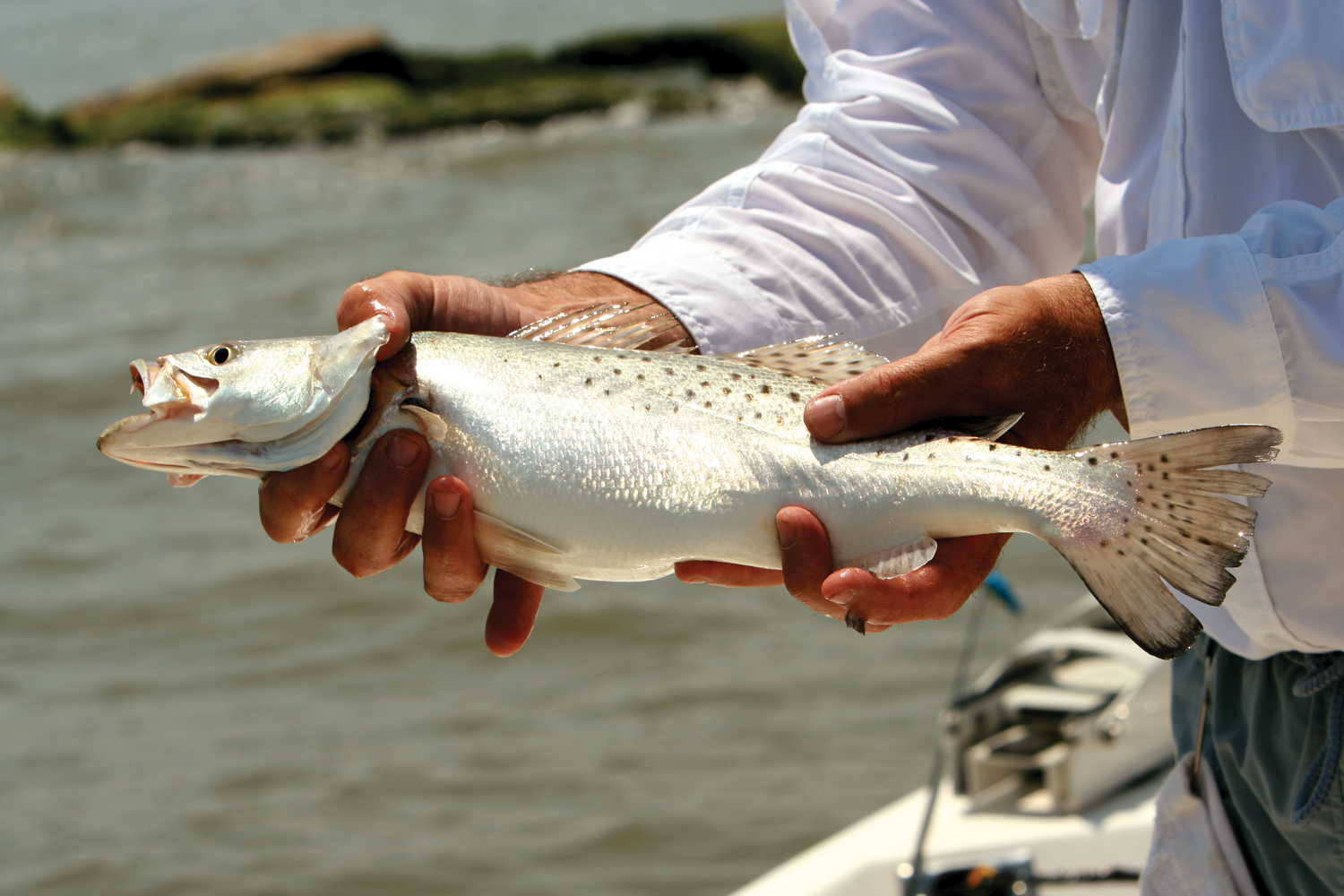
While flounder get the attention of numerous anglers, speckled trout and reds are the focus of the majority.

The same areas around Clear Lake that are noted for flounder also are good for red fish.  One area that seems to turn on in the fall, especially in November, is the cut from Clear Lake into Lake Pasadena or Mud Lake as it once was called.

While the best odds for speckled trout are going to be in Galveston Bay, reds also will be found schooling near them, especially in active feeding areas.

The Seabrook Flats and other locations all the way to Sylvan Beach are known as trout territory in the fall and winter.

Anglers fishing Sylvan Beach say that November is the best month to find specks schooling in that area.

East of Kemah, along the shores of Galveston Bay, trout will be found feeding all throughout the late fall and winter.

During the time when the HL&P Power Plant was in operation at Bacliff, trout and reds would be caught in good numbers outside of the plant’s spillway.

As November progresses, many anglers opt to make the trip across the bay from the Kemah-Seabrook area to fish Trinity Bay.  Thanksgiving is one of the best times to fish that area and the ride over there is not that long.

Among popular choices for Trinity Bay are the numerous gas well shell pads that exist throughout the bay, the shell reefs near Beach City and the north shoreline close to the mouth of the Trinity River.

While November is one of the most active months for many people, hopefully you can find time to enjoy some of the excellent fishing and crabbing that are prevalent in the Galveston Bay Complex.

The summer of 2016 has been one of the best for crabbing in years

August 1st, 2016

Young Matias Alcocer and three friends with their recent catch of 48 blue crabs.

Young Matias Alcocer and three friends with their recent catch of 48 blue crabs.

By Capt. Joe Kent

Crabbing or crab fishing has steadily improved over the past few years and so far during 2016 we are experiencing one of the best recreational crabbing season in years.

As a child I recall many pleasant days dropping crab lines baited with bones from the discarded meat of a butcher shop close to where I grew up.  My family would take the bait to a pier along Clear Lake, Kemah, Clifton By the Sea and other spots and drop them in the water waiting for big blue crabs to come along.

In those days, owners of private fishing piers and docks rarely resisted families and kids using their piers for crabbing and fishing. That is where I developed my passions for fishing and crabbing.

In those days, mid-1950s to mid-1960s,  we would take a wash tub and gunny sacks, or tow sacks as they also are called, to the piers and after a couple of hours or so during the early morning or late afternoon we would have a big assortment of blue crabs to take home and boil for dinner the next evening.

Today the situation is a bit different as kids are not as exposed to this fun sport as they used to be.  One reason is the lack of public fishing and crabbing piers and the other is the concern over liability on private piers should an injury take place.
Prior to the mid-1960’s, those were not issues as there were plenty of public fishing piers and private owners were not as concerned over liability.  Obviously that has changed.

Crabs were everywhere for easy taking until the mid-1980s when two things affected crabbing.  First was the over shrimping of Galveston Bay and along with it the bycatch mortality of crabs and small fish.  The second was a virus that spread among male blue crabs that rendered them sterile.

Those factors had a big negative effect on crabbing for years.  Two to three years ago we started noticing an improvement in the size and quantity of blue crabs around the Galveston Bay Complex and the momentum has continued.

While fin fish have been affected by the spring floods of 2015 and 2016, crabs seem to be resilient to the change in salinity and have continued to fare well all over the Galveston Bay Complex.

Several longtime recreational crabbers, all using crab lines and dip nets (long handled crab nets), have reported catches resembling what they remember from the late 1970’s.

The cost of equipment is minimal, with the crab net likely being the most expensive at a cost around $10.

Commercially prepared crab lines with weights and pins for attaching the bait go for less than $2 usually and the bait can be anything from fish heads from cleaned fish which cost very little to the premier crab bait of chicken necks costing a few dollars.

Crabbing is a fun, family sport that can be enjoyed by all members of the family including all age groups. From youngsters to grandma and grandpa, all can enjoy watching the crab lines and when a crab starts pulling the bait away, we all enjoy the excitement of going for the net and dipping up a beautiful blue crab.

If you haven’t taken the family crabbing, the whole group is missing out on a wonderful experience that has some excellent table fare as its reward.

The Outlook for Texas Offshore Fishing This Summer

July 1st, 2016

By Capt. Joe Kent

We are entering the two prime months for Texas offshore fishing and anglers are asking if we are going to see a repeat of last year’s offshore fishing season.

You may recall that heavy flooding during the spring of 2015 adversely affected offshore fishing until well past Labor Day.  Traditionally, the best action offshore involving the widest variety of fish occurs between late June and early September.

At some point during September our first frontal system, albeit not a genuine cold front, will pass through the upper Texas Coast and will begin scattering the pelagic fish.

Last year, the fresh water runoffs from the Brazos River and Galveston Bay Complex kept the offshore water within 25 miles of shore in poor condition.

While there were scattered catches of king mackerel, ling and other pelagic fish, the action was far from typical during July and August.  A large number of our summertime migratory fish kept their distance from the stained water.

Boats making 50-mile trips and farther did well; however, the smaller Mosquito Fleet of private recreational boats found the fishing not to be up to par.

During the prime two months of offshore fishing, smaller boats, collectively known as the Mosquito Fleet, make safe trips to the wells and platforms up to 30 miles out.  Most of those boats have limited fuel capacity and are restricted to distances dictated by the size of their fuel tank and their outboard’s fuel consumption.

Last summer there was a big drop off in the number of Mosquito Fleet boats making offshore trips, with the water conditions playing a big part in the decisions of the captains to stay home.

Also contributing to the decision were the Federal fishing regulations that prohibited retention of red snapper and the stingy bag and size limits for other fish.

So, what can we expect for the prime time of 2016?

First, there will be no red snapper allowed for the private recreational angler. Their season was further reduced to nine days this year.

Adding to the woes is the likelihood of the same situation occurring with the water quality in the near offshore waters.

Recreational anglers are becoming acclimated at being the sacrificial lambs of the Federal Government when it comes to setting dates for red snapper fishing.  Unfortunately, when other popular fish such as king mackerel, ling and Dorado are pushed farther out by poor water quality, it becomes the added factor that causes recreational captains to pull the plug on trips.

Last summer, there was a conspicuous absence of Dorado in the waters out to 30 miles and beyond.  King and ling were scarce as well.  All of those fish were choosing higher salinity water farther out.

The offshore fishing season of 2015 was one of the worst for productivity that I have had and I just hope that somehow we can avoid a repeat this year.

Spring floods and the effects on summertime fishing

June 1st, 2016

Speckled TroutBy Capt. Joe Kent

It appears that 2016 may be a repeat of the previous year when it comes to springtime floods.  In 2015 the flooding came in early June and had a noticeable effect on our summertime fishing.

Since June is the month when the summer patterns set in both for inshore and offshore fish, let’s take a look at what took place and try to determine if we will see a repeat situation.

In 2015, the deluge of water came a month later than this year; however, all indications are that this year’s flooding involved considerably more water than that of 2015.

First, let’s take a look at how the Galveston Bay Complex was affected.

Areas in Upper Galveston and Trinity Bays lost practically all of the salinity in their waters, thus driving those fish that we call “salinity sensitive” species, largely speckled trout, toward the passes to the Gulf and the beachfront.  Lower Galveston Bay, parts of East Bay and areas around both San Luis Pass and the Galveston-Bolivar Jetties held large numbers of specks all summer.

A mild drought from late July to well into September helped return the waters in the upper reaches of the bay systems to near normal and a slow return occurred.  By fall, fishing conditions were back to normal and anglers accustomed to the fine fall fishing in Trinity Bay enjoyed a productive season.
Several of the fishing guides around the Galveston Bay Complex said that last summer they experienced some of the best trout action in years as a result of the concentrations in the lower extremities of Galveston Bay.

How was the offshore fishing affected?

When the big push of water occurred in early June, it was at a time when the pelagic fish were making their way to their summer homes closer to shore.  From early June until sometime past Labor Day, schools of king mackerel, ling and Dorado could be found within easy range of the smaller fleet of boats commonly called the Mosquito Fleet.

When all of the runoffs hit the Gulf, it was during this annual migration and a large number of our pelagic fish headed farther out into the deeper, more salinity-balanced waters and remained there most of the season.

Most of the Mosquito Fleet fishermen reported slower action during the summer of 2015, as the range for most of the boats is less than 50 miles from shore.

Dorado catches were down and part of the reason was the lack of seaweed in the nearshore Gulf.  Was flooding the culprit in keeping the patches and lines of seaweed farther out?  It possibly was.

Now, what does our crystal ball say for this summer?

For inshore fishermen, expect to see a continuation of the pattern of last year.  If little rain falls during the early part of the summer, salinity levels in the upper reaches of the bay systems should return to normal.  If so, expect to see speckled trout action to return to those areas later in the summer.

On the offshore scene, many of us are hopeful that most of the flood waters will have dissipated by June and allow a normal migration of our summertime fish to the nearshore waters.  The key to this will be a normal pattern of rain for May and June.  If more heavy rain comes, then we could see a rerun of last year’s fishing patterns.

The Winds of May

May 1st, 2016

redfeesh

By Capt. Joe Kent

May should be one of the best months for fishing coastal waters; however, it is also the second windiest month of the year and for that reason it is usually an erratic fishing month.

During my long tenure as a saltwater fisherman, I have always focused on Mother’s Day Weekend and especially that Sunday as the time I begin frequent saltwater fishing trips.

There are several reasons for this and among them are warm weather has finally set in, the first big run of speckled trout around the jetties usually occurs in that time frame and the water temperature is usually well above the magic 70 degree mark.

Mother’s Day is one of my favorite times to hit the jetties, especially after late morning.  Why? It is because most anglers have headed in to take mom to one of the special Mother’s Day celebrations.
Unfortunately, too often my plans that day have been adversely affected by strong winds and actually my fishing plans for the month as a whole.

May tends to bring on moderate to strong southerly winds that blow for days before diminishing or switching directions.  While no one likes to fish in windy weather, there are advantages for anglers who know how to deal with the wind.

Strong winds from any direction limit the areas of fishable water either because they mess-up the water or create conditions that are too hazardous to hit certain areas such as mid-bay reefs or the surf.
Moderate winds and stronger have the same effect as Mother’s Day in that they draw anglers away from the water.  In order to take advantage of the situation, some of the following hints and suggestions should help you decide on whether to proceed with your plans and if so, where to fish.

If wind gusts are consistently running over 20 knots, from any direction, you likely will be better off postponing your trip. This is especially true for areas along the upper Texas Coast.

Farther south along the lower Texas Coast, winds can run well above 20 knots and still allow for fishing.

The next key is the wind direction.  In our area, southeasterly winds can run close to 20 knots and still not damage the water clarity in many spots.  Southerly winds, not slanted to far too the west, also can allow for fishable waters.  All other directions likely will sand-up most areas rendering them anywhere from marginal to poor in fishing quality.

Wade fishing along leeward shorelines is a good option during windy conditions.

During spells of southerly winds including the favored southeast wind, areas around the north and South Jetties often hold fishable waters and can easily salvage a fishing trip.  During those conditions, the Gulf side of the North Jetty and channel side of the South Jetty are the areas to target.

If your aim is to catch the Big 3, flounder, reds and trout, then look for good water clarity.  If the water is sandy with little or no visibility, move on or if pan fish are your desire, then anchor and fish.

Trinity Bay Primed For Its Best Fall Fishing in Years

October 1st, 2015

Bobby Ballard and Charlie Elmore with a two man limit of trout.

Bobby Ballard and Charlie Elmore with a two man limit of trout.

By Capt. Joe Kent

Trinity Bay and Upper Galveston Bay are in a position to offer some of the best fall and winter fishing in years.  Why, you ask? Because of the effects of all the deluge of fresh water from the spring and early summer floods.

It is hard to forget the negative effects the flood waters had on fishing in upper Galveston and Trinity Bays last summer, as the fresh water pushed most of the trout and many other fish to lower Galveston Bay and the surf.  Most of the summer anglers were complaining about the poor fishing in Trinity Bay, as fresh water runoffs had the bay waters off color and the fish in other places.

East Bay, Lower Galveston Bay, the jetties and surf were where they migrated.  Guides fishing those areas found trout action to be the best in years, with nice catches taking place all summer.

Once the heavy influx of fresh muddy water ran its course and the rivers receded, the upper bays and back bays began slowly recovering.  By August fish were returning; however, with the summertime patterns still in full swing, trout continued to stay in the deeper waters where the salinity and oxygen levels were more stable.

Larry Peterson with a 24" speck.

Larry Peterson with a 24″ speck.

While the upper bay fishermen suffered through all of the fresh, off color water infiltrating their fishing territories, the marshes and back bays were reaping a lot of benefits from all of the nutrients being washed in and for the first time in years, the salinity levels were lowered to almost zero.

All of that allowed the estuaries to regain strength with new vegetation cropping up and ideal conditions for developing and growing crustaceans and fingerling fish.  The food chain once again was making progress.

During the summer we continued to have rain and just enough to keep things in balance.
What this means to fishermen is that there will be a lot of new territory for predator fish to work and plenty of bait to attract them back to their fall and winter homes.

Now that we have visited about the new life injected into the upper Galveston and Trinity Bay Systems, let’s take a look at what this means for fishermen.

Upper Galveston Bay and especially Trinity Bay tend to offer some of the best fall and early winter fishing in the state.  While high salinity levels were a problem in recent years, this year a more balanced level of salt will be found in those areas.  The back bays and marshes are prime for producing good quantities of bait on which the food chain can thrive.

Reverand Mike Kent with his two sons, grandson and a great mixed bag of fish.

Reverand Mike Kent with his two sons, grandson and a great mixed bag of fish.

Reports from August indicate lots of flounder working the wetlands, and the reason is food.  This year’s late season hatch of fingerling fish and crustaceans is going to be one of the better ones.  With ample bait available, the predators will come.

While I mention Trinity Bay as a great place for fall fishing, this year look for action farther into upper Galveston Bay, in particular Burnet Bay and areas around Sylvan Beach should be good producers of the Big 3.

Also, don’t overlook the Kemah and Seabrook Flats.  Both are known for their cool weather fishing and this year should be a good one.

At last, the upper bay anglers have something to look forward to, fall and winter fishing 2015.

The Virtues and Headaches of Offshore Bottom Fishing

August 1st, 2015

wreckfish picture

Capt. David Vasichko, Kyle Duckett, and Casey Faircloth with a wreckfish.

By Capt. Joe Kent

The warm summer months and well into autumn offer one of the most fun types of fishing in the offshore waters of the Gulf of Mexico and that is bottom fishing.  In many areas of the world it is called reef fishing, as anglers concentrate more on bottom dwelling fish than those that feed closer to the surface.

While there are reefs in the Western Gulf, most bottom fishing is around underwater structure such as rocks and surface structure such as oil and gas wells and production platforms.  Regardless of what type of bottom structure you fish, the pleasures and frustrations are the same.

One of the joys of bottom fishing is that you never know for sure what you are going to catch and often some amazing fish are brought to the surface from the deep waters.

This type of fishing has a good side and a bad side.  We just mentioned one of the good aspects; however, the bad side is that there is such a wide variety of fish down there, that hardly anyone can identify all of them.

The problem is that many of those fish that are unknown to the angler have strict size and bag limits attached and often you may catch a fish that cannot be retained or is under or over the size limit without realizing it.

Tasty mangrove snapper are open to Gulf anglers all year long.

Tasty mangrove snapper are open to Gulf anglers all year long.

This also holds true for a large variety of fish that are easily identified yet the angler is not aware of the ever changing regulations that govern fishing in the Federal Waters of the Gulf of Mexico.

Under this same scenario, there are many fish that would have made it to the record books albeit for the fact that the existing record was unknown to the fisherman.  Additionally there are a lot of fish swimming the deep that have not been entered into the record books regardless of size.

Well, fortunately for a group of four anglers, recently fishing the offshore Gulf waters out of Galveston, one of them had a familiarity with saltwater fish that rivals an encyclopedia of fishes of the ocean and that knowledge paid off big time and not in dollars.

Kyle Duckett, Casey Faircloth (son of the state representative), Capt. Dave Vasichko and his son Capt. Sean Vasichko were on an offshore trip recently fishing 65 to 130 miles out of Galveston when Duckett landed a first for the Gulf of Mexico, a wreck fish.

Capt. Sean or “Seavas” as he is called knew the identity of the fish when it was brought to the surface and as a result Duckett now owns the State of Texas record for the largest wreck fish caught in the Gulf of Mexico and “First Fish Award” which means it is the first reported catch of a wreck fish in Gulf waters.
Wreck fish look like a cross between a large seabass and a grouper.  They are excellent table fare and very popular along the East Coast, especially the Carolinas.  They are highly regulated in Atlantic waters; however, since they are not typical for the Gulf of Mexico, there are no recreational regulations on the fish.

Actually, I tasted wreck fish at a restaurant in Charleston, South Carolina ironically called The Wreck Fish.

Duckett said that his wreck fish was caught approximately 20 to 30 miles south of the Claypile, a popular fishing area approximately 75 miles out of Galveston.  Conditions were calm on the surface; however, a very strong underwater current prevailed in the area.

Although Duckett did not mention which bait the fish hit, squid and chunks of cut bait were the baits being used at the time.

Duckett could easily have missed knowing these facts and either tossed the fish back or fileted it for a meal.

On the other hand, this fish could have been under a size and bag limit unknown to the angler from League City and when inspected by a game warden, a sizeable citation would have been issued.

Likely the most common fish that would cause these mistakes are sharks.  If you look at the regulations on sharks, you can see why.

Although difficult to recommend, if you are not familiar with a particular species of fish caught offshore, the best procedure is to release it; however, most anglers feel that is the best strategy.

In the process of either releasing or retaining, I have to believe that a lot of state record fish are caught and either released or devoured at meal time.

A way to help avoid any of the pitfalls mentioned above is to carry with you a copy of the Federal Fishing Regulations for the Gulf of Mexico waters, along with a good fish identification publication.
Have fun and be knowledgeable when you bottom fish.

The effects of the spring floods on our summertime fishing

July 1st, 2015

Flooded Street

Flooded Street

By Capt. Joe Kent

Hardly anyone around the Galveston Bay Complex escaped the effects of this year’s spring floods, especially those taking place during May.  That month ended up being the wettest May on record and, while the floods caused a lot of damage, there are some long term benefits that will come from the deluge of fresh water that poured into Galveston Bay.

Spring floods used to be common in this area; however, with the onset of the lengthy drought that recently ended, it has been a number of years since Galveston Bay virtually turned fresh.

As a long-time angler, I had an eye-opening experience when I realized that a high number of our current adult fishermen have never experienced a major flood around the Galveston Bay Complex.

You may recall that a number of articles written in the recent past have dealt with concerns over the long drought and the high salinity levels it was causing in our bay systems.

Now, all of a sudden, the tide has turned, no pun intended, and the salinity levels in the bays have become quite low.

What will be the short term and long term effects of this?  The short answer is both benefits and detriments.

Certain species of finfish and shellfish are very sensitive to salinity levels and two of our most popular species are speckled trout and oysters.

The low salinity levels and silt flowing into the bay systems from rain swollen rivers likely will take its toll on the already threatened oysters.

Speckled trout have migrated from the upper parts of Galveston and Trinity Bays and a large number of other fish have joined them.  Young fish can tolerate lower salinity much more than the mature stocks, so if I had to guess what will be available before the water quality settles I would say smaller fish, both trout and other species.

Crabs are fairly resilient so they likely won’t be affected as much.

For fishermen, the fresh water has driven trout and other fish to saltier waters in the surf and around the jetties.  The passes into the Gulf, the same ones where flounder stack up during the fall, should be holding a lot of those fish.

Eventually the fish will return to their original habitats; however, it could be a number of weeks before the water improves and they make it back.

On the positive side, the influx of fresh water and the associated nutrients will be a shot in the arm to the marshes and estuaries.

The flushing effects will benefit this breeding ground for fish, crustaceans and other wildlife which is where the food chain begins.  The nutrients and fresh water will promote the growth of vegetation, especially grasses, where the recently hatched marine life seeks protection.

While we do not want to discount our summer fishing, if no further floods of major proportion occur, fall fishing should be outstanding.

The wade fishermen’s time of the year

May 1st, 2015

fishing at sunriseBy Capt. Joe Kent

May always has been noted as the wade fishermen’s time to hit the water.  It is one of the months that wind tends to be a factor as May is known as the second windiest month of the year along the Texas Gulf Coast behind April and ahead of March.

While the wind velocities may keep boats from their favorite fishing spots, wade fishermen have numerous choices.  The surf is alive with action beginning around Mother’s Day Weekend and all of the bays offer good wade fishing.

During windy days, the surf usually is sandy and off color; however, protected shorelines of East and West Bay often hold fishable waters that are beaming with bait and predator fish following after them.

While in earlier months of the year insulated waders are a must for wading, May is the month when many fishermen shed the waders for wading pants and shoes.

Southern stingray feeding on crustaceans on sea floor

Southern stingray feeding on crustaceans on sea floor

Along with the gamefish, stingrays hit the shallows and are in prime position to be stepped on by wade fishermen.  For that reason it is imperative that these anglers have protection from the nasty barbs of the rays.

The best form of protection is wading leggings which wrap around the lower extremities of the leg with a type of “bullet proof” material that prevents a barb from penetrating.  Along with the leggings are wading shoes of thick canvas type material that likewise heads off a barb.

Wading pants (any light weight pants will work) are desired to prevent stings from jellyfish that are plentiful in the bays and surf during May and often brush up against waders while moving through the water.

Now that your protective gear is set for wading, where do you go?

Ask the Wind Gods. as the fresh winds of May dictate that answer.

We mentioned earlier that when the wind is up, the surf usually is unfishable therefore that leaves the bays and their protected shorelines.

Protected shorelines along West Bay include the South shore line of West Galveston Island and leeward shoreline of the Spoils along the Intracoastal Waterway.

In East Bay all along Bolivar Peninsula’s south shoreline are good spots to find fishable waters.

Contrary to winter fishing when baits need to move slowly, during May the water is usually warm and fish are aggressively feeding at fast pace.  Artificial baits like soft plastics and hardware such a Mirrolures are worked faster.

Live shrimp fished under a popping cork also is excellent bait.

For surf fishing the tried and true spoon is a favorite of many anglers.  Both gold and silver work well depending on what baits fish are feeding upon.  When the surf is full of mullet, silver spoons tend to be the favorite while for other baits the gold spoon is the popular choice.

All of those baits work well in both the surf and in the bays this time of year.

On those limited days when the surf is calm and the water green just about any species of saltwater fish is a candidate for taking your bait.  Trout, reds, Spanish mackerel, pompano and many others are caught including pelagic fish that are in close and feeding.

In both areas, bay and surf, tidal movement continues to play a major role in the successful fishing trips.

For the surf an incoming tide is the preferred tide while in the bays, tidal movement whether incoming our outgoing is desired.

Anglers fishing shorelines tend to prefer the incoming tide while others fishing the mouth of drains, creeks and bayous prefer the outgoing tide.

For those new to wade fishing, safety comes first.  The Cardinal Rule is to not wade alone.  Have a companion fishing nearby that can quickly come to your assistance and vice versa.

Surf Fishing Techniques Along the Upper Texas Coast

June 1st, 2014

surffishingBy Capt. Joe Kent

June is the beginning of active surf fishing along the upper Texas Coast.

The beachfront from High Island to Surfside is filled on days when conditions are right with anglers with lines in the water.  Many wade-fish the first through third sand bars while others use their kayaks and most recently bait launchers to go after that big fish.

Anglers, especially newcomers to the Galveston Bay complex, often ask for tips on how and when to surf fish and what equipment to use.  Hopefully we can shed some light on this and contribute to a successful surf fishing trip for you this summer.

Fish are found in the surf year round and the species vary in size and numbers with each season that passes.  June through November and often well into December is the most active time.

During the summer months, speckled trout will roam the surf and experienced anglers know when and where to target this popular game fish.  Wind and water clarity are two of the key components to a successful trip, with tidal flow being of equal prominence.

My experience has shown that July and August are the best months for catching specks in the surf.  Days where light winds prevail and good tidal movement and water clarity all come together are almost a given for catching a nice stringer of specks.
The best time to hit the surf is just before daybreak or at dusk.  An incoming tide is the best and when the specks are running, other fish will be as well.

Live shrimp fished under a popping cork likely is the most popular bait; however, small finfish like croaker work equally well if not better at times.  Artificial baits tossed by experienced fishermen catch their share of fish too.

Choosing your days is a big part of having success.  If there is a strong wind from a southerly direction, the surf is usually choppy and the water off color for fishing.  When the wind velocities drop to less than 10 knots, it is time to hit the surf.

So, what else besides specks can be expected during the summer?  The answer is lots of other fish.  Spanish mackerel and reds like the same terrain and during the peak of summer, just about any of the offshore species might come visiting.  Sharks are prevalent in the surf during warm weather.  Tarpon often are hooked by trout fishermen who have a live finfish dangling from a popping cork along one of the deep guts.

After Labor Day, specks are usually headed back into the bays for their fall transition.  Another transition hits the surf at the same time and that is the arrival of spawning reds, especially bull reds.  September through early December is a time when reds are just about a given along the beachfront.

The bull red run, as it is often called, takes place from late September through November and along with the big bulls are good numbers of sizable sharks like bull shark, blacktips and others.  Jack crevalle love the same stretch of beach and along with sharks, bull reds, tarpon and others can be found from one to 12 miles out.

Tarpon Alley is a mythical term coined by Capt. Mike Williams of Tarpon Express Guide Service.  Williams designated the area from just off of the beachfront to approximately 12 miles out as Tarpon Alley, as that is where he has found countless tarpon, sharks and other pelagic  fish roaming for many years.

The alley extends from near High Island to the middle Texas Coast.

With live shrimp and small fin fish being the bait of choice for trout, what about the bigger fish?

Large fresh ribbon fish and shad along with live bait such as mullet are excellent for going after the big ones. Hunks of bonito are one of the best shark baits.

Keep in mind that conditions need to be good to enhance your chances at catching fish.  Green, clear water along with light to calm winds are the best.  Water clarity is probably the most important of the group.

One thing to keep in mind, if you wade fish the surf be sure to have an extra-long fish stringer as sharks often mutilate stringers of fish and in the past have taken a swat at an unprotected leg. Stingrays also pose a problem during warm weather and that necessitates careful movement or ray guards over your ankles and calves.

While the first part of the year tends to be slow in the surf, during times of calm conditions in January through March, whiting provide a lot of entertainment and good table fare.  Whiting are easy to catch and one of the best baits is fresh dead shrimp with the cartilage peeled.

Bay Area Houston Magazine