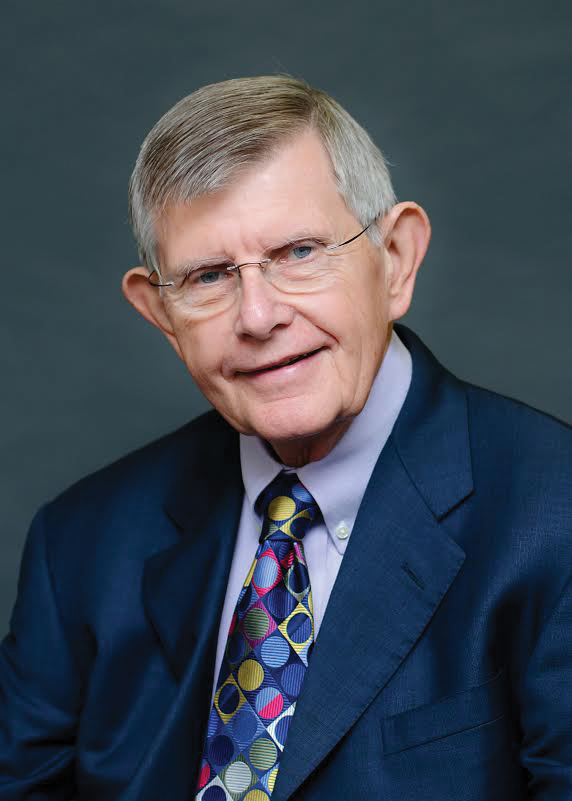
Port chairman stresses need for a deeper, wider channel

October 1st, 2019

Port of Houston Commission Chairman Ric Campo updates the BAHEP crowd on the State of the Port at the Hilton.

By Kathryn Paradis

Neither rain nor wind nor anything else brought on by Tropical Storm Imelda could stop Ric Campo, chairman of the Port of Houston Authority, from his appointed task of speaking to members of the Bay Area Houston Economic Partnership about the state of the port.

Considering the state of the weather Sept. 17, a good-sized audience gathered at the Hilton for the late afternoon reception.

What is the state of the port? It’s good. It’s really good. There are nearly 200 public and private terminals that make up the port. Houston is the nation’s No. 1 region for exports and home to the largest petrochemical manufacturing complex in the Americas.

Energy production and the export of crude oil, along with the increasing global demand for chemicals produced in the region, are major drivers of this success. This activity along the 52-mile ship channel has helped make the port the No. 1 U.S. port in foreign waterborne tonnage.

The economic impact of the greater port nationally includes 3.2 million jobs and $802 billion in economic value. In Texas, the port generates 1.35 million jobs and has an economic impact of $339 billion.

However, such growth can also create problems. Since 2015, there have been nine ship-ship or barge-ship collisions. He cautioned, “You ultimately have to get down to really simple concepts — no channel, no port, no port, no cargo, no cargo, no commerce, no commerce, no jobs. It really is about the channel.

“We have to make sure the channel is expanded and improved in order to meet this demand that is going on with increased cargo when it comes to both energy and containers. If we can’t move our energy products out through the channel, then the entire supply chain backs up. This creates serious issues for energy companies, for job growth, and for Texas. So, it’s really critical that we have a deeper and wider channel with two-way traffic.”

He concluded, “A wider channel is a safer channel. We have to make sure we protect lives as well as the environment. Jobs are important, but we can’t lose sight of the safety of everyone who lives around the channel. . .It will cost $1 billion . . .a lot of money, but when you think about the economic benefit, it’s really not. It’s about making sure that our kids and their kids have economic opportunity in the future and a better quality of life.”

Houston Methodist Clear Lake adds orthopedic specialist Dr. J. Sawyer Croley

October 1st, 2019

Houston Methodist Orthopedics & Sports Medicine-Clear Lake has added a another specialist to its medical staff — Dr. J. Sawyer Croley.

Croley is an orthopedic surgeon who specializes in partial and total knee replacement, hip replacement, reconstructive surgery of the knee and hip; and minimally invasive surgery. His expertise includes the ability to perform direct anterior hips, which drastically reduce time for recovery, as well as unicompartmental knee arthroplasty, also known as “uka” or partial knee replacement.

He is a graduate of the University of Texas Medical Branch in Galveston, where he also completed his residency in orthopedic surgery. Most recently, he completed an advanced fellowship in adult reconstruction surgery at Beaumont Hospital in Royal Oak, Mich.

“My philosophy of care is to take the time to listen to and educate each patient, so that together we can develop a customized treatment plan to fit their unique situation and lifestyle,” Croley said. “I’m excited to join my new colleagues at Houston Methodist Orthopedics & Sports Medicine and begin serving the Bay Area and surrounding communities.”
The addition of Croley brings the number of specialists on staff at Houston Methodist Orthopedics & Sports Medicine – Clear Lake to eight.

Croley began seeing patients in September at his office at 2020 NASA Pkwy., Suite 230, in Nassau Bay, and will also see patients at Houston Methodist Orthopedics & Sports Medicine’s Clear Lake location at 14903 El Camino Real. To make an appointment with Croley or one of the other Houston Methodist Orthopedics & Sports Medicine physicians, visit houstonmethodist.org/orthopedics/clearlake or call 713.363.9090.

Texas Constitutional Amendments Election This November

September 9th, 2019

Since the adoption of the Texas Constitution in 1876, 498 amendments have been added. These amendments typically appear on November ballots in odd numbered years after the conclusion of the regular legislative session. This year, 10 proposed amendment will appear on the statewide ballot.

Below you will find a brief explanation of each amendment. if you would like further details the nonpartisan House Research Organization publishes the “Guide to the Constitutional Amendments.” which can be found by clicking here.

The election will occur on November 5th with Early Voting beginning on October 21st.

PROPOSITION 1: “The constitutional amendment permitting a person to hold more than one office as a municipal judge at the same time.”

Current law allows for an appointed municipal judge to serve as a judge in more than one municipality. In municipalities where the judge is elected, however, a judge may only serve in one municipality. Voting YES for this constitutional amendment would create parity between appointed and elected municipal judges, so that both may serve more than one municipality. This proposition passed both the Texas House and Senate unanimously.

Serving as a municipal judge is often a part-time job in smaller municipalities, and these positions can be hard to fill by qualified judges. Voting YES for this constitutional amendment in November would make it easier for small cities and towns to find and retain qualified judges, ensuring that misdemeanor offenses are prosecuted and search warrants are obtained in a timely fashion, having a positive impact on public safety.

PROPOSITION 2: “The constitutional amendment providing for the issuance of additional general obligation bonds by the Texas Water Development Board in an amount not to exceed $200 million to provide financial assistance for the development of certain projects in economically distressed areas.”

Created in 1989, the Economically Distressed Areas Program (EDAP) operated by the Texas Water Development Board (TWDB) provides financial assistance to projects where water and wastewater services do not meet minimum state standards. Since its creation, EDAP has provided over $1 billion in loans to political subdivisions estimated to serve 400,000. In House District 62, the City of Whitewright has received $6.3 million from this program.

The TWDB currently has constitutional authority to issue $500 million in bonds; however, the program has reached its bond capacity and can no longer issue bonds for additional projects. Voting YES for Prop 2 would amend the Texas Constitution to allow the TWDB to issue bonds on an ongoing basis, as long as the total outstanding debt does not exceed $200 million.

Voting YES for this constitutional amendment DOES NOT grant the TWDB an additional $200 million, but allows the agency to issue additional bonds. The legislature has already appropriated $3.5 million over the next two years to TWDB for debt service payments on existing bonds. Capping the total outstanding debt at $200 million will ensure that Texas does not take on an excessive amount of debt, while at the same time allowing for the state to assist local governments in providing one of the basic functions of government, water service.

PROPOSITION 3: “The constitutional amendment authorizing the legislature to provide for a temporary exemption from ad valorem taxation of a portion of the appraised value of certain property damaged by a disaster.”

This amendment would allow the legislature to grant a temporary property tax exemption following a disaster declared by the Governor. Voting YES for this proposition would allow for property owners of damaged property to receive a temporary tax exemption if the legislature passed a law, without requiring a statewide election to amend the Texas Constitution. This proposition passed the Texas House and Senate unanimously.

Property owners struggling to rebuild damaged property should not have to pay taxes based on the value of the property before the damage. The owner of a $300,000 home that is 50% damaged should not have to pay taxes as if their home is still worth $300,000, as happened to some Texans after Hurricane Harvey. Voting YES would protect property owners from unfair taxes after any future disaster.

PROPOSITION 4: “The constitutional amendment prohibiting the imposition of an individual income tax, including a tax on an individual’s share of partnership and unincorporated association income.”

I am proud to be a coauthor of this legislation that allows for voters to constitutionally ban a future income tax in Texas. Currently, Texas does not have an income tax, but a future legislature could pass a general law with a majority vote to impose one. This law would then go to the Texas voters for approval.

Voting YES for this proposition would place a ban on an income tax in the Texas Constitution. If a future legislature chose to impose an income tax, they would have to pass another constitutional amendment to undo it, which would require a 2/3 vote of both the House and Senate, instead of a majority vote. Voting YES would further protect future Texans from the possibility of an income tax.

PROPOSITION 5: “The constitutional amendment dedicating the revenue received from the existing state sales and use taxes that are imposed on sporting goods to the Texas Parks and Wildlife Department and the Texas Historical Commission to protect Texas’ natural areas, water quality, and history by acquiring, managing, and improving state and local parks and historic sites while not increasing the rate of the state sales and use taxes.”

Currently, the sales taxes collected on sporting goods are collected and deposited in the state’s General Revenue funds, along with sales tax collections on all other goods. Each session, the legislature then appropriates this money during the budget-writing process to the Texas Parks and Wildlife Department (TPWD) and Historical Commission (THC).

This proposition would constitutionally dedicate the sporting good sales tax revenue to TPWD and THC in perpetuity, ensuring that future legislators do not spend the funds elsewhere (as has been done in the past.)

Voting YES on Prop 5 will dedicate the existing sales tax revenue to our state’s emergency response efforts and game warden operations, wildlife management programs, recreational opportunities, and state parks.

If this amendment passes, any time you purchase bicycles, hunting and fishing equipment, or exercise equipment, you can be assured the sales tax collections, estimated to be at least $170 million per year, are going toward these state programs.

PROPOSITION 6: “The constitutional amendment authorizing the legislature to increase by $3 billion the maximum bond amount authorized for the Cancer Prevention and Research Institute of Texas.”

In 2007 Texas voters approved the establishment of the Cancer Prevention Research Institute of Texas (CPRIT) to support institutions of learning and advanced medical research facilities in finding the cause of all types of human cancer and developing cures from lab research and clinical trials. Voters granted CPRIT the ability to issue bonds up to $3 billion to fund cancer prevention research and trials. The current maximum bond authority will be reached by 2022, after which the Institute will no longer be able to issue bonds for additional research grants.

Voting YES for this constitutional amendment DOES NOT grant CPRIT an additional $3 billion, but allows them to issue additional bonds up to $6 million. The legislature has already appropriated $2.5 million over the next two years to CPRIT for debt service payments on existing bonds.

PROPOSITION 7: “The constitutional amendment allowing increased distributions to the available school fund.”

In 1854 the Texas legislature created the Special School Fund (now called the Permanent School Fund or PSF), endowed with $2 million from the federal government that Texas received in exchange for its claims on the territory of present-day New Mexico, Colorado and Oklahoma. The Constitution of 1876 permanently restricted the Fund’s use to provide for public education.

Currently the PSF receives revenues from the sale and leasing of more than 13 million acres and other investments. The revenue from these investments is then deposited in the Available School Fund. Because greater investment returns have resulted in more revenue for the Permanent School Fund, this amendment would allow an increase from $300 million to $600 million the revenues that could be distributed to the Available School Fund each year.

Funds in the Available School Fund are then distributed to school districts annually through the school funding formulas. Voting YES for Prop 7 would increase the amount of Permanent School Fund revenues that would ultimately be distributed to our public schools.

PROPOSITION 8: “The constitutional amendment providing for the creation of the flood infrastructure fund to assist in the financing of drainage, flood mitigation, and flood control projects.”

In 2013 in response to the 2011 drought, Texas voters approved a constitutional amendment creating the State Water Implementation Fund for Texas to finance projects that would ensure the long-term water supply of Texas through low-interest loans backed by the state.

Now, in response to Hurricane Harvey, the legislature unanimously passed this constitutional amendment that would create the Flood Infrastructure Fund to assist in financing drainage, flood mitigation, and flood control projects that are as equally vital to the infrastructure of our state as the water-planning projects.

This amendment is part of a package of legislation passed this session to address the recovery and long-term resiliency of Texas. Voting YES for Prop 8 would establish a much-needed statewide, cooperative effort to “future-proof” the state against future flooding disasters. If approved, the Fund would receive $50 million in state funds to provide loans at or below-market rates to local governments to assist with basic flood project planning and engineering of flood mitigation projects.

PROPOSITION 9: “The constitutional amendment authorizing the legislature to exempt from ad valorem taxation precious metal held in a precious metal depository located in this state.”

The Texas Constitution requires that all real and tangible personal property in the state be taxed in proportion to its value unless otherwise exempt. Voting YES for this proposition would allow for the legislature to pass a law exempting precious metals held in a commercial depository in Texas from annual property taxation, just as the household goods, personal vehicle, and personal property (including precious metals) held in one’s home is exempt from property taxation.

Without an exemption, local governments may attempt to impose annual property taxes on their residents’ precious metals held in depositories, which could lead to confusion in the property tax system. A property tax exemption would also align with current Texas law that already exempts precious metals from the sales tax.

PROPOSITION 10: “The constitutional amendment to allow the transfer of a law enforcement animal to a qualified caretaker in certain circumstances.”

Current state law prohibits law enforcement agencies from transferring valuable property to a private person or organization without payment. Valuable property may include police dogs and other law enforcement animals whose ownership could not be transferred free of charge upon the animals’ retirement from service.

Voting YES for Prop 10 would allow for these animals to live with their handler or other caretaker upon their retirement, as determined by the head of the law enforcement agency. This proposition passed both the House and Senate unanimously, and is widely supported by law enforcement agencies.

— State Rep. Dennis Paul, District 129

NASA Satellite Spots a Mystery That’s Gone in a Flash

September 9th, 2019

Pops of bright blue and green in this image of the Fireworks galaxy (NGC 6946) show the locations of extremely bright sources of X-ray light captured by NASA’s NuSTAR space observatory. Generated by some of the most energetic processes in the universe, these X-ray sources are rare compared to the many visible light sources in the background image. A new study, published in the Astrophysical Journal, offers some possible explanations for the surprise appearance of the green source near the center of the galaxy, which came into view and disappeared in a matter of weeks.

The primary objective of the NuSTAR observations was to study the supernova — the explosion of a star much more massive than our Sun — that appears as a bright blue-green spot at upper right. These violent events can briefly produce enough visible light to outshine entire galaxies consisting of billions of stars. They also generate many of the chemical elements in our universe that are heavier than iron.

The green blob near the bottom of the galaxy wasn’t visible during the first NuSTAR observation but was burning bright at the start of a second observation 10 days later. NASA’s Chandra X-ray Observatory later observed that the source — known as an ultraluminous X-ray source, or ULX — had disappeared just as quickly. The object has since been named ULX-4 because it is the fourth ULX identified in this galaxy. No visible light was detected with the X-ray source, a fact that most likely rules out the possibility that it is also a supernova.

“Ten days is a really short amount of time for such a bright object to appear,” said Hannah Earnshaw, a postdoctoral researcher at Caltech in Pasadena, California, and lead author on the new study. “Usually with NuSTAR, we observe more gradual changes over time, and we don’t often observe a source multiple times in quick succession. In this instance, we were fortunate to catch a source changing extremely quickly, which is very exciting.”

Possible Black Hole

The new study explores the possibility that the light came from a black hole consuming another object, such as a star. If an object gets too close to a black hole, gravity can pull that object apart, bringing the debris into a close orbit around the black hole. Material at the inner edge of this newly formed disk starts moving so fast that it heats up to millions of degrees and radiates X-rays. (The surface of the Sun, by comparison, is about 10,000 degrees Fahrenheit, or 5,500 degrees Celsius.)

Most ULXs are typically long-lived because they’re created by a dense object, like a black hole, that “feeds” on the star for an extended period of time. Short-lived, or “transient,” X-ray sources like ULX-4 are far more rare, so a single dramatic event — like a black hole quickly destroying a small star — might explain the observation.

However, ULX-4 might not be a one-off event, and the paper’s authors explored other potential explanations for this object. One possibility: The source of ULX-4 could be a neutron star. Neutron stars are extremely dense objects formed from the explosion of a star that wasn’t massive enough to form a black hole. With about the same mass as our Sun but packed into an object about the size of a large city, neutron stars can, like black holes, draw in material and create a fast-moving disk of debris. These can also generate slow-feeding ultraluminous X-ray sources, although the X-ray light is produced through slightly different processes than in ULXs created by black holes.

Neutron stars generate magnetic fields so strong they can create “columns” that channel material down to the surface, generating powerful X-rays in the process. But if the neutron star spins especially fast, those magnetic fields can create a barrier, making it impossible for material to reach the star’s surface.

“It would kind of be like trying to jump onto a carousel that’s spinning at thousands of miles per hour,” said Earnshaw.

The barrier effect would prevent the star from being a bright source of X-rays except for those times when the magnetic barrier might waver briefly, allowing material to slip through and fall onto the neutron star’s surface. This could be another possible explanation for the sudden appearance and disappearance of ULX-4. If the same source were to light up again, it might support this hypothesis.

“This result is a step towards understanding some of the rarer and more extreme cases in which matter accretes onto black holes or neutron stars,” Earnshaw said.

NuSTAR is a Small Explorer mission led by Caltech and managed by JPL for NASA’s Science Mission Directorate in Washington. NuSTAR was developed in partnership with the Danish Technical University and the Italian Space Agency (ASI). The spacecraft was built by Orbital Sciences Corp. in Dulles, Virginia. NuSTAR’s mission operations center is at the University of California Berkeley, and the official data archive is at NASA’s High Energy Astrophysics Science Archive Research Center. ASI provides the mission’s ground station and a mirror archive. Caltech manages JPL for NASA.

To read more about NASA’s NuSTAR mission, go here: https://www.nustar.caltech.edu/

Samantha Williams named Lunar Rendezvous queen

September 3rd, 2019

Lunar Rendezvous royalty pose together with Queen Samantha Williams during the Coronation Ball at the San Luis Convention Center in Galveston. They are, from left, Captain David Oliver, King Shade Lewis and Queen Alternate Nicole Leistad, who will reign over the 2020 festival next summer.

A PRETTY BLONDE Clear Springs High School senior, Samantha Grace Williams, is the new queen of Lunar Rendezvous and will reign over the 2020 festival next summer with King Slade Lewis and other members of the Royal Court.

She was crowned by 2019 Lunar Rendezvous Queen Sabrina Curran, daughter of Georgette and Christopher Curran.

2019 Queen Sabrina Curran takes one last stroll around the ballroom.

The daughter of Diane and Allen Williams, she was crowned at the Coronation Ball, this year’s festival finale at the San Luis Convention Center in Galveston and escorted by Kai Tipton Sabin, son of Daric Sabin and Christi Skaggs.

She is also a member of the National Honor Society. In fact, all three members of the 2020 Lunar Rendezvous Royal Court are National Honor Society members.

Ashley Nicole Leistad, a Clear Creek High senior, was elected the queen alternate, or runner-up, when the princesses voted to elect a queen from among their number. She is the daughter of Janelle and Reed Leistad and was escorted by Andrew Stephen Dry, son of Laura and Stephen Dry.

The new captain is David Stoney Oliver, son of Elizabeth and Dana Oliver Jr. and a senior at Clear Falls High who plans to attend Texas A&M. His escort was Kylee Barth, daughter of Cherra Barth.

Afterwards, the new queen and king danced the first dance before they were joined by the entire Royal Court and their escorts, making a beautiful picture as their parents looked on.
The evening, which had the theme, “Hot Havana Nights,” began with a champagne reception as Festival Chairman Michelle Holland and Vice Chairman Debby Reichert joined Coronation Ball Chairman Kathy Rea and Vice Chairman Veronica Rapp and Festival Advisory Board Co-Chairmen Jill Williams and Kelli Byrd in welcoming the several hundred guests, who later enjoyed a filet mignon dinner and danced to the music of Password.


Festival fashion show a big hit again this year

YEAR AFTER YEAR, the Lunar Rendezvous Fashion Show is a runaway hit, and it was again this year, with dozens calling it “the best ever” as they headed for home.

And, fashion guru Lenny Matuszewski was at his best as he took the crowd on “A Sail Around the World” while celebrating his 30th year of producing the fashion show with a video of him expressing how much it has meant to him to produce the style show and showing clips from previous shows.

Which was quite a thrill for Fashion Show Chairman Anouk Davis and Co-Chairman Meg Crowleyand Advisory Board Co-Chairmen Kelli Byrd and Jill Williams and many of the long-time volunteers, such as Board Chairman Mike Landolt and his wife, Ann Wismer.

The 54th annual show ended with a bang. A model emerged to the tune of Stars & Stripes Forever and as she turned at the end of the runway, the train of her gown turned into a U.S. flag – to the delight of the crowd.

And, what a crowd it was with 2019 Lunar Rendezvous Queen Sabrina Curran, Karen Reed,Lisa Holbrook, Gail Ashby, Missy Rorrer, Betsy Salbilla, Wendy Drapela, Wendy Shaw, Katy and Chris Rea, Christina Ballard, Kim Woods, Ruth Ashraf, Mike Reeves, Emmeline Dodd, Kimberly Fleming, Kelsey McNeil,Kelly Oetting, Lisa Peters, Michelle Richardson, Michelle Blackwell, Kristy Caraway Brown, Kelli Braumbaugh, Sara Taylor, Jennifer Pung Dean, Melissa Duran, Katie Rehrer, Kippy Caraway, Thora Payne, Christina Ballard and Kim Woods in the mix.

The Lunar Rendezvous Festival is dedicated to providing community-based support including scholarships for higher education, youth development and educational programs, funding for the arts and historical preservation in the Bay Area Houston/NASA area. In the past 10 years alone, Lunar Rendezvous has given over $1 million in scholarships for higher education!

Kelly Oetting, Lisa Peters, Michelle Richardson, Jill Reason, Kelsey McNeil and Stashia Hardman, from left, were among the many enjoying the Lunar Rendezvous Fashion Show at the San Luis Convention Center on Galveston Island.

Movers & Shakers: Joe Dee Barlow

September 3rd, 2019

Name: Joe Dee Barlow

Occupation: Attorney

Hometown: Petersburg, TX

Current home: Friendswood

Family: Wife, Jeanette and two daughters, Jessica Waller and Jackie Barlow

My favorite writer is: Dr. Catherine Langford

Someone I’d like to meet: William J. Bennett, former Secretary of Education

If I could switch places with someone for just one day, I’d choose: Bill Gates

My favorite performers are: Tom Selleck

I like to spend my leisure time: Playing tennis

If I could travel any place, I’d go to: Italy

My favorite meal is: My wife’s gumbo

As a youngster, I wanted to grow up to be: Major league baseball player

You’ll never catch me: Jumping out of an airplane

The thing that bugs me the most is: Hypocrisy

My favorite movie is: The Thomas Crown Affair

Few people know: I’m a seventh generation Texan with Ottawa Indian ancestry, and a member of the Sons of The Republic of Texas

Creatively Aggressive

September 3rd, 2019

Behind the scenes filming the pilot, “Firm Fixer.”

By Blaine Ochoa

Great achievement in life and obtaining success takes effort, focus, and discipline. Even more so, it takes being aggressive and taking action. Rising to the top consists of working hard, working smart, and being creatively different and uniquely aggressive. Aggression not displayed as violence, instead, meaning tough, relentless, and driven.

Attorney, McDonald (Don) Worley is the epitome of the words creatively aggressive, resilient, and successful. As an esteemed and recognized attorney, Worley’s experience and passion has led to his success. Winning in the courtroom consists of being bold and knowledgeable, combined with honesty and creativity. “You lie, you loose. Always tell the truth, that goes for every part of life.”

Don Worley was born and raised in Texas. Worley studied at the University of Texas at Austin, Howard Payne University, and the University of Houston. He has been the owner of McDonald Worley Law Firm for 21 years, is fluent in Spanish, and has seven lawyers working for his firm. The firm specializes in Personal Injury, Vehicle Accidents, Mass Torts, and a variety of other areas of law. The McDonald Worley Law Firm has locations in Houston, Los Angeles, Las Vegas, New York, Washington D.C., and has recently expanded into Beaumont.

In the world of law and legal matters, a client would most assuredly want an attorney who is knowledgeable, trustworthy, and fights to the best of his or her ability to win their case.
“People come to me with the most tragic and catastrophic experiences of their life.” I want my clients to know that we are in it together.”

Worley is also a professional actor and stand up comedian. Being a trained actor, has “helped me become a better trial lawyer. Acting is my passion and so is being able to help others through law.”

Part of the driving force that has led to the success of the McDonald Worley Law Firm is the unique marketing approach the firm has formed and properly executed.

Shylene Correa is the Business Development Director and promotes the image and reputation of the law firm. Correa breathes creativity and utilizes different marketing techniques. She and the team has developed different video and social media marketing tactics that has changed the way attorneys are viewed and presented.

Don Worley has become the go-to legal expert and resource in the Houston community and beyond. You can find Worley’s educational and informative law videos on his social media platforms such as Instagram: @mcdonaldworleypc.

Worley has recently started a new project with well known Director, Producer, and Director of EverConvert Productions, Jay Russell. Russel and his TV crew, are currently in the process of shooting a pilot episode called, “Firm Fixer,” to sell to TV networks. Russell says, “Don gets calls all the time from other law firms asking for advice and help, they just don’t have the background that Don has. We want people to know and trust him and feel that they have a personal relationship with Don.” The TV show will be comprised of episodes related to specific, real cases that showcase topics and situations that are relevant to the public and educates the audience. The creativity and message behind the show, Firm Fixer, combined with social media marketing, brings the firms marketing efforts to ceiling shattering levels, guaranteed for success and growth. This type of marketing isn’t typically done by other law firms and introduces marketing a law firm and legal experts on a whole new level.

Ultimately, “our job is to get justice for our clients and increase satisfaction of life.”

The McDonald Worley Law Firm specializes in providing excellent service and communication within all areas of the legal industry, and helps its clients to the very best of their ability.

In life, in the courtroom, or in marketing strategies, you have to be prepared, aggressively take action, and learn how to creatively set yourself apart to rise above the rest.

If you need legal advice or assistance, contact the McDonald Worley Law Firm at McDonaldworley.com or call 1-800-610-2001.

Bureaucracy

September 3rd, 2019

Photo: Michael Gos

By Michael W. Gos

Waco, Texas

“He went to the dark side.”

That is what professors say when a fellow faculty member decides to take even a temporary administrative position. There is clearly a distrust, or worse, of administrators on the part of faculty members in education.

I was at Baylor University for a conference for mid-level managers in higher education and one of the hot topics was why those in administration at all levels, are so disliked by the rank and file educators. I found it surprising that most of the attendees honestly didn’t have a clue about the causes of this hostility. I always thought it was pretty clear.
Most colleges can cite the year when their administrative staff members first outnumbered the faculty. Today, it is common to have two to one or even three to one ratios of administrators to faculty in colleges and universities. But, of course, this phenomenon is not limited to higher education. The explosion of bureaucrats and administrators is ubiquitous. It plagues business and industry as much, if not more, than education.

Why should we be concerned about this trend? It’s all about “paper.” Okay, most of it is electronic these days, but you get the idea. Every administrator must justify his job, so they all are forced to introduce new ideas, new “procedures” that somehow translate to “projects” for the non-administrators. And since there are now so many on the dark side, they compete for the work hours of those in the productive, non-administrative positions. These new ideas are often referred to by the productive employees as the “flavor-du-jour” because almost none of them are ever carried to completion. They are almost immediately displaced by the latest “great new idea.”

My experiences with this kind of nonsense are far too numerous to count. Among them were five different policies for travel reimbursement in a single fiscal year, four different three-year assessment plans, none of which ever made it past 18 months before being replaced by a new idea, and many other “great ideas” that we’ve had to live with. I’m sure everyone in the business world can tell similar horror stories.

This explosion of non-productive employees is exacerbated by the fact that each new administrator brings with him a few additional satellite employees such as administrative assistants, secretaries, etc. All these new workers have to justify their existence as well; they have to do something. So, they create new policies, new layers of paper. And that has costs.

First, we need more money to pay these employees. In the public sector, tax money is the first choice of course, but government is often reluctant to give increases sufficient to fund this exploding employee base. Choice two: go after grants. Of course, that means hiring more administrators to go apply for, and then manage the grants that are secured. Then, when the grants run out, the public sector is reluctant to lay off people, so they find some other place for them, in the administration, of course. And the dark side staff keeps growing.

In the private sector, there is a double jeopardy — two levels of administrators to deal with. Not only are the administrators within the company creating the usual extraneous, pointless work, but there are also millions of government administrators who also believe they have to justify their jobs as well. So, business is slapped with more regulations and hence, more paperwork. As a result, companies have to hire more administrators to deal with federal, state and local regulations. That is why many people feel the bulk of government is nothing more than a jobs program.

If you doubt my analysis of this issue, just look at your organization’s number of vice-president positions in 1980 compared to today.

The results of increased bureaucracy are pretty clear. In the private sector, more employees are now required but the same (or more likely, less) productive work is being done. Of course, this results in reduced profit. In the public sector the result is inevitably increased taxes. Meanwhile, the employees who are engaged in productive work are forced to spend more and more time buried in paperwork. After all, every new administrator MUST add at least one more layer of paper.

In my line of work, that means that each year, teachers have less and less time to spend on planning, grading and helping students. They have no choice but to let that important work go by the wayside so they can deal with the administrative load. Most just can’t work beyond about 60 hours a week for very long.

The solution seems obvious, but there is a problem. I read once that a simplified, postcard-sized tax return would put millions of accountants out of work. Removing the bulk of unnecessary administrators would make many times that number unemployed. That is not a good scenario for the nation’s economy, so we can’t afford to fix this problem overnight. All of these soon-to-be displaced people will have to be found jobs in the productive parts of business, industry and the public sector. To avoid an unemployment crisis, this will require a long-term, gradual shift in our thinking. We might start, say, by reducing the administrative and support staff by as little as 5% each year. Yeah…good luck with that. Companies would only hire new people to administer those reductions.

It won’t be easy…but just think about how our productivity as a nation would soar as a result of these once counterproductive employees, now contributing to the bottom line and the freeing up of all that formerly wasted time for the rest of us.
But till then, we have to continue with the system the way it is.

On my return from the conference, I had to deal with the nightmare of filing for reimbursement of my trip expenses. I had already filled out a battery of forms to get approval before taking the trip. Now I had to play the game again to actually get my money. My plan was to dedicate four hours of my day to the process.

I filled out a two-page form, gathered, scanned and attached all my receipts, a copy of the conference program, and copies of the prior approval emails from both my dean and my department head. I then had to write an explanation of why the trip was necessary. (For that, I just copied the same explanation I wrote in requesting the trip initially. It would be okay. I’m sure no one reads them anyway.) That was followed by trips around campus to secure signatures of the dean and department head, even though they both had signed off on the initial request for funds. Their offices were in separate buildings, about a quarter mile apart. Then I had to re-scan it all into a single file. Finally, I sent the required three copies of the electronic package to the business office. It took considerably more than the four hours allotted.

Two days later, I received a call from the Business Office. The woman said there was a problem with my reimbursement form. My mileage to the airport did not match the mileage she said I should show. It was too low. I explained that I drove from my home instead of from campus so the distance was less. She said the mileage had to be from campus. I pointed out that I was saving the college a bit of money and just being honest. She answered “The mileage has to be from campus.”

So the next day, I began the entire process again. This time I hoped to make it within the four hours allotted.

Bureaucracy! Life in triplicate. I think I’ll need three beers after work.

Mileage Motoring

September 3rd, 2019

By Don Armstrong

Hybrid and all-electric markets continue to grow and so do showroom offerings. We recently had a chance to drive one of each and found a change of mindset was needed with one.

2019 Niro EV

Kia Niro EV
Pricing and range have kept most buyers of electric vehicles on the sideline, until now. With a starting price of $38,500, the Kia Niro EV becomes the “everyday guy’s” bargain, allowing the driver to never stop for gas. And with an average travel distance of 239-miles per charge, a day trip from Kemah to Brookshire and back is a piece of cake.

The Niro EV is classified as a small station wagon but looks more like a small SUV. The nicely appointed, entry level EX will be plenty for most and adding an extra $5,500 for the Premium version may be a bit too much for leather, LED lighting and a big audio system.

Driving the Niro EV is pleasant. It handles well and offers a quieter cabin than those SUV’s with gasoline power plants. There will always be wind and tire noise at highway speed, and, in that regard, this vehicle is not very different.

The caveat: Having to constantly use brain power to calculate the distance of your destination and having to allow at least a 30 minute charge for an additional 100 mile range .

Toyota Corolla Hybrid
We may have discovered the ultimate car: Modern, attractive interior and exterior, long history of quality and dependability, gets 53 miles per gallon-city, 52-highway and a base price of $23,100.

The 2020 Toyota Corolla Hybrid borrows the drivetrain from its stablemate, Prius, and we’re predicting this new mashup will serve its owners well, especially in MPG bragging circles.

Is it perfect? No. There is only one “entry-level” trim package, the LE. It does not offer Android Auto. You WILL get a choice of 7 attractive exterior colors and two interior fabrics.
The Corolla Hybrid is roomy for its size, has a smartly designed dash and an interior with just the right mix of materials and quality construction.

Under the hood of this mileage-maker is a 1.8-liter gasoline engine connected to two electric motor/generators that drive the front wheels through a CVT transmission. It has a long list of standard and safety features too.

You won’t have any regrets with the Corolla Hybrid. Test drive one and let us know what you think.

One of Few Left on the Texas Coast

September 3rd, 2019

South Texas Yacht Service owner Mark Grinstead has close to 40 years of experience.

By Xander Thomas

There are plenty of boat yards along the coast, and certainly in the Clear Lake Area, home to marinas and great sailing areas, but any of them offering full service seems like a thing of the past. South Texas Yacht Service is one of few places that still does just that.

Service is one of few places that still does just that.

“Most of the yards now are what we call contractor yards, where you got 10, 12, 15, different contractors working out if the yard,” said owner Mark Grinstead.

He says that the convenience of a full service yard like this one can be priceless to someone who doesn’t want the hassle of going through a different professional for any problem that comes up. So that you do not have to act as your own general contractor by yourself, South Texas Yacht Service can do almost anything you need, all at one time, right in one place.

“You got an electrical problem, you gotta find an electrical contractor, if you got a mechanical problem, you gotta find a mechanical contractor, you got a rigging problem, you gotta find a rigger, well we do all of those things in house,” Mark said.

It’s not just that these guys can do whatever you need them to, they are good at it.

“I’ve been doing this for almost 40 years now, and most of my staff probably average about 20 years experience,” he said, “We have an experienced staff, probably the most experienced staff of any yard on the Texas coast.”

So what this means for you, is that you talk to one person about everything, you take it to one place, you get quality service, and you won’t have different people messing with someone else’s previous work – we all know how that ends up.

“We keep our employees, we don’t have a real high turn-over rate, so our work is consistent,” Mark said.

Mark says that his love of sailing and the sea started at an early age. His family lived on a boat for a few years when he was a child, and he has been around them his whole life, so this line of work just came naturally to him. He has earned a bachelor’s degree in marine transportation and has a Coast Guard license.

He says that there is almost nothing that they can’t do for you. They even take on a few complete restoration cases a year, usually.

“We handle the whole deal,” he said, “I think we’re the only yard left on the Texas coast that’s a full service yard.”

South Texas Yacht Service is located at 1500 Marina Bay Dr. #3510 in Kemah.

Bay Area Houston Magazine