The Magnificent Marvels of NASA

November 1st, 2018

NASA’s special 747 carries the shuttle above the Johnson Space Center.
Photo Credit: NASA/ Sheri Locke

Sumer Dene with a Space Exploration Vehicle (SEV), which is designed to safely navigate harsh terrain.

By Sumer Dene

Wonder is experienced, it can’t be taught. Through exploration and research, aerospace changes everything. NASA celebrates 60 years of encouraging passionate, dedicated individuals to go above and beyond what they see.

The Johnson Space Center, home of human spaceflight, made Bay Area Houston the thriving waterfront city it is today. Furthermore, NASA is voted year after year the best place to work in the federal government. The International Space Station improves lives through education and innovation to strengthen relationships with academia, government and private sector leaders. The space station is built piece-by-piece in orbit with the help of many nations. The modules are built in separate countries and first meet in space to be assembled. Friday nights at the space station, astronauts and cosmonauts join together to watch movies and share cuisine. They become family with an outlook that reaches beyond our scope.

Astronauts and Cosmonauts enjoy the pre-release of ‘Star Wars: The Last Jedi at the International Space Station.

Educating the world
Improved technology in robotics can lead to minimally invasive surgeries, safer cars, and mass harvesting of fruits and vegetables. Robotics engineer Lucien Junkin says, “The purpose of the Robotics Education program is to gather knowledge and spread it to the public. Failures are meant to teach you; the most important philosophy in engineering is safety, commitment and hard work.” Young adults overcome challenges with collaborative effort to reach competitive goals. NASA offers free educational programs and scholarships to help empower education in STEM. The Robotics Education program is in need of young leaders to build the future in technological development.

The highly-respected professionals involved in aeronautics push forward courageously in pursuit of a new frontier. NASA Public Affairs Officer Gary Jordan develops and hosts Houston’s first space podcast, “Houston, we have a podcast.” The podcast discusses many influential aspects of space travel live at Johnsons Space Center. It is released every Friday with various guests, sometimes including astronauts in orbit. Questions can be asked using hashtags #askNASA and #HWHAP on various social media accounts. “NASA shows that we are all connected. We are on the same mission and happy to explore new ways to make our lives better on Earth. It is important to communicate that with the public. Society is shaped by what we do today.” We have come a long way.

What has changed?
In the early 60s, it was easy to imagine space exploration. The lives of people and how they communicated was vastly different. A peaceful movement began to end all wars, remove barriers and expand consciousness through music and language. The youth wanted to end all wars so people would realize we are all parts to a greater whole. Traveling across the galaxy in an intergalactic world to save the human race was something first seen in black and white fantasy films.

NASA developed in 1958 during a crisis in the last “idealist” time in America. Hate, fear and propaganda spread through the use television and radio. Sixty years later, we long to connect, have our voices heard and be a part of something greater than us. Now, our generation faces many more distractions. “Hope” first begins with “Focus.”

NASA is working on robonauts to help human astronauts complete simple, repetitive and dangerous tasks in space.

The Vision
NASA looks forward to the future with a goal to solve pertinent problems and coexist peacefully. Intensive research help people live a better quality life and find answers to meaningful questions. The space center influences medical and technological advances, as well as society’s culture. Dr. Liz Warren is a NASA scientist who investigates how human physiology changes in microgravity. She leads a team to implement experiments in space. Cells change to a spherical, 3D structure and protein crystals grow perfectly in space, leading to a perfect environment for groundbreaking research in all life and physical sciences.

“Our bodies are capable of enduring and adapting to new environments. We explore because we want to push ourselves further to learn, grow and make an impact. We want the next generation to feel inspired.” Space research discovers ways to combat endemic disease, understand how the planet is evolving, and harness energy and resources sufficiently.

Space exploration has helped us understand human psychology. “The Overview Effect” is coined by Frank White as the cognizant shift in awareness some astronauts experience when viewing earth from the lunar surface. He describes space exploration as the “inevitable steps in the evolution of human society and consciousness.” On Earth, conflicts and differences divide people as our navigation system judges distance from our feet to the ground. Astronauts see 16 sunsets and sunrises each day and orbit earth every 90 minutes. In space, distance is measured expansively as the speed of light. There are no borders to separate the universe and humankind, opportunities are limitless when we work together on a mission.

Former astronaut continues practice of medicine with Elite Care ER

November 1st, 2018

Photo: Sandy Adams Photography

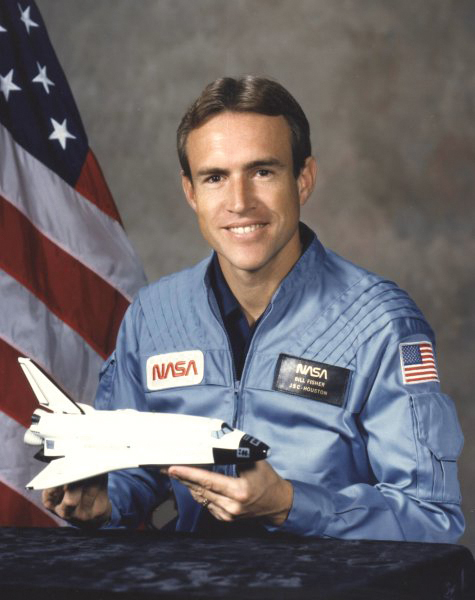
William F. Fisher is an American physician and a former NASA astronaut. Fisher went into space in 1985 on board the Space Shuttle. He retired from NASA in 1992 and returned to the full-time practice of medicine. His time at NASA coincided with that of his former wife and fellow astronaut Anna Lee Fisher.

Fisher was born April 1, 1946, in Dallas, TX He graduated high school in Syracuse, NY, then attended Stanford University before entering medical school at the University of Florida.

He married fellow physician and later fellow astronaut, Anna Lee Fisher of St. Albans, NY on Aug. 23, 1977. They have two daughters, Kristin Anne (b. July 29, 1983), who is a Washington D.C.-based correspondent for the Fox News Channel, and Kara Lynne (b. Jan. 10, 1989) who received her MBA degree in May, 2017 from SMU in Dallas.

Dr. Fisher collects Bill Graham Fillmore, Family Dog, and other rock/concert music posters from the 1965-1973 time frame. He is an amateur luthier, specializing in making, repairing, and refinishing Neapolitan-style mandolins. Dr. Fisher is also the owner of Twenty-First Century Arms, a sporting goods company, and is both a Federal Firearms Licensee and NFA Firearms Dealer.

After graduating from Stanford in 1968, he served as a mountaineering instructor in Leysin, Switzerland. Following his graduation from medical school in 1975, he completed a surgical residency from 1975 to 1977 at Harbor–UCLA Medical Center in Torrance, California. He entered private practice in emergency medicine in 1977. He also attended graduate school at the University of Houston from 1978 to 1980. He has logged over 2,000 hours in prop, rotary-wing, jet aircraft and spacecraft.

Fisher was selected as NASA astronaut in 1980. His technical assignments included: scientific equipment operator for high altitude research on the WB-57F aircraft (1980–1981); astronaut medical support for the first four Shuttle missions (1980–1982); astronaut office representative for Extravehicular Mobility Unit (spacesuit) and Extravehicular Activity (EVA) procedures and development, including thermal vacuum testing of the suit (1981–1984); astronaut office representative for the Payload Assist Module (PAM-D) procedures and development (1982–1983); Astronaut office representative for Shuttle Mission Simulator (SMS) development (1983); support crewman for STS-8; CAPCOM for STS-8 and STS-9; Remote Manipulator System (RMS) hardware and software development team (1983); Manned Maneuvering Unit (MMU) development team (1983); Deputy Director of NASA Government-furnished and Contractor-furnished Equipment (1982–1983); Chief of Astronaut Public Appearances (1985–1987); Member of the U.S. Air Force Scientific Advisory Board (1986–1991); NASA Medicine Policy Board (1987–1991); Astronaut Office Space Station Manned Systems Division, and Health Maintenance Facility (1987–1989); Astronaut Office representative on space crew selection and retention standards for Space Station (1989–1991). Fisher also continued to practice Emergency Medicine in the greater Houston area in conjunction with his Astronaut duties.

Fisher was a mission specialist on STS-51-I, which launched from Kennedy Space Center in Florida, on Aug. 27, 1985. STS-51-I was acknowledged as the most successful Space Shuttle mission yet flown. The crew aboard Space Shuttle Space Shuttle Discovery deployed three communications satellites, the Navy SYNCOM IV-4, the Australian AUSSAT, and American Satellite Company’s ASC-1. They also performed a successful on-orbit rendezvous with the ailing 15,400 pound SYNCOM IV-3 satellite, and two EVAs (space walks) by Fisher and van Hoften to repair it, including the longest space walk in history (at that time). Discovery completed 112 orbits of the Earth before landing at Edwards Air Force Base in California, on Sept. 3, 1985. Fisher logged over 170 hours in space, including 11 hours and 52 minutes of Extravehicular Activity (EVA).

After leaving NASA, Fisher returned to the practice of emergency medicine. Currently, Dr. Fisher practices full-time at Elite Care 24/7 ER- League City.

Salata

November 1st, 2018

Yasmin and John David

Local restaurant is becoming national chain

By Xander Thomas

It seems that for the past few years, eating healthy has been somewhat of a challenge for busy people. Business professionals, college students, single parents and so many more have had the dilemma of how to eat quick and/or cheap but also not consume too many calories or fill their diet with too many fats.

“We know what’s going on in the food industry, we know what’s going on with nutrition, we can offer you those healthy options that are not going to be your everyday soup and salad bar,” said Salata franchise owner for the Bay Area, Yasmin David.

Salata – which loosely translated means salad — is what Yasmin refers to as a “fast casual” restaurant; it has most of the perks of a fast food restaurant, quick, cheap and easy, without the negative connotation connected with those words. A person on the go can run in, grab some food and go about a busy day, or have a nice atmosphere to sit and eat a tasty meal alone while working. Or eat with friends and still have a good time without the regret and brick-in-the-stomach feeling later.

“The way people are eating and dining is very, very different from the way they used to dine,” Yasmin said. “People don’t necessarily want fast food because of the stigma and the health concerns revolving around it, but they want something fast.”

The growing chain was born right here in Houston, Texas in 2005.

Salata co-founder, Berge Simonian owned a downtown tunnel restaurant, and he noticed that his guests were beginning to favor fresher, healthier options more and more with his ancillary offering – a side salad bar. From this, he and his brother-in-law Tony opened the first, of the now national, sensation that is known as Salata.

Salata is the only salad concept that is gluten-free certified and completely customizable. Guests choose from an array of lettuces, vegetables, fruits, cheeses, seeds, nuts, chicken, seafood and vegan proteins, and all of Salata’s dressings, soups and sauces are house-made and preservative-free. The restaurant also offers a selection of signature teas and lemonades, which are made in-store as well.

“All of our vegetables and fruits are chopped daily here in our restaurant. The protein selection is consistently fresh, lean and sourced from local farms. What sets us apart has always been our house-made dressings that are created daily in our brand new Houston-based headquarters’ commissary and shipped out to each store.

Yasmin’s husband, John, discovered Salata while at work, and according to her, he ate there every day and sometimes twice a day before convincing her to try it… but she was less than excited to go out and pay for a salad, which she thought was something that she could easily make at home. She was surprised to learn that she was wrong. “One day, on my day off, I went up and met him for lunch. We had Salata” she said. “I tried it and I was like ‘oh my gosh, this is crazy good!’” she recalled with a fondness in her voice.

Before long, the couple were looking into franchise opportunities. They chose Bay Area, initially opening only one store in 2014, and eventually realized that their territory could take on a few more. They now own four – Clear Lake, Friendswood, League City, and Pasadena – locations in the area, and two in North Houston (Kingwood & Generation Park).

Yasmin says that it is the dressings that keep people coming back, adding

“We are excited to expand our menu and dressing portfolio with the hiring of a nutritionist and chef.”

One of the things Yasmin says she loves about the company is the way it adapts to new audiences. One example of this can be seen at the League City store with the unveiling of the new logo, interior design and the first wine on tap system. “The Pinnacle Park development will soon transform into a destination Town Center for League City and we are excited to participate in creating a lifestyle for this community. We look forward to hosting happy hours for our guests to try the wine on tap. We also have a newly installed “selfie wall” that’s perfect for those ever popular Instagram moments.”

Yasmin adds, “Being a part of the community in each of our locations is key to our success. We are grateful to have always been welcomed with open arms and look forward to being active participants in our growing communities.”

The Room

November 1st, 2018

By Xander Thomas

A new poker club and lounge, opening soon in the heart of South Shore Harbour, will be catering directly to local lifestyle. A major question surrounding this – is it legal?

“We operate within accordance of Texas law,” said Keith Taylor, managing partner of The Room.

Keith says that Texas is “one of the biggest exporter of gamblers in the U.S.,” so it just makes sense to have a place in town where people can go play their card games, instead of constantly traveling across state borders.

He also explained that there are three major rules to being able to open a business like this in Texas: it must be a private place, no one can receive a profit outside of personal winnings – in other words, the house cannot take a rake from the game, and the odds of winning and losing must be equal between all players – other than luck and skill, of course.

“There is no way to lose to the house,” Keith said.

While poker is a large part of what they do, the guys at The Room would like people to know that it is more than just a place for card players. “You could be playing Tiddlywinks, Monopoly, whatever,” he said.

The Room is a private club that has more than just tables to offer its members. They have TVs, a conference room and even have a cigar lounge, which can double as a banquet hall for private tastings member events. They were conscious in the design of the area to make sure that the entire place does not fill with smoke.

“We engineered the air conditioning with negative pressure in there and positive pressure out here so that air is pushed into that room when you open that door.” Keith said, adding that they will have viewing events for game days, and members can always just come in and hang out, even if they don’t play games or use the tables at all.

They will even have a night devoted to bringing women in; every Tuesday night is ladies’ night. They offer free sangria, wine and beer, and have separate tables for regular players and beginners. “Don’t be scared to come try it,” Keith said.

They are encouraging beginners and advanced players alike to check it out and just have a good time, maybe even use it as a date night idea. They offer lessons on Friday nights, as well, so that people of all skill levels can join in the games.

The grand opening of The Room is on Saturday, Nov. 10, and they say that there will be free beer, cigars, smoked meats, an event for charity, even a prize drawing. There will be separate tables for beginners, so that new players don’t have to feel intimidated. You can follow them on Facebook or sign up on their website at www.theroomleaguecity.com for more info.

Primos Coffee: Farm to table fresh

November 1st, 2018

By Rick Clapp

Bay Area Houston is proud to boast about the many small, unique international businesses that are located in our community. Primos Coffee Company is one of these organizations. Primos is becoming a legend in its own time. It is the perfect example of a responsibly operated, socially conscious company.

The roots of this company began in 1929 when Don Felipe Blandon started growing high-quality Arabica coffee beans on his farm in the lush, green mountains of Jinotega, Nicaragua. Over the years, the hard-working Blandon family perfected the process to ensure they produce only the finest specialty coffee in Central America. Don Felipe’s grandson, Gustavo Blandon, grew up on the 1,100 acre farm and now runs the day-to-day operations.

Primos Coffee is planted in fertile, rich soil at an elevation over 4,000 feet in the gorgeous, emerald green rainforest of the Nicaraguan mountains. The coffee plants are protected from the direct sunlight by shade trees and from the strong winds by cornflower plants. The colorful coffee cherries are so named for the bright, red color they produce as they slowly ripen over seven months. This enhances the sugars within the fruit and results in the pleasant flavor.

The harvest is hand-picked by local Nicaraguan migrant families that have worked on the farm for generations. The picking season coincides with the school year, and so the families come and live on the farm during that time to tend the fields. They are provided lodging, food and shelter for those months.

Once harvested, the coffee cherries are wet milled daily with clean spring water. The seeds of the cherries are naturally dried by the sun and fresh Nicaraguan air. Next, the seeds, or “beans” as commonly referred to, are exported to the Port of Houston, which has become one of the largest import coffee centers in the world.

Primos’ 1,100 acre farm in Nicaragua.

The green coffee beans are sent to a rustic but state-of-the-art roasting facility in Cove, Texas, operated by Gustavo’s wife, Betty Ann Blandon, and her brother, Steve Coggins. Thousands of pounds of high-quality coffee are drum roasted in small batches using distinct profiles carefully developed for the medium bodied coffee. This low acidic coffee boasts smooth, as well as sweet, characteristics with citrus notes. After brewing the roasted-to-order coffee, your delicious cup of Primos is ready for you to enjoy and savor.

Primos Coffee Company is true to its name. In Spanish, “primos” means cousins and there are many cousins descending from Don Felipe. Now, in Texas, Betty Ann’s children and Steve’s children form a new line of cousins in the coffee business. The word “primos” also signifies the very best, which is exactly what Primos Coffee Company strives for in producing coffee.

Equally important to the company is implementing sustainable farming practices. Nothing goes to waste on the working farm; the skin of the coffee fruit is used for compost, the tree trimmings are used for firewood, and the processing water is cleaned and recycled. Primos Coffee Company was and is committed to not only producing the finest quality coffee but also to maintaining the highest social, economic and environmental standards. The Blandon family works diligently to protect their country’s rainforest and natural resources.

Primos Coffee is sold on their website primoscoffeeco.com and also on Amazon. Their Amazon sales have exploded, and Primos Coffee became Amazon’s Best Seller and Amazon’s Choice for unroasted green coffee beans as well as Amazon’s Choice for French press coffee. Primos Coffee Company sells over 4,000 pounds of coffee per month, locally and nationally. The whole beans or ground are available in a medium or dark roast and also in single serve, Keurig compatible cups. Orders may be made online at primoscoffeeco.com or through Amazon. Enjoy your morning, noon or evening with an aromatic, flavorful cup of Primos Coffee.

Movers & Shakers: John Baumgartner

November 1st, 2018

Name: John Baumgartner

Occupation: League City’s city manager

Hometown: Juneau, Alaska

Current home: League City

Family: Wife, Dee Dee; Children: Dallas 26, Robert 26, Emily 22, and Daci 14

What do you like about your job: The great people working together to make League City the very best!
Someone I’d like to meet: Jesus

My favorite performers are: James Taylor or anything sports

I like to spend my leisure time: Relaxing with family

If I could travel any place, I’d go to: Alaska in the summer and Hawaii in the winter

My favorite meal is: Anything my mother cooks, but a great steak and salad with her apple pie is the best

As a youngster, I wanted to grow up to be: Lawyer, but math was better than English, so I went to engineering school

You’ll never catch me: Cheating at golf

The thing that bugs me the most is: Dishonesty

My favorite movie is: Forrest Gump

Few people know: I ran the Boston Marathon when I was skinny

Clear Lake Chatter

November 1st, 2018

Eileen Hult, right, and Mary Alys Cherry are happy to see the big crowd celebrating Bay Oaks Country Club’s 30th anniversary.

Bay Oaks Country Club marks 30th anniversary

BAY OAKS Country Club in Clear Lake is turning 30 years old this year, so club executives hosted a black tie gala for members to mark the occasion and joined them in celebrating the milestone. It was quite a party!

General Manager Stephen Morris joined Head Golf Pro Scott Olsen, Member Relations Director Cassandra Brown, Private Events Director Ashley Williams and Golf Course Superintendent Kyle Brown in welcoming the crowd, which included Board of Governors Chairman Julia Gallagher and her husband, Abe, and Bay Oaks Women’s Association President Susan McCoy and her husband, Mike.

John and Jeannette Koerschner, Mike and Sharon Phelps and George and Glenna Crist were among several there who have been members for 30 years, so you can imagine what fun they had thinking back over all the great events at the club through the years.

Early arrivals included Board of Governors members John Whalen, with his wife, Patty; Jim Maultsby, with his wife, Cheryl; Yvonne Perrin, Perry Laabs and his wife, Sue; and Jodi Schnabel and her husband, Kirby; plus Murry and Sandy Lantz, John and Roemehl Dewey, Glenn and Carlene Langford and Craig and Cindy Zook.

Still others joining in the celebration were Russ and Mary Colombo, Dane and Darla McKitrick, Luis and Teresa Albuerne, Ron and Bo Lohec, Joseph and Carol Base, Sue and Everett Lyons, Marty and Amy Schweers, Mitzi and Dr. Mike Romanko, Malcolm and Sue Franklin, Danele and Jack Buehler, Joseph and Sue Kazda, Ray and Shiva Landry, Annette Dwyer and Pat Monks and Gene and Eileen Hult, to name a few.
Quite a celebration for a place we’ve all enjoyed so much through the years.


These pretty cowgirls sit for a photo at the Bay Area Museum Guild’s Just A Pretty Table Luncheon. They are, from left, Courtney Myers (standing left), Ashton Garrison, Virginia McMullen, Mary McMullen, Tracey Webb and Stacy Bush Lyon.

Pretty tables another big success

FEW EVENTS remain as popular year after year as the Bay Area Museum Guild’s Just A Pretty Table. Credit Angie Weinman for that.
Year after year for over a decade she had lined up some of our community’s most talented ladies. Each picks a theme for their table, gets a crew of helpers, each contributing ideas and – voila! ­­– everyone is amazed. Plus, proceeds help support the charming little Bay Area Museum over in Clear Lake Park.

Some of the tables are just jaw-dropping beautiful – the kind you’d love in your home – while some are humorous but always memorable. Usually, those sitting at the table carry out the theme in their dress. If you haven’t attended, make next year a must-see.

Angie and her team of volunteers — Sandi Allbritton, Jan Larson, Ava Galt, Jannine Galt and Anita Fogtman – have already started working on the 2019 event. See you there.

State of Counties Address draws large BAHEP crowd

November 1st, 2018

BAHEP President Bob Mitchell, from right, welcomes Galveston County Judge Mark Henry, TXU Energy Business Director Jason Schultz and Tiger 21 Chairman Rick Gornto to the State of the Counties Address Sept. 27 at Lakewood Yacht Club in Seabrook.

By Mary Alys Cherry

Galveston County Judge Mark Henry and Harris County Judge Ed Emmett probably grow tired of giving speeches, but one attending Bay Area Houston Economic Partnership’s State of the Counties Address Sept. 27 at Lakewood Yacht Club would never know it.

Both reeled off things foremost in the public’s mind, and, interlacing their remarks with a sprinkling of humor, provided BAHEP members with a quick look at the projects and problems at hand.

Judge Emmett spoke first, expressing his pleasure over the passage of the $2.5 billion Harris County flood bond referendum, noting that having the money on hand is necessary to getting matching federal dollars for Harvey improvements, going on to stress that “we need more accurate flood plain maps.”

He also discussed indigent healthcare, a cost borne by property owners that will probably be even more costly in the future. “We’ve got to get away from the county jail being the largest healthcare facility in the county,” he said, explaining that we’re turning a lot of bad kids into bad criminals instead of trying to rehabilitate them. “They get out of prison but can’t get a job because they have a prison record,” he said, “and eventually end up back in jail.”

Judge Henry reeled off a number of headline-type facts for the crowd, including the news that a Coastal Spine study by the seven-county group is due next month. Other items of interest:

  • Work on the expansion of State Highway 146 will begin in January 2019.
  • A total of 20,000 Galveston County homes were damaged during Hurricane Harvey.
  • The Highway 646 overpass will be destroyed in January 2019.
  • Friendswood is growing with a big new development under way.
  • Galveston is getting a third cruise line and a record number of tourists this summer.
  • League City’s population is now approximately 120,000.
  • La Marque is the county’s fastest growing city, because of a big new development.

Area mayors attending included Pat Hallisey of League City, Carl Joiner of Kemah, Mike McNamara of Clear Lake Shores, Mike Foreman of Friendswood, Louis Rigby of La Porte, Thom Kolupski of Seabrook and Michel Bechtel of Morgan’s Point, along with State Rep. Dennis Paul, Councilmen Dave Martin of Houston and Larry Millican of League City and Mayor Pro-tem Amanda Fenwick of Clear Lake Shores.

LUXE

November 1st, 2018

By Don Armstrong

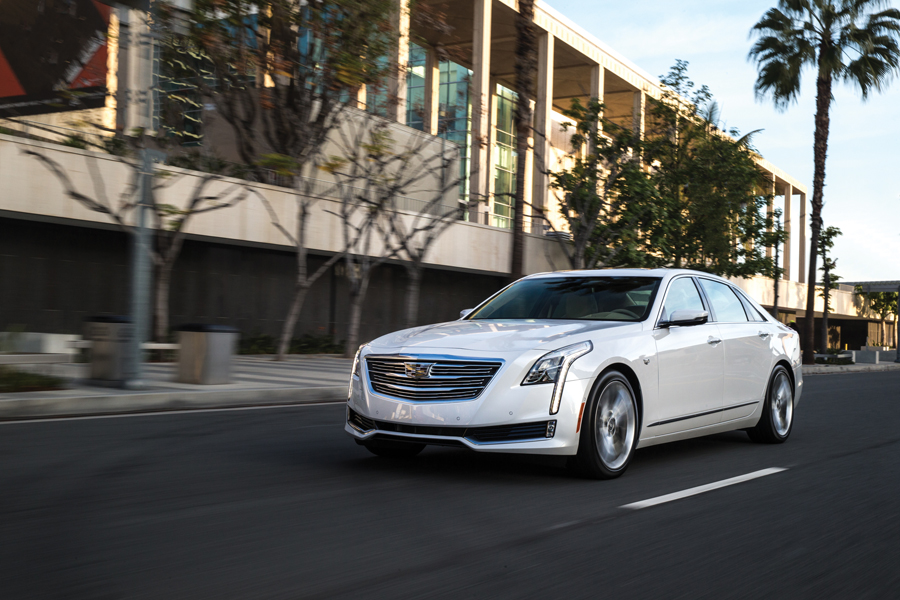
Cadillac CT6

Cadillac CT6
Think American luxury sedans and chances are good that Cadillac comes to mind.

More than just another full-size luxury machine, the 2018 CT6 can now be equipped with Cadillac’s Super Cruise semi-autonomous driver control, that can take you down a road not experienced by many.

Cadillac’s Super Cruise uses multiple cameras and sensors that work in tandem to help keep the car traveling in the highway lane you put it in, alerting the driver and releasing control when it “sees” something that can get you in trouble. No, it’s not completely autonomous, yet, but it’s easy to see where Cadillac is heading.

The body of the CT6 is ultra-modern up front with sharp-cornered lighting that bookend’s the large Caddy emblem center grille. The rear fascia is ultra conservative. Somehow, it works.

Motivating this beauty is an optional 3.0-liter twin-turbocharged V-6 that delivers 404-horsepower to all four wheels. A turbo-4 is standard.

The conservatively designed interior is cutting edge with a large, easy-to-use infotainment screen. All of Cadillac’s latest and greatest techno is there too. Materials and workmanship are top notch.

Pricing starts $54,095. Our loaded CT6 with Premium trim was a touch over $100,000.

Lexus LS 500h
You are either a lover or hater of the Lexus “spindle” grills. Either way, it certainly makes a statement, and so goes the LS grille.

The Lexus LS is the brand’s full-size model and we think it’s a beauty, particularly the interior. And really, isn’t that what matters most?

This Lexus comes with sumptuous, perforated leather seating with reclining and massaging functions in back along with real wood trim and the optional 23-speaker Mark Levinson sound system.

The dash is very different with many shapes and forms coming together in a museum quality work of art. There’s even a backlit piece of eye candy for the front passenger to enjoy. If there is a drawback it would be the finger touch control pad for the infotainment screen. We could make-do though.

Lexus no longer offers a V-8 engine in the LS. Instead, you’ll get the naturally aspirated V-6 or the hybrid that whispers 354 horsepower through a continuously variable transmission to the rear wheels. All-wheel drive is available.

The ride is what you’d expect, like a cloud and worthy of at least 10-hours behind the wheel or as a lucky passenger.

Pricing begins at $79,510.

Vacations

November 1st, 2018

By Michael W. Gos
King Ranch, Texas

We learn a lot of valuable lessons from our parents. Work hard. Don’t tell lies. Never punch out a moose. And most of those lessons serve us well in life. But we also learn some, shall we say, “less helpful” lessons. One of those is about vacations.

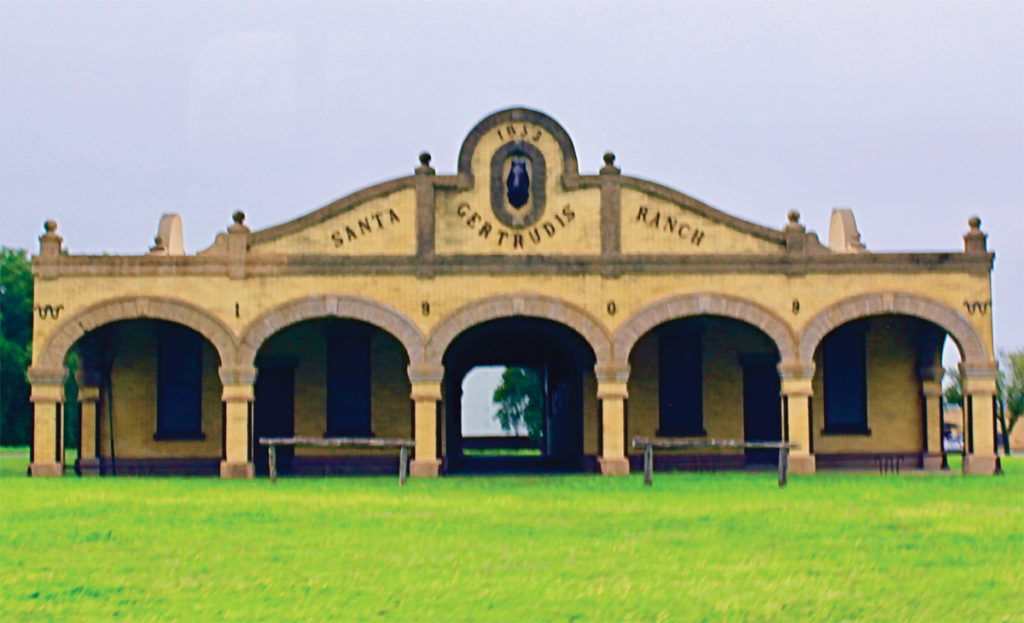
We were spending a bit of time on the King Ranch. For me it has always been a place with a two-fold draw. First, of course, is the historic angle. It was the largest ranch in America and it still is the most famous one today. Most of us have heard the stories of “Captain” King and how the ranch got its start. He bought the first grant (15,500 acres) at just under two cents an acre and then grew the ranch into the 825,000 acres it is today. Imagine, a single ranch larger than the entire state of Rhode Island.

King Ranch gave us the first American cattle breed, the Santa Gertrudis. King’s cowboys (the kinenos) also worked with the mustang horses they found roaming the Wild Horse Desert and through steady improvement of the breed, the ranch became famous for quarter horses and thoroughbreds. In 1946, they even had a Triple Crown winner, Assault, who is buried there at the ranch.

But there is also another, far more important reason I love this place. Out here I can just sit for a while in my boots and cowboy hat and feel like I belong. This place suits me. I wouldn’t mind just staying here for a few days, or months, hanging out in a small cabin and just spending my days ambling around the back forty. In many parts of the ranch there is no cell phone service. I could drive here (with a cooler of beer, of course), park my Jeep somewhere where I can’t see it, and just do whatever felt right at the moment. For a month of so, I would hope to see no signs of the 21st century urban world at all. That is my idea of the perfect vacation.

My wife wants to take a trip to Italy. I am okay with that. I’d love to see the art and architecture of Rome and Florence. Like everyone else, I’d like to do the gondola ride under the Bridge of Sighs in Venice. But I don’t want to do a two-week Grand Tour. I want to experience life there. Tuscany might be a good home base, but I’d want to live there for at least a year. Clearly, I am not—and never will be a tourist by nature; I am a vacationer…a long vacationer.

Unfortunately, that is often not how it turns out for me. More commonly, when it is vacation time, there are flights involved. I don’t particularly enjoy flying even under the best of circumstances. Even worse than the flight itself are the airports. Parking issues, hauling heavy luggage, long hours sitting and waiting, and eating very bad, over-priced food are all less than pleasant. And then, of course, there is the ultimate depravity: security. Every time I enter an airport I think about that morning, sitting nude (well, bottomless anyway) for a half hour on a cold metal chair in a tiny “room” at the Hobby Airport security area, my cell phone confiscated while the screeners were off somewhere doing something with my knee brace. It was beyond unpleasant. None of this matches my idea of a fun way to spend some time off.

But that is just the start. Once you get to your destination, there is travel from the airport to the hotel. Do you go through the hassles of renting a car or do you look for a shuttle? Then there is the hotel check-in process. Don’t even get me started there.

Of course, once at your destination, there are all the “sights” you came to see. The travel to them, the long lines and the fact that I am getting grumpier by the minute make this not only unpleasant for me, but for all around me. (Poor Jill. When you see her, give her your condolences.) And when it is all over, you return home exhausted and needing another week’s rest before you can even face the prospect of going back to work.

I do understand that many people have jobs that are not only unpleasant but also demanding in terms of their time and attention. Sometimes we just have to run away. Taking a week or two off and staying home is often not an option. Even if you can walk away from work (and most of us can’t), work will find you. The phone calls and emails don’t stop just because you are “on vacation.” No one cares, or even believes that you are truly “away from work.”

For many of us, our daily life is unpleasant enough that we will spend thousands of dollars and endure the inevitable indignities the travel industry forces on us just to be able to spend ten or twelve days beyond the reach of those responsibilities.  Our lives have degenerated into 50 weeks of unpleasantness, or as Curley said in City Slickers, “getting knots in our rope.” Then we try to do all of our living in the two (or three, or four) weeks we call “vacation”.

This vacation business is tough, but before you say it is worth it, think again—you’re not going to get off that easily. Before you can leave on this vacation, you get the inevitable bonus of increased stress due to the need to get extra work done before your exodus. The whole time you are gone, you are entertained by worries about what a mess you will return to when it is finally over.

What I find most amazing is that this problem is ubiquitous. Somewhere along the line, it has become the norm.  What I described is not surprising to anyone; we all live it—and do it, willingly. You, and just about everyone you know, are doing it. How did that happen?

They say the best way to impose an idea on someone is to start when he is still a child. I suspect that is what happened here. We grew up seeing this vacation scenario as “the thing we do.” Just as brushing our teeth, sleeping at night or taking a bath are normal because they are what we grew up doing, this mode of vacationing is what we were taught was normal. Many of us never considered an alternative. I remember the novelty of the “staycation” when that word was first coined a few years ago. We found it interesting because “we never thought about that.”

Yes, some of those lessons our parents taught us turned out to be extremely valuable in life. But some are less helpful. At the top of that second list is the way we vacation. It sort of makes you question other things you were taught growing up.

But I still won’t punch out a moose.

Bay Area Houston Magazine