Rice U group finds fault with Ike Dike proposal

December 1st, 2018

By Mary Alys Cherry

Ten years after the storm surge from Hurricane Ike devastated the Galveston Bay area, the U.S. Army Corps of Engineers announced plans Oct. 26 for what is considered a more ambitious version of the proposed Coastal Spine or Ike Dike, as the project to protect the region.

The Corps proposes building a 70-mile-long coastal barrier to protect the Texas coastline from future storm surge, at a cost of somewhere between $23 and $31 billion – considerably higher than the original projection, which was for a smaller project.

Four days later on Oct. 31 Moody’s Investors Service gave its stamp of approval, noting that the proposed system would protect a region that contributes 24 percent of the state’s gross domestic product (GDP) and is home to the largest manufacturing center in the United States along the Houston Ship Channel and to one fourth of Texas’ population.
Now the federal agency’s plan has come under attack.

Just as most of the area population was glad that at long last, something was going to be done to protect us came headlines that the folks over at Rice University’s Severe Storm Prediction, Education and Evaluation from Disasters Center were questioning the Corps of Engineers’ proposal, charging that the Corps’ information was out of date.

This did not sit well with Bay Area Houston Economic Partnership President Bob Mitchell, who worked for several years with UTMB Galveston Prof. Bill Merrell, Texas Land Commissioner George P. Bush and others trying to get the coastal spine project approved and financed.

“I think it is very unfortunate,” Mitchell said, “that Rice SSPEED Center has elected to attack the work that the Corps of Engineers has done in support of the ‘coastal spine’ and its ‘tentatively selected plan.’ There is a process that we go through in the form of hearings and written testimony that allows organizations and individuals to ask for clarification or to present ideas and changes they may think are important. “Rice SSPEED Center, in my opinion, should follow the process like the rest of us and try to be part of the team and not adversarial. This is not the time to see who can yell the loudest but a time to work together.”

Instead of being glad to finally see the federal agency come up with a plan to protect the area, SSPEED officials questioned the proposal, just as they had done after UTMB Galveston Prof. Bill Merrell proposed building the Ike Dike in 2009. Back then, instead of protecting homes and businesses in Galveston and the Bay Area communities with an Ike Dike to stop storm surge, the Rice SSPEED Center felt it was more important to protect industry along the Houston Ship Channel than those homes, schools and businesses in the Galveston Bay area. Finally, when they found everyone else favored the Ike Dike/Coastal Spine concept, SSPEED officials dropped their proposal.

But once the Corps of Engineers released its proposal, SSPEED officials found fault with the study. They said the proposal was incomplete as it did not account for the recent stronger storms and that the Corps information was out of date – assertions that were quickly disputed by the Corps. In addition to the Ike Dike, the Rice group proposes building a midbay seagate to protect the Houston Ship Channel and Harris County from storm surge. Their suggestion is much the same as their earlier proposal. And, just as before, they want to protect industry; and they don’t appear to care what happens to Kemah, Seabrook, Nassau Bay, Dickinson, El Lago, Taylor Lake Village, Clear Lake City, Friendswood, Santa Fe, Alvin, Pearland, Texas City, La Marque, League City, Webster and Galveston.

The Houston Chronicle also was upset with their actions, pointing out in an editorial that protecting the coastal region from the devastation suffered during Ike and Harvey “is far too important to let a fight over the path forward leach away the project’s necessary momentum before it ever has a chance,”

“It’s worth cheering that we’ve arrived at wide support for the coastal spine project, a system of floating gates intended to ward off storm surge….When was the last time officials from Houston, Harris County, the coastal region and the State of Texas have all been on the same page about spending (billions) in mostly federal dollars to help this region? How about never?”

“Critics and supporters of the Ike Dike should take care to help steer but not divert the ship that is finally on course to becoming reality,” the Chronicle added.

We agree. We’ve waited far too long for some action, and the Army Corps of Engineers has worked more hours than they can probably count to get this far. The SSPEED officials should submit their thoughts at one of the public hearings just like everyone else, instead of trying to make headlines and disrupt the process.

A series of six public meetings have been scheduled in November and December by the Corps for public comment on the proposal with the first held Nov. 27 in Port Lavaca. Others are planned in Seabrook, Corpus Christi, Port Isabel, Winnie and Galveston.

The Seabrook meeting will be held Tuesday, Dec. 18 at the Bay Area Community Center in Clear Lake Park from 5:30 p.m. to 9. The Galveston meeting will be on Wednesday, Dec. 12 in the Galveston Island Convention Center, 5600 Seawall Blvd., also from 5:30 p.m. to 9. For a complete list or information on how to submit public comment, visit the Army Corps of Engineers website, http://coastalstudy.texas.gov/get-involved/index.html

A final study is to be released in 2021 before sending it to Congress for funding.

Is it flu or something more serious?

December 1st, 2018

Ronny Carrera, 49, thought he was experiencing symptoms of the flu when he began feeling ill one evening while at home.

“I expressed concern to my wife and she was just as concerned, if not more so and really pushed and encouraged me to consider going to the doctor,” said Carrera. When he began experiencing extreme tingling in his legs and started having difficulty moving, Carrera and his wife quickly went to the emergency center at Memorial Hermann Southeast Hospital.
Doctors assessed Carrera and he was admitted into the hospital with a diagnosis of Guillain-Barre syndrome.

Guillain-Barre syndrome is a rare disorder that occurs when the body’s immune system attacks its nerves causing weakness and tingling in arms and legs. The fast-moving syndrome can quickly spread and cause paralysis and in Carrera’s case, require hospitalization. Additional symptoms include unsteady walking, difficulty speaking, rapid heart rate, difficulty breathing and difficulty with facial and eye movements.

“When doctors informed me of my diagnosis, I was scared but I wanted to know what I needed to do to get better and get better fast,” said Carrera. “I wanted to get back to my family, my wife and children and I wanted to get back to doing activities such as fishing.”

According to the Centers for Disease Control and Prevention, the exact cause of Guillain-Barre syndrome isn’t known but the syndrome is often associated with a viral-like illness prior to onset.

“It was a scary time for me because I went from being able to do so much to being limited and unable to walk on my own,” said Carrera. “I honestly wasn’t sure what was going to happen but my doctors said I would get better and I believed them.”

Carrera’s upper and lower extremity weakness were similar to the weakness experienced by a spinal cord injury patient. After spending a week in the Intensive Care Unit, he was admitted to the inpatient rehabilitation unit at Memorial Hermann Southeast, affiliated with TIRR Memorial Hermann, to start intense rehabilitation and therapy treatment to improve his motion, strength and functional independence.

“For Mr. Carrera, it was great that he sought out immediate treatment for the symptoms he was feeling because there is a critical time period when we must start treatment to stop the body’s breakdown of the nervous system,” said Dr. William Brendel Jr., medical director at Memorial Hermann Southeast Inpatient Rehabilitation Unit and a Physical Medicine and Rehabilitation specialist with Memorial Hermann Medical Group.

“Although it is difficult to pinpoint the exact cause of this syndrome, we can treat the symptoms with intense rehabilitation focusing on improving strength in the lower extremities through gait training and exercise.”

During his stay, therapists worked with Carrera on his strength, range of motion, functional mobility and activities of daily living.

During his month-long stay in inpatient rehabilitation, Carrera made tremendous improvements, going from using a wheelchair to standing and walking with minimal assistance.

“When I was in the hospital, it was hard to see the future and how I would be, but every one of my therapists and Dr. Brendel believed I would get better and I did,” Carrera said.

“I’m very thankful to be back home with my family, going back to work and getting back to doing the things I enjoy to do.”

To learn more about Guillain-Barre and how it’s treated visit http://tirr.memorialhermann.org/programs-specialties/guillain-barre/

Healthcare Nation

December 1st, 2018

By Sumer Dene

Change is constant, and culture is changing. A society’s principles and policies represent a nation’s way of life. We all have freedom of choice, the natural rights inherent to all. According to the United Nations, Human rights include the right to life, freedom, liberty, work, education and even to enjoy the arts. However, in our Democracy, do we have the right to truth and transparency in public and private institution? What is the price placed on quality of life and well-being?

A ‘conscious corporation’ succeeds by recognizing a need in society and satisfying that need in the most effective, responsible way. Consumer expectations evolve as we empower each other and find true purpose for the greater good. In the media age, there is no gap between corporation and consumer and no limit to how far we can go together. There is no room left for egos and agendas as we face fundamental issues across the nation, within industries and throughout humanity. Difficulties stem from misunderstanding of ourselves and others, misleading claims in media and advertisements, and insufficient research sponsored by parties of interest. We are inundated with information as we search for innovative ways to discover life-changing medicine, communicate shared value systems, and allocate resources efficiently. If people are confused and distracted, it’s far more difficult to think critically and make imperative, conscientious decisions. Marketing is everything. How something is presented to you determines what you see.

A study from BBC indicates pharmaceutical companies spend more on marketing drugs, in some cases twice as much, than they do on developing them. BBC concludes profit margins are often much larger than money spent on research. Furthermore, companies have been faced with multi-billion dollar fines for malpractice and misbranding unsafe drugs. According to Reuters, an international news agency, “U.S. prices for the world’s 20 top-selling medicines are, on average, three times higher than in Britain.” In America, prescription costs are based on economic incentive and marketable value. Although, by being innovators and leader in research and technology, we help subsidize the rest of the world’s drug costs. The FDA works closely with pharmaceutical companies to determine which drugs can be marketed to the public. In recent years, FDA regulations are not as rigorously regulated. Competition and variety in a free market, in theory, would help lower prices of medication and encourage Americans to be more involved with their health. However, Consumers pay for brand names, not the effectiveness of drugs and the strained relationship between patients and healthcare providers lead to an overmedicated, mismanaged system.

America spends the most per capita and GDP on healthcare, yet has less than average life expectancy rates and higher rates of chronic conditions, obesity, and infant mortality. The U.S. Government mandates outdated dietary guidelines that advise a low-fat diet, which is linked to poor mental health, hormonal imbalances, inflammation and higher risks of insulin resistance and diabetes. The Food and Drug Administration allows companies to market processed, chemically engineered food that is highly addictive and unhealthy, not to mention cheap to produce. A recent study at the 2018 Experimental Biology conference examined the biochemical effects of artificial sweeteners on the body.

Data suggests artificial sweeteners alter how the body ‘processes fat and obtains energy.’ Top researchers at the Center for Science in the Public Interest agree, “Artificial colors pose risks of cancer, allergies and hyperactivity in children and should be banned.” Factory-farmed animals are cramped in small cages and injected with artificial hormones and antibiotics. If one animal becomes sick, they all are treated with antibiotics in order to reduce need for individual care. However, unnecessary use of antibiotics can lead to antibiotic-resistant organisms that propagate in dangerous numbers and enter the food supply. In the US National Library of Medicine, researchers conclude Antibiotic resistance is an emerging public health crisis and the effect on human health is yet to be determined. Experts agree, “Given divergent stakeholder interests and inadequate research to date, public policy discussions of this issue are often contentious and highly polarized.”

A change of perspective begins with grassroots effort. The goal is to spread knowledge and build a connection that links individuals, international policy and industry to global needs. Consumers want dedicated research, consistency and transparency in public and private industry as well as honest, sustainable product development. After all, people are far more important than profit, and we’re all people looking to make a difference while making a living.

Academic institutions, government agencies, non-profit organizations and industry lead the way to a future of preventative medicine, technological development, educational programs, and breakthroughs in research. Organizations can change culture through collaboration and honest communication. They can create a value system that measures value and outcome on a large-scale by setting a criteria and specific goals. Professionals from many backgrounds could develop teams to measure progress and cost-effectiveness, working together is simple when you speak a universal language.

For the holiday season, I encourage you to continue to be active in festive activities and involved with your health. Communicate with friends and family and do your own research to improve health and wellness. Eat good food but be mindful of what you’re consuming. Most of all, be grateful and give thanks for all of the blessings in your life. Let happiness, love and spirit follow us into the new year.

Masa Sushi Stands Strong for 13 Years

December 1st, 2018

By Xander Thomas

Within the last couple of years, sushi has grown immensely in popularity, it’s gone from having to make a drive out of your way for it, to being able to head down to your local grocery store if you just can’t live without it for the moment. Masa Sushi is considered a front runner in the market for the area.

“Sushi restaurants and Japanese restaurants in general didn’t have a large presence in the area in 2005 when this was opened” said Jason Ames, Masa Sushi general manager “Masa Sushi has stood the test of time, and we’re still the premiere restaurant in SE Houston area”

Owner Michael Zhou opened the first restaurant on El Dorado Blvd. in October 2005, and they just celebrated their 13-year anniversary on Thursday the 18th. So, what makes people choose Masa when there are more and more restaurants to grab the same grub popping up around town?

“As far as ambiance, décor, staff, portion sizes, pricing, originality of our menu, I think that takes the cake as far as our competition is concerned in the area”

There are three locations currently; the original store located in Webster, the second one is on 646 in Dickinson, and the one most recently opened is in the middle of Friendswood. Each restaurant has a unique floorplan and different luxuries to offer the guests.

“Masa 2, for example, the Dickinson location, has a loft, with couches and a lounge upstairs” Jason said, “the third location in Friendswood has a private sushi bar that customers can purchase so to speak, and Michael, the owner of the establishment, of all the restaurants, will actually prepare a meal for them.”

While the nice layout and these unique offerings are nice, the food is really what keeps anyone coming back into any eatery. Jason immediately came up with a list of dishes that would be a good start for anyone who has never eaten at any of the restaurants.

“Costa Rica beef, Costa Rica black pepper tuna, black pepper tuna sashimi, combination Costa Rica,” he said.

He says that when available, the menu features fish specials including blue fin tuna and the fatty belly of the same fish, called toro, and sometimes uni (sea urchin). He says the best part is where they get their blue fin from.

“The owner has a cousin that owns a fishing outfit in Hawaii and on occasion we will get fresh blue fin which is caught in Hawaii and packed with dry ice and expressed shipped to us” Jason said “Which puts us a leg up on other competition in the area given that we have that source.”

There are many places to get your sushi fix around the Clear Lake area, and more popping up every day, but there is a reason Masa has lasted 13 years in the same spot, and has since grown to have three locations, each of which brings people in the door. Jason says that Michael really has it figured out, where the market is concerned.

“We’ve stood the test of time,” he said “we’re still doing well, still making money, still get good crowds, still get good customers and happy employees.”

CCISD launches Special Ed Parent Advisory Committee

November 2nd, 2018

The Clear Creek School District is seeking parent participation in the newly formed Special Education Parent Advisory Committee.
This committee will be comprised of one parent of a special education student from each of school, 44 CCISD parents. The group will meet quarterly with the CCISD superintendent, special services executive director, and other pertinent staff members to discuss topics and services related to special education.

“We are excited about this additional layer of communication and two-way partnership with our families,” said Superintendent of Schools Greg Smith. “Clear Creek ISD is already home to the first Special Education PTA in Texas, and this committee will serve as another avenue to deepen our shared commitment for students with special needs.”

The working guidelines for this committee are to consider the best interest of each student, value the perspective of each committee member, work as a team to examine services, practices and recommend improvements, and serve the needs of each student receiving special education services, Dr. Smith explained.

Applications are due no later than Nov. 14, 2018. A lottery drawing for each campus representative will be held on Nov. 15. Click here to apply. Parents should select the school in which their child attends. The group’s first meeting will be held on Thursday evening, Nov. 29 from 6 to 8 p.m.

NASA Is Born

November 1st, 2018

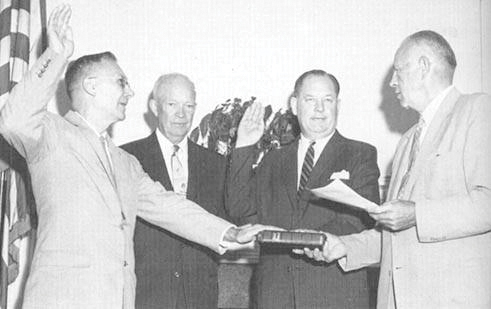
NASA Deputy Administrator Hugh L. Dryden, at left, and NASA Administrator T. Keith Glennan, second from right, being sworn in as President Eisenhower, second from left, looks on. Image: NASA

On Oct. 1, 1958, the National Aeronautics and Space Administration officially opened for business. President Dwight D. Eisenhower signed into law the National Aeronautics and Space Act the previous July, creating NASA to lead America’s civilian space program in response to Soviet advances in space exploration.

The new agency incorporated elements of the National Advisory Committee for Aeronautics, founded in 1915 to advance aeronautics research in the United States. NASA also absorbed three NACA research laboratories — Langley Aeronautical Laboratory in Hampton, Va., Ames Aeronautical Laboratory in Mountain View, Calif. and Lewis Flight Propulsion Laboratory in Cleveland, Ohio – as well as elements of the Army Ballistic Missile Agency in Huntsville, Ala., and the Naval Research Laboratory in Washington, D.C.

In December 1958, NASA gained control of the Jet Propulsion Laboratory in Pasadena, Calif., a contractor facility operated by the California Institute of Technology. Over time, the agency established or incorporated additional centers and facilities to meet the growing needs of the nation’s space program. Today, 10 field centers across the nation work together to accomplish NASA’s varied missions.

President Eisenhower nominated T. Keith Glennan, president of Case Institute of Technology in Cleveland, Ohio, and Hugh L. Dryden, director of NACA, to be NASA administrator and deputy administrator, respectively. Glennan served until 1961, Dryden until 1965. The Dolley Madison House on Lafayette Square in Washington, D.C., served as the first headquarters of the new space agency (until 1961).

In April 1959, NASA introduced the seven Mercury astronauts to the world at an event in the house’s ballroom. As the agency grew, its headquarters relocated to more spacious accommodations in the nation’s capital.

Just 10 days after opening its doors, NASA launched its first spacecraft. Part of a program of lunar orbiters inherited from the U.S. Air Force, Pioneer 1 blasted off aboard a Thor-Able rocket from a fledgling launch facility at Cape Canaveral, Fla. Although it did not achieve its intended mission to orbit the Moon due to a rocket malfunction, Pioneer 1 did reach a then record altitude of about 70,000 miles. The probe returned scientific data confirming the existence of the Van Allen radiation belts until it burned up on reentry in the Earth’s atmosphere 43 hours after launch.

In the subsequent 60 years, NASA has launched spacecraft to unlock the mysteries of the universe, dispatched probes to make close up observations of every planet in the solar system, sent men on voyages to the Moon, and built a space station to maintain a permanent human presence in space.

Although NASA is best known for 60 years of engineering and scientific achievements, it originally came into being as a matter of national security. After the Soviets flew the first two Sputniks in 1957 and Sputnik 3 in 1958, the U.S. government saw space as an important new political, if not military, battlefield and began to lay the course for a long-term space plan.

“It was almost as if a bomb had fallen” on Capitol Hill, congressional staffer Eilene Galloway said in a 2000 oral history interview, “because we were so surprised that the Soviet Union was first. Both the United States and the Soviet Union had space projects in the International Geophysical Year, but our project was very small. It was a satellite that weighed a little more than three pounds, and the Soviet satellite [weighed 184 pounds and] really opened up outer space as the new environment, added to land, sea and air.”

Scientists pushed President Eisenhower to make any new agency charged with overseeing space exploration a civilian agency, fearing military control would mean research only into military priorities.

Congressional hearings on the matter, chaired by Senate Majority Leader Lyndon B. Johnson (D-TX), began in November 1957 and continued for six weeks. Johnson asked Galloway, a defense analyst with the Legislative Reference Service, to summarize the congressional testimony. Her report, titled “The Problems of Congress in Formulating Outer Space Legislation,” recommended several options including creation of a new civilian agency to lead America’s space efforts.

On April 2, 1958, President Dwight D. Eisenhower sent a draft law to Congress that called for a civilian National Aeronautics and Space Agency, based on the existing National Advisory Committee for Aeronautics to oversee the U.S. space program. Twelve days later both the Senate and the House introduced versions of a bill to establish such an organization, with hearings beginning the next day. Galloway successfully lobbied to designate the new organization an administration rather than an agency to give it broader authority to coordinate with many other government agencies.

NASA History Overview

November 1st, 2018

A new era in space flight began on April 12, 1981, when Space Shuttle Columbia, or STS-1, soared into orbit from NASA’s Kennedy Space Center in Florida.

The National Aeronautics and Space Administration is responsible for unique scientific and technological achievements in human spaceflight, aeronautics, space science, and space applications that have had widespread impacts on our nation and the world.

Forged in response to early Soviet space achievements, NASA was built on the National Advisory Committee for Aeronautics and other government organizations, as the locus of U.S. civil aerospace research and development.

When NASA opened for business on Oct. 1, 1958, it accelerated the work already started on human and robotic spaceflight. NASA’s first high profile program was Project Mercury, an effort to learn if humans could survive in space. This was followed by Project Gemini, which used spacecraft built for two astronauts to perfect the capabilities needed for the national objective of a human trip to the Moon by the end of the 1960s.

Project Apollo achieved that objective in July 1969 with the Apollo 11 mission and expanded on it with five more successful lunar landing missions through 1972. After the Skylab and Apollo-Soyuz Test Projects of the mid-1970s, NASA’s human spaceflight efforts again resumed in 1981 with the Space Shuttle program that continued for 30 years. The shuttle was not only a breakthrough technology, but was essential to our next major step in space, the construction of the International Space Station.

Over the last 60 years NASA has continued to push the boundaries with cutting edge aeronautics research that has dramatically changed the way we build and fly airplanes. NASA has also completed the reconnaissance of our solar system, with intense investigation of all the planets. Using orbital spacecraft like the Hubble Space Telescope, NASA has also dramatically changed our understanding of the universe around us, as well as our own planet.

NASA’s early work on launch vehicles, communication satellites, and weather satellites has fundamentally changed daily life and created whole new industries. As a catalyst for international cooperation, NASA has also changed how and why humanity conducts space exploration. Now, NASA is preparing to take humankind farther than ever before, as it helps to foster a robust commercial space economy near Earth, and pioneers further human and robotic exploration as we venture into deep space.

The NASA History Office Program publishes a quarterly newsletter, as well as an array of books (print and digital), hosts social media, provides fellowships, and runs the Historical Reference Collection (our version of an archive) to assist the public in finding more information on aeronautical and space history. In addition, the staff produces the Aeronautics and Space Report of the President.

The National Aeronautics and Space Act of 1958 directs NASA to produce an annual report that includes a “comprehensive description of the programmed activities and the accomplishments of all agencies of the United States in the field of aeronautics and space activities” during the preceding year.

Explorer 1 Becomes America’s First Satellite

November 1st, 2018

Launch of Explorer 1 on the Juno rocket. Photo: NASA

The year 1958 held much promise for the United States space program. Both the U.S. and the Soviet Union were preparing to orbit a satellite as part of the International Geophysical Year (IGY), a series of activities planned between July 1957 and December 1958, intended to allow scientists around the world to study the Earth and space through coordinated observations.

Given the Cold War competition between the two superpowers, the first to launch a satellite could claim technological pre-eminence. The Soviet Union leaped ahead of the U.S. and stunned the world when it orbited Sputnik, the world’s first artificial satellite, on Oct. 4, 1957.

The U.S. response to Sputnik was two-fold. The first was to accelerate the Vanguard program, a joint National Academy of Sciences/U.S. Naval Research Laboratory project, which unfortunately resulted in the spectacular and embarrassing launch failure of Vanguard TV3 on Dec. 6.  By that time, the Soviets had already achieved their second success with Sputnik 2, carrying a dog named Layka, the first live animal in space.

The second response was to resurrect the Army Ballistic Missile Agency’s (ABMA) Jupiter-C rocket program, which had involved Wernher Von Braun’s team and the California Institute of Technology’s Jet Propulsion Laboratory testing reentry vehicles in sub-orbital launches. JPL designed and built the Explorer satellite.

BUILT IN 84 DAYS
The ABMA and JPL completed the job of modifying the Jupiter-C to the Juno rocket and building Explorer 1 in 84 days, and it was hoped that 1958 would start off much better than 1957 had ended.

The Juno rocket could trace its ancestry back to the German V-2 rocket, which Von Braun had also designed. Once working in the U.S. after World War II, he used the V-2 to develop the Redstone intermediate range ballistic missile, from which he developed the Jupiter-C as a high-performance three-stage rocket. The addition of a fourth stage created the Juno rocket, capable of launching a satellite into orbit.

Explorer 1 successfully launched from Cape Canaveral’s Pad 26 on Jan. 31, 1958. A team of women mathematicians at JPL computed Explorer’s trajectory and were able to confirm that it was indeed in orbit around the Earth, although its orbit of 224 miles by 1,575 miles was somewhat higher than planned.

WEIGHED 30 LBS
Explorer 1 weighed 30 pounds of which more than 18 pounds were scientific instruments developed under the direction of James Van Allen of the University of Iowa. The instrumentation consisted of a cosmic-ray detector, five temperature sensors and two micrometeoroid detectors. The cosmic ray detector indicated a much lower cosmic ray count than expected.

Van Allen postulated that the instrument was giving these readings because it was actually saturated by energetic charged particles originating mainly in the Sun and trapped by Earth’s magnetic field. Explorer 1’s discovery of these trapped radiation belts, subsequently named after Van Allen, is considered one of the outstanding scientific discoveries of the IGY.

Explorer 1 continued to record and transmit data until its batteries died on May 23, 1958. By then it had been joined in orbit by Explorer 3, also launched on a Juno rocket on March 26 (Explorer 2 failed at launch). Although no longer active, Explorer 1 remained in orbit until March 31, 1970, when it burned up on reentry over the Pacific Ocean.

FIRST IN SERIES
It was not only America’s first satellite in orbit, but also the first of a long-running series of scientific satellites that returned a wealth of useful information about the Earth, its environment, and interactions with the Sun.

The competition between two separate groups to independently develop and orbit the first American satellite contributed to the recognition for the need of a single civilian space organization to plan future efforts. Following lengthy committee hearings, Congress passed the National Aeronautics and Space Act of 1958 on July 16, and President Dwight D. Eisenhower signed it July 29, establishing the National Aeronautics and Space Administration. NASA officially began operating on Oct. 1, 1958.

A fully-instrumented flight backup of Explorer 1 is on display at the Smithsonian Institute’s National Air and Space Museum’s Milestones of Flight Gallery, as is a model of a Juno rocket. A mockup of a Juno rocket also is on display at Kennedy Space Center Visitors Center.

Leidos nears its 50th anniversary while NASA celebrates its 60th

November 1st, 2018

Leidos’ Benjamin.T.D.Minish, Jon Reyna, Wesley Tarkington and Carlos Aguilar. Photo: Moonbridge Media

By Xander Thomas

Leidos is a relatively new company name for some, but not altogether a new company. In fact, it has a 50-year anniversary coming up in 2019 — just after the 60th anniversary of NASA this year. And it has a long history in the space industry.

“At Leidos, our mission is to make the world safer, healthier and more efficient through the application of information technology, engineering and science,” Leidos NASA programs division manager Nan Hardin said.

The Fortune 500 company, she explains, is actually a combination of Lockheed Martin Integrated Systems and Global Solutions (IS&GS) and national security and commercial portions of SAIC before the company’s split in 2013, both entities with a legacy of technical support to NASA and the space industry.

“Through our heritage and deep understanding of the customer’s mission, we have built a track record of success at NASA centers and within the engineering and scientific community” Hardin said.

A resident of Houston, Hardin manages the Leidos teams supporting the Cargo Mission Contract, the Integrated Mission Operations Contract, the Human Health and Performance Contract and the Research Engineering Mission Integration Services Contract.

SECOND GENERATION
Many Leidos employees supporting today’s NASA contracts are the second generation to do so.

Jon Reyna, a quality team lead, explains that on the current Cargo Mission Contract they “plan, coordinate, prepare and pack standardized containers for all of the International Space Station cargo missions at NASA, international partners and commercial hardware vehicles.”

“We have different layout requirements for each vehicle, so there are no two cargo missions that are alike,” Reyna said. The cargo, he said, usually includes things like food, clothing, crew provisions, soft goods, computer hardware and other electronics gear, batteries, cameras, and experiments.

Reyna’s father also worked for NASA; he was involved in working with mission patch designs and on documentation for flight controls as a graphic artist. His dad worked for multiple NASA contractors and retired at the end of the shuttle contract.

Tyler Minish and Kimberly Johnson, both with the Integrated Mission Operations Contract that is known as the plan/train/fly contract, also followed in their parents’ footsteps.

Both of Minish’s parents worked right here in Houston at the Johnson Space Center. His mother worked in the reconfiguration group, helping train astronauts. She helped with the computer programs of the motion simulators, and later moved over to help support the International Space Station. His father first worked writing software for the shuttle motion simulators before moving into the crew training office and then to the International Space Station. Minish’s father still works in the mission controls center.

In similar fashion, Johnson calls herself a “second gen space cadet” because her mother worked for NASA during the Apollo/Gemini era as a secretary for the engineering director in the Space and Life Sciences Directorate.

Kimberly Johnson of the plan/train/fly contract with a cold stow box.

Johnson was hired on in 1992 by Lockheed Martin, and over the course of her career, she was a crew procedures engineer helping write and format flight data file documentation on shuttle missions. “I got to watch the astronauts get trained and execute the procedures that I was a part of,” she said.

When she was hired, she was a Russian technical specialist flight controller, and she said that being a part of the generation when the U.S. and Russia worked together was a great feeling, knowing that previous tensions between the countries prevented the collaboration.

Like Minish and Johnson, Wes Tarkington is also a 2nd generation employee. His father worked at Johnson Space Center for 33 years. He had been hired early in the Gemini program, worked through Apollo, and was part of Space Station Freedom when it was transferred to Virginia. His family almost moved up there, Tarkington said, but instead, his father transferred to a different department and became mission manager for the Space Shuttle Program.

Tarkington currently supports the Human Health and Performance contract, which provides medical health services in support of all the astronauts.
“In my current role within the human health performance contract, I manage a task order that includes support services and personnel for NASA’s crew health and safety program and also includes NASA’s integrated medical model, lifetime surveillance of astronaut health program and the life sciences data archive,” He said.

He described his role saying he has a team of medical, scientists, and PhDs who monitor and try to identify common conditions that have occurred with crew members as a result of their exposure to space flight.

PROUD MOMENTS
Tarkington said that one of the accomplishments he is most proud of is getting the “Treat Astronauts Act” signed into law. Basically, this bill gives astronauts a legal right to medical care beyond their time working in space flight, in case of any issues that the work may have caused. In return, NASA retains the data over what damage may or may not be caused for use with future flight crews.

Another one of Tarkington’s favorite memories working in support of NASA, he said, was meeting his now-wife of 13 years. “That’s obviously a memorable moment in my career here at NASA,” he said.

For Johnson, one of her proudest moments came when she was working in Moscow in support of the MIR program. “I received a call down from astronaut Dave Wolf recognizing my effort where I scheduled out his day as a planner,” she said.

A MATTER OF TRUST
According to Carlos Aguilar, a business development manager supporting NASA programs, many of the accomplishments being made right now are due to trust and collaboration between Leidos and NASA.

“Our management team really works hard to make sure that our performance is consistent,” Aguilar said, “we’ve also worked to have clear and open dialogue channels with NASA so we can get the feedback we need on our performance and make any course corrections.”

He said that Leidos strives to achieve a partnership, but they want NASA to be the judge of whether it really is.

He continued to say that it is not easy to keep pace with an agency like NASA, but he says that Leidos aims to help with innovations and improvements however they can.

“We are here to help do three things: Innovate, provide NASA with a top tier work force, and deliver on our corporate commitment to accomplish NASA’s mission.”

Leidos is the proud sponsor and underwriter of Bay Area Houston Magazine’s special issue celebrating NASA’s 60th Anniversary. Kudos to Leidos for all they do to support the manned space program. [article export control #20196]

One Giant Leap For Mankind

November 1st, 2018

Apollo 11 Commander Neil Armstrong working at an equipment storage area on the lunar module.

Official crew photo of the Apollo 11 Prime Crew

July, 1969.

It’s a little over eight years since the flights of Yuri Gagarin and Alan Shepard, followed quickly by President Kennedy’s challenge to put a man on the moon before the decade is out.

It is only seven months since NASA’s made a bold decision to send Apollo 8 all the way to the moon on the first manned flight of the massive Saturn V rocket.

Now, on the morning of July 16, Apollo 11 astronauts Neil Armstrong, Buzz Aldrin and Michael Collins sit atop another Saturn V at Launch Complex 39A at the Kennedy Space Center. The three-stage 363-foot rocket will use its 7.5 million pounds of thrust to propel them into space and into history.

OFF TO THE MOON
At 9:32 a.m. EDT, the engines fire and Apollo 11 clears the tower. About 12 minutes later, the crew is in Earth orbit. After one and a half orbits, Apollo 11 gets a “go” for what mission controllers call “Translunar Injection” — in other words, it’s time to head for the moon. Three days later the crew is in lunar orbit. A day after that, Armstrong and Aldrin climb into the lunar module Eagle and begin the descent, while Collins orbits in the command module Columbia. Collins later writes that Eagle is “the weirdest looking contraption I have ever seen in the sky,” but it will prove its worth.

ALARMS SOUND
When it comes time to set Eagle down in the Sea of Tranquility, Armstrong improvises, manually piloting the ship past an area littered with boulders. During the final seconds of descent, Eagle’s computer is sounding alarms.

It turns out to be a simple case of the computer trying to do too many things at once, but as Aldrin will later point out, “unfortunately it came up when we did not want to be trying to solve these particular problems.”

When the lunar module lands at 4:18 p.m EDT, only 30 seconds of fuel remain. Armstrong radios “Houston, Tranquility Base here. The Eagle has landed.” Mission control erupts in celebration as the tension breaks, and a controller tells the crew “You got a bunch of guys about to turn blue, we’re breathing again.” Armstrong will later confirm that landing was his biggest concern, saying “the unknowns were rampant,” and “there were just a thousand things to worry about.”

FIRST STEP
At 10:56 p.m. EDT Armstrong is ready to plant the first human foot on another world. With more than half a billion people watching on television, he climbs down the ladder and proclaims: “That’s one small step for a man, one giant leap for mankind.” Aldrin joins him shortly, and offers a simple but powerful description of the lunar surface: “magnificent desolation.” They explore the surface for two and a half hours, collecting samples and taking photographs.

They leave behind an American flag, a patch honoring the fallen Apollo 1 crew, and a plaque on one of Eagle’s legs. It reads, “Here men from the planet Earth first set foot upon the moon. July 1969 A.D. We came in peace for all mankind.”

HEADING HOME
Armstrong and Aldrin blast off and dock with Collins in Columbia. Collins later says that “for the first time,” he “really felt that we were going to carry this thing off.”

The crew splashes down off Hawaii on July 24. Kennedy’s challenge has been met. Men from Earth have walked on the moon and returned safely home.

In an interview years later, Armstrong praises the “hundreds of thousands” of people behind the project. “Every guy that’s setting up the tests, cranking the torque wrench, and so on, is saying, man or woman, ‘If anything goes wrong here, it’s not going to be my fault.’”

In a post-flight press conference, Armstrong calls the flight “a beginning of a new age,” while Collins talks about future journeys to Mars.

Over the next three and a half years, 10 astronauts will follow in their footsteps. Gene Cernan, commander of the last Apollo mission leaves the lunar surface with these words: “We leave as we came and, God willing, as we shall return, with peace, and hope for all mankind.”

Bay Area Houston Magazine